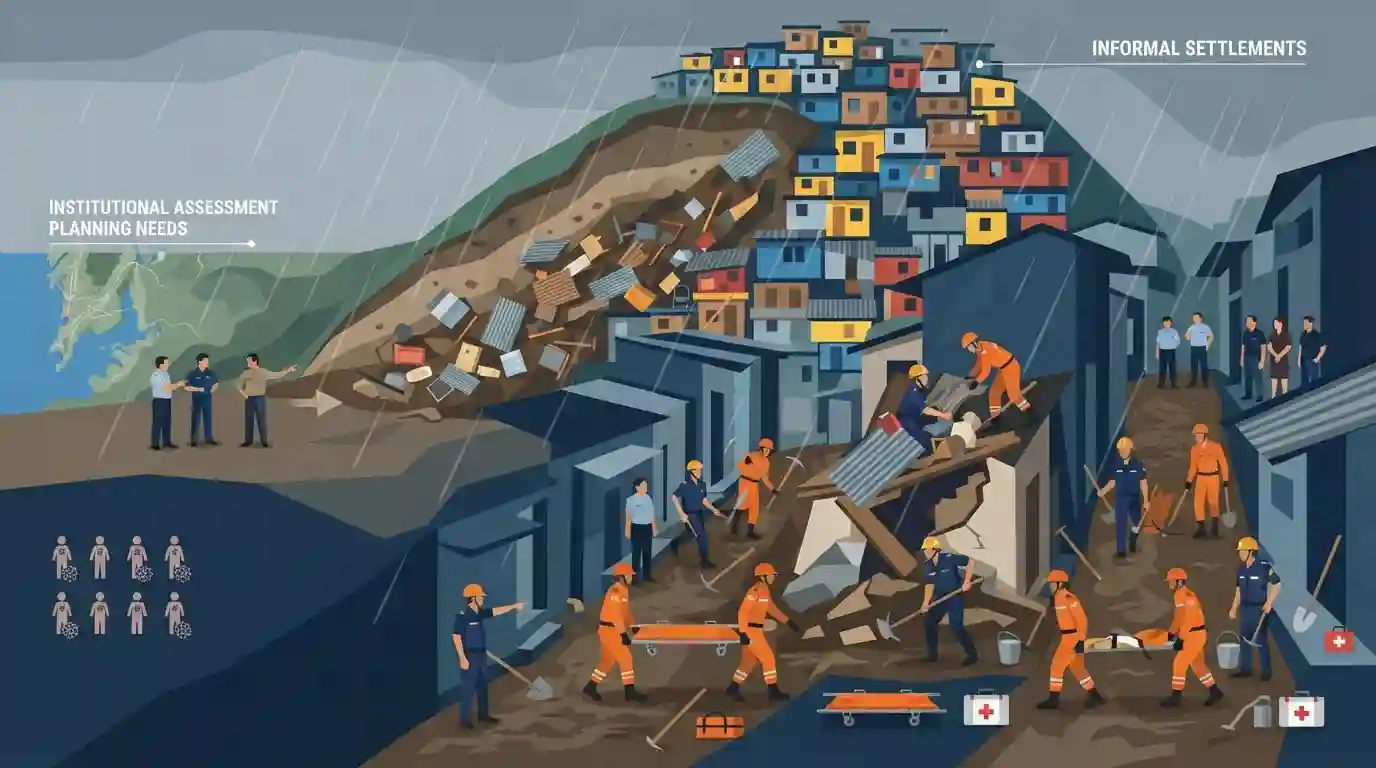
Sakinaka Landslide Disaster and Urban Slum Vulnerability
Source:theshillongtimes ↗
Why It Matters
Urban flooding and landslides in coastal cities like Mumbai are recurring disasters. Understanding the geographical vulnerabilities (hillock settlements) and the operational challenges of disaster response forces (NDRF, BMC) is crucial for MPSC candidates studying urbanization, geography, and disaster management governance in Maharashtra.
Summary
A landslide in Mumbai's Sakinaka area claimed eight lives before the National Disaster Response Force (NDRF) and local authorities called off rescue operations. The disaster highlights the severe risks faced by informal settlements located on hilly terrain during heavy monsoons. Rescue efforts were notably hampered by the narrow, inaccessible lanes of the slum, which prevented the use of heavy machinery and required manual removal of debris. The incident emphasizes the urgent need for better urban planning and localized disaster management strategies in densely populated coastal cities.
Key Points
- A tragic landslide in the Narayan Nagar area of Sakinaka, Mumbai, resulted in the deaths of eight individuals and injured several others.
- Search and rescue operations were jointly conducted by the National Disaster Response Force (NDRF), the Mumbai Fire Brigade, and the Brihanmumbai Municipal Corporation (BMC).
- The rescue teams faced severe logistical constraints, as narrow access lanes prevented the deployment of heavy earth-moving machinery, forcing responders to clear debris manually.
- The incident highlights the acute vulnerability of informal slum settlements situated on hillocks in urban centers, particularly during the monsoon season.
Important Terms
Disaster Management Act, 2005

The primary legislation establishing India's legal and institutional framework for managing natural and man-made disasters, shifting focus from post-disaster relief to comprehensive prevention, mitigation, and preparedness.
UPSC context
GS Paper 3 (Disaster Management). Tests the foundational statutory framework governing disaster response and resilience.
National Disaster Response Force (NDRF)
A specialized, multi-skilled force constituted under the Disaster Management Act, 2005, mandated to provide prompt, expert search and rescue response during threatening disaster situations.
UPSC context
GS Paper 3 (Disaster Management). Tests knowledge of India's operational disaster-response architecture and capacity building.
Brihanmumbai Municipal Corporation (BMC)
The urban local body governing Mumbai, India's wealthiest municipal corporation, responsible for civic infrastructure, urban planning, and executing localized disaster management responses.
UPSC context
GS Paper 2 (Local Governance) / GS 3 (Disaster Management). Tests urban governance, devolution of powers, and city-level resilience.
Prelims Trap
"The Geological Survey of India, the nodal agency for landslides, functions under the Ministry of Earth Sciences."
While the GSI is indeed the nodal agency for early warning and landslide hazard studies in India, it falls strictly under the Ministry of Mines.
Static Concepts Connected
What is the institutional structure under the Disaster Management Act, 2005?
- NDMA (National): Headed by the Prime Minister, it serves as the apex body to lay down policies, plans, and guidelines for disaster management.
- NEC (Executive): Headed by the Union Home Secretary, it assists the NDMA and coordinates the actual response and relief operations.
- NDRF (Force): A specialized, multi-skilled response force constituted under Section 44 of the DM Act for threatening disaster situations.
- State & District: Execution cascades down to the State level (headed by the Chief Minister) and District level (headed by the District Magistrate/Collector).
Why are Indian megacities increasingly vulnerable to urban landslides?
- Anthropogenic factors: Unchecked hill-cutting, toe excavation, and unregulated heavy construction on vulnerable slopes to accommodate expanding populations.
- Drainage constraints: Extensive concretization limits groundwater percolation, leading to increased surface runoff, topsoil erosion, and slope destabilization during heavy rainfall.
- Socio-economic pressures: High real estate costs force urban poor and migrants into informal settlements on marginal, hazardous lands like steep hillocks.
Cross-Topic Patterns
Compound Extremes in Coastal Megacities
Urban landslides often coincide with extreme monsoons and localized urban flooding in cities like Mumbai, creating compound extreme events that severely stretch municipal response capacities.
Spatial Inequality & Disaster Vulnerability
The relegation of informal slum settlements to ecologically sensitive and hazardous zones (hillocks, floodplains) directly links GS1 urban poverty challenges with GS3 disaster management.

Compound urban disasters (landslides + flooding) driven by informal settlements and climate extremes are highly probable as a GS3 15-marker.
Linked PYQs · 2
Linked PYQs · 2
- 2017MPSC_PRELIMSGS1
Which of the following mountains are considered as one of the top biodiversity hot spots ?
- 2025MPSC_PRELIMSGS1
As per the Hazardous Waste (Management, Handling and Transboundary Movement) Rules, 2008, the ________ shall be the nodal Ministry to deal with the transboundary movement of the hazardous wastes and to grant permission for transit of the hazardous wastes through any part of India.
