Mumbai hosts youth climate consultation ahead of COP summit
Source:The Hindu ↗
Why It Matters
This article illustrates the convergence of local climate action (urban flooding, state-level initiatives) and global environmental diplomacy (UNFCCC, COP). It is highly relevant for GS3 Environment and Disaster Management, showcasing how marginalized and youth perspectives are integrated into international policy frameworks.
Summary
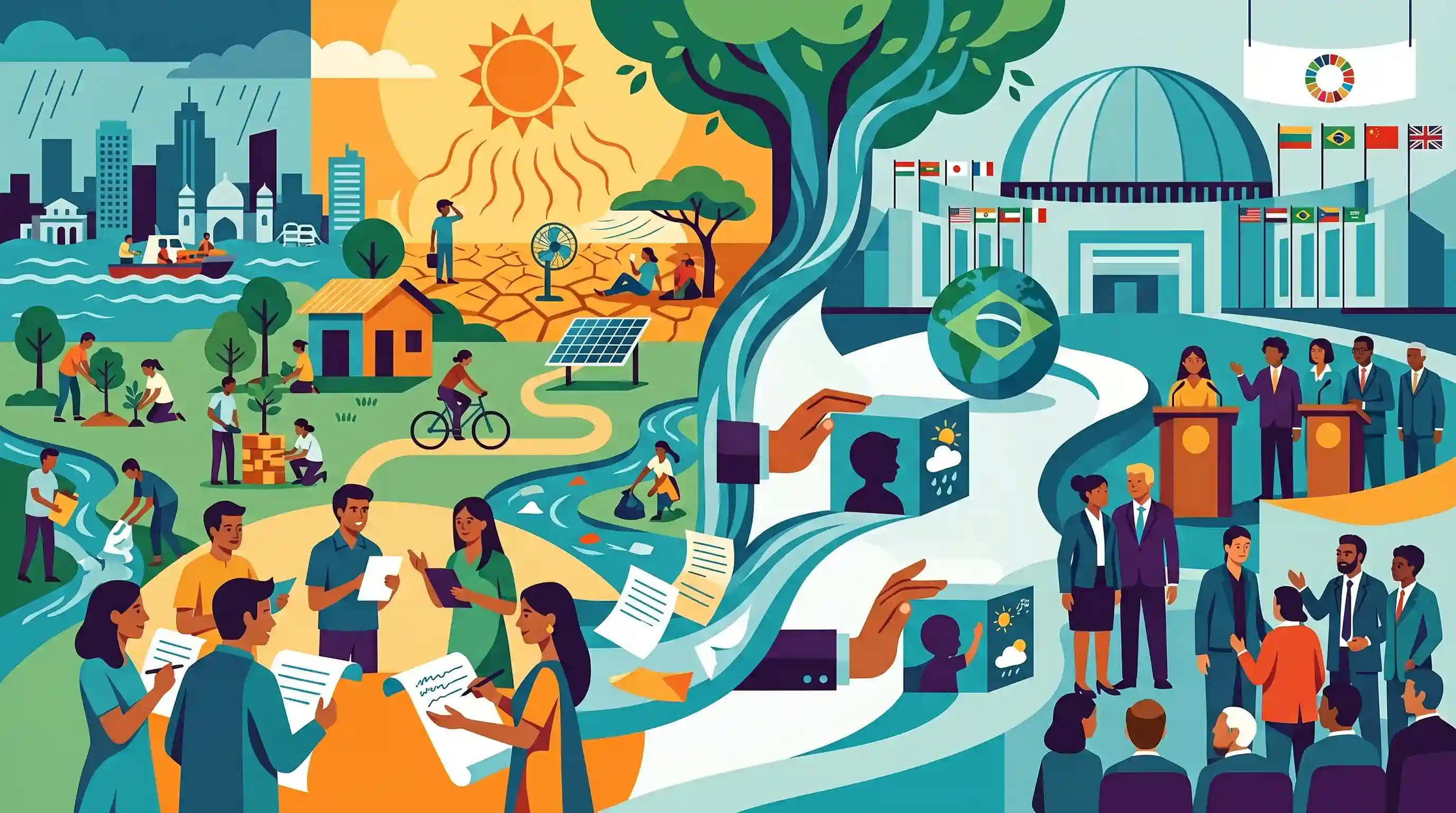
Mumbai recently hosted a youth-led climate consultation organized by the Indian Youth Climate Network (IYCN), UNICEF India, and the Sattvic Soul Foundation. As part of the Local Conference of Youth (LCOY) India 2025, the event aims to formulate the Indian National Youth Statement for the upcoming COP30 summit in Brazil. Deliberations focused on pressing urban climate challenges such as flooding, heatwaves, and sustainable mobility, while examining Maharashtra's grassroots initiatives like the State Action Plan on Climate Change (SAPCC) and 'Mazi Vasundhara'. The consultation underscores the importance of the Children's Climate Risk Index and ensures that Indian youth perspectives formally reach the UNFCCC through its official youth constituency, YOUNGO.
Key Points
- Mumbai hosted a youth-led climate consultation as part of LCOY India 2025 to gather inputs for the Indian National Youth Statement ahead of COP30 in Brazil.
- The initiative brought together youth leaders to address localized climate vulnerabilities, focusing on urban flooding, extreme heatwaves, and sustainable mobility.
- Maharashtra's decentralized climate action models, specifically the State Action Plan on Climate Change (SAPCC) and the 'Mazi Vasundhara' campaign, were highlighted as effective grassroots initiatives.
- The consultation emphasized using data frameworks like the Children’s Climate Risk Index to design targeted interventions for vulnerable populations.
- The final policy recommendations will be channeled to the UNFCCC through YOUNGO, the official youth constituency, integrating Indian youth perspectives into global climate negotiations.
Important Terms
COP30

The 30th UN Climate Change Conference scheduled for 2025 in Belém, Brazil. It is critical for submitting updated Nationally Determined Contributions (NDCs) 3.0 to align with the 1.5°C global warming goal.
UPSC context
GS Paper III: Environmental Conservation and International Treaties. Tests knowledge of global climate governance and India's NDCs.
UNFCCC
The 1992 treaty aimed at stabilizing greenhouse gas concentrations. It serves as the parent framework for the Paris Agreement and Kyoto Protocol, facilitating annual global climate negotiations (COPs).
UPSC context
GS Paper III: Environment and International Agreements. Foundational concept for understanding global climate negotiations and climate change mitigation.
YOUNGO
The official children and youth constituency of the UNFCCC. It empowers young people to contribute to intergovernmental climate policy through technical inputs and representation at UN climate summits.
UPSC context
GS Paper II: Role of Civil Society/NGOs. Relevant for discussions on inclusive policymaking and youth-led climate advocacy.
State Action Plan on Climate Change (SAPCC)
A decentralized policy framework through which Indian states implement climate adaptation and mitigation strategies. Maharashtra’s SAPCC focuses on sectors like agriculture, water, and health to build local resilience.
UPSC context
GS Paper III: Climate Change and Disaster Management. Focuses on the role of states in India's federal climate action framework.
Mazi Vasundhara
A flagship initiative of the Maharashtra government focusing on the five elements of nature (Panchamahabhuta) to promote sustainable living and local climate action through citizen engagement.
UPSC context
GS Paper III: Conservation and Environment. Example of sub-national and grassroots environmental initiatives for sustainable development.
Children's Climate Risk Index
A UNICEF framework that ranks countries based on children's exposure to climate shocks (e.g., heatwaves, floods) and their vulnerability based on access to essential services.
UPSC context
GS Paper II: Issues related to Children; Paper III: Climate Change. Tests understanding of climate change’s disproportionate impact on vulnerable populations.
Local Conference of Youth (LCOY) India
A youth-led national gathering, affiliated with YOUNGO, aimed at localized climate dialogue. It produces a 'National Youth Statement' to influence global climate negotiations at the annual COP.
UPSC context
GS Paper II: Role of Youth in Governance. Important for decentralized climate action and participative policy formulation.
Prelims Trap
"The Children’s Climate Risk Index is a flagship report published annually by the UNFCCC to assess youth vulnerability."
This index is actually published by UNICEF, not the UNFCCC or UNEP. UPSC frequently tests the exact publishing agencies of prominent global environmental and social indices.
Static Concepts Connected
What role do non-Party stakeholders and constituencies play in the UNFCCC?
- Observer Status: Civil society groups, youth (YOUNGO), businesses, and indigenous peoples are granted official observer status to attend negotiations.
- Policy Input: They can make formal interventions, submit views, and host side events, though they lack direct voting or decision-making rights.
- Structured Constituencies: The UNFCCC recognizes 9 distinct constituencies, each with a designated focal point facilitating interaction with the climate secretariat.
How do State Action Plans on Climate Change (SAPCC) operate in India?
- NAPCC Alignment: SAPCCs localize the broad objectives of the National Action Plan on Climate Change (NAPCC) to fit specific geographic and socio-economic vulnerabilities of each state.
- Decentralized Focus: They shift climate action from national policy to grassroots implementation, addressing local challenges like urban flooding, coastal erosion, and heat islands.
- Funding Mechanism: Implementation is primarily supported by state budgets, though specialized central funds like the National Adaptation Fund for Climate Change (NAFCC) provide targeted assistance.
Cross-Topic Patterns
Urban heatwaves + Decentralized governance
GS1 (Urbanization) intersects with GS3 (Disaster Management). Grassroots schemes like Maharashtra's 'Mazi Vasundhara' demonstrate how state and municipal bodies are becoming the primary responders to micro-climate disasters.
Demographic dividend + Climate diplomacy
Integrating youth perspectives via YOUNGO at COP30 represents India leveraging its demographic dividend in global environmental diplomacy, marking a distinct shift from purely state-led climate negotiations.

Expect a Prelims match-the-following on climate indices (like CCRI) and publishers, or a GS3 Mains on decentralized urban climate action.
Linked PYQs · 5
Linked PYQs · 5
- 2010PrelimsGS1
The United Nations Framework Convention on Climate Change (UNFCCC) is an international treaty drawn at
- 2025PrelimsGS1
Consider the following statements : Statement I: Article 6 of the Paris Agreement on climate change is frequently discussed in global discussions on sustainable development and climate change. Statement II: Article 6 of the Paris Agreement on climate change sets out the principles of carbon markets. Statement III : Article 6 of the Paris Agreement on climate change intends to promote inter-country non-market strategies to reach their climate targets. Which one of the following is correct in respect of the above statements?
- 2024MainsGS3
Flooding in urban areas is an emerging climate-induced disaster. Discuss the causes of this disaster. Mention the features of two such major floods in the last two decades in India. Describe the policies and frameworks in India that aim at tackling such floods.
- 2013MainsGS1
Bring out the causes for the formation of heat islands in the urban habitat of the world.
- 2021MainsGS3
Describe the major outcomes of the 26th session of the Conference of the Parties (COP) to the United Nations Framework Convention on Climate Change (UNFCCC). What are the commitments made by India in this conference?
