Maharashtra Ministerial Staff Oversight and Governance Probity
Source:Indian Express ↗
Why It Matters
This article provides a practical case study of how centralized political offices (like the CMO or PMO) exert control over government machinery to enforce probity and accountability among civil servants and political appointees. It is highly relevant for GS-2 (Governance and Role of Civil Services) and GS-4 (Probity in Governance), illustrating real-world mechanisms to ensure the ethical conduct of public officials and the dynamics between the political executive and permanent bureaucracy.
Summary
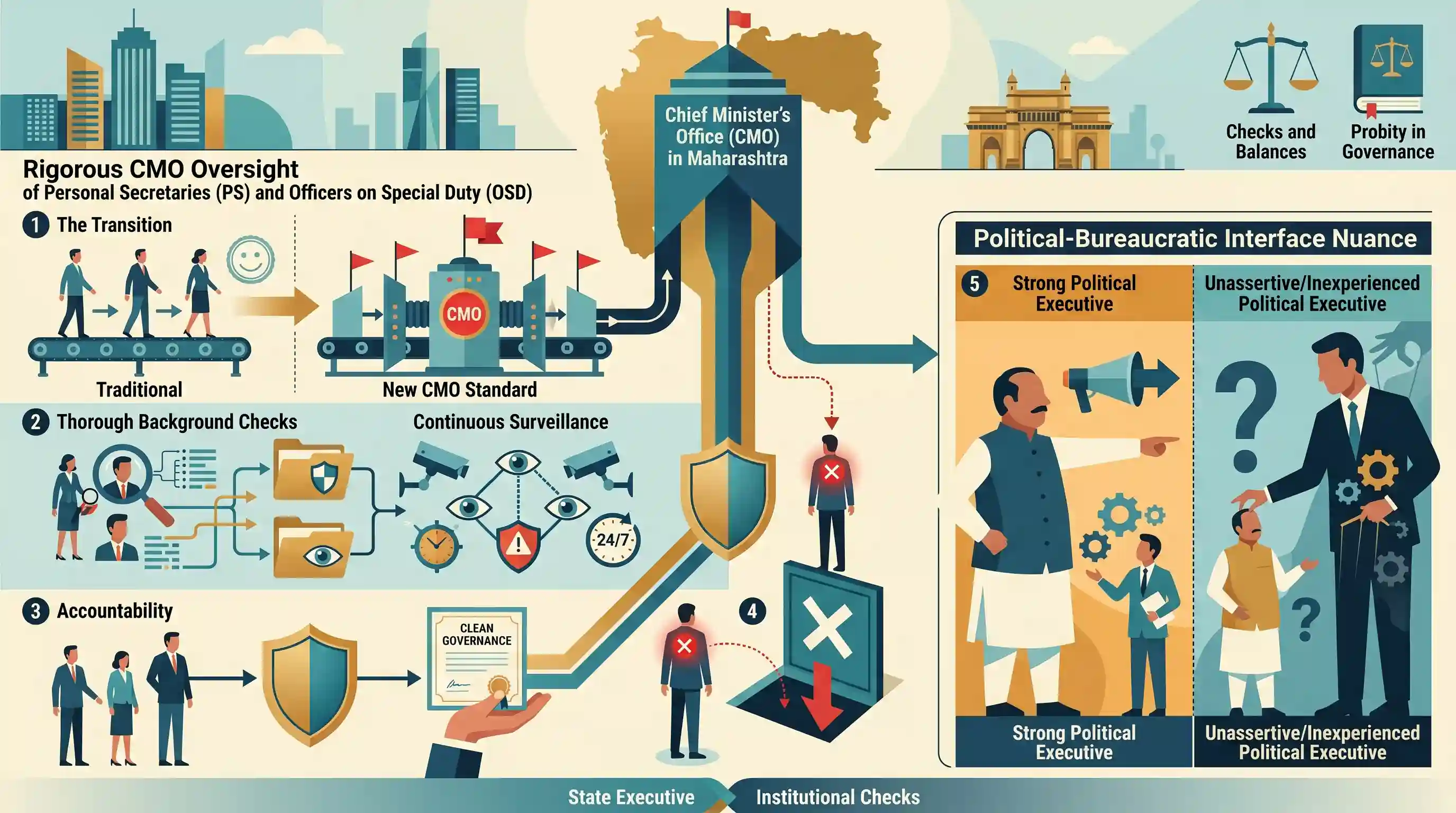
The Chief Minister’s Office (CMO) in Maharashtra has adopted a rigorous approach toward the appointment and oversight of Personal Secretaries (PS) and Officers on Special Duty (OSD) attached to state ministers. Breaking from the tradition of routinely approving ministerial picks, the CMO now mandates thorough background checks prior to appointment and maintains continuous surveillance to ensure clean governance. Officials have been explicitly warned that any ethical transgressions will lead to immediate dismissal. This unprecedented centralization of oversight has altered the traditional accountability structure, compelling the personal staff of ministers to answer to the CMO as well. Concurrently, the piece underscores the nuances of the political-bureaucratic interface by revealing how bureaucrats often take unassertive or inexperienced political executives for granted.
Key Points
- The Maharashtra Chief Minister's Office (CMO) has implemented a stringent screening process for appointing Personal Secretaries (PS) and Officers on Special Duty (OSD) for state ministers.
- Rather than merely rubber-stamping ministerial recommendations, the CMO has cleared 35 PSs and 90 OSDs only after comprehensive background checks.
- The CMO maintains active surveillance on these officials post-appointment to enforce probity, issuing explicit warnings that any corrupt practices will result in immediate removal.
- This centralized oversight has shifted accountability dynamics, placing PSs and OSDs under pressure as they must answer to both their respective ministers and the CMO.
- The article also illustrates the political-bureaucratic interface by highlighting how an unassertive, young Minister of State (MoS) is being taken for granted by the bureaucracy.
Important Terms
Chief Minister's Office (CMO)

The specialized administrative unit assisting the Chief Minister in policy coordination, departmental oversight, and public grievance redressal. It serves as the state’s highest decision-making support hub.
UPSC context
GS Paper 2: State Executive. Tests understanding of centralized executive power and its role in coordinating state administration.
Private Secretary (PS)
A senior official, typically an IAS/state cadre officer, managing a minister's official schedule, inter-departmental coordination, and the execution of policy decisions within the ministry.
UPSC context
GS Paper 2: Role of Civil Services. Tests knowledge of the link between political executives and the permanent bureaucracy.
Officer on Special Duty (OSD)
A specialized role often filled by subject-matter experts or officials to provide technical advice, policy inputs, or handle specific projects for a minister or department.
UPSC context
GS Paper 2: Governance. Relevant for discussing discretionary appointments and their impact on administrative neutrality.
Probity in Governance
The active adherence to high ethical standards, including honesty, transparency, and incorruptibility. It focuses on the 'ethics of process' rather than just outcomes.
UPSC context
GS Paper 4: Ethics. Fundamental for answers on administrative integrity, anti-corruption measures, and public trust.
Political-Bureaucratic Interface
The dynamic relationship between elected ministers (political executive) and career civil servants (permanent executive), balancing political responsiveness with administrative neutrality and meritocracy.
UPSC context
GS Paper 2 & 4. Tests the ability to analyze challenges like politicization of bureaucracy versus effective policy implementation.
Prelims Trap
"Personal Secretaries and OSDs to State Ministers must be drawn exclusively from the organized State or All India Civil Services."
Ministers can appoint private individuals to these roles on a co-terminus basis (ending with their tenure). They are not constitutionally or legally mandated to be career civil servants.
Static Concepts Connected
What dictates the Chief Minister's authority over other State Ministers?
- Sole Recommender: Under Article 164, the Governor appoints other Ministers solely on the advice of the Chief Minister.
- Portfolio Allocation: The CM allocates and reshuffles portfolios among ministers, effectively controlling the domain of each political executive.
- Power of Dismissal: The CM can ask a minister to resign or advise the Governor to dismiss them in case of differences.
What defines the ideal political-bureaucratic interface in India?
- Neutrality and Anonymity: Bureaucrats are expected to offer frank, objective advice and implement policies without displaying partisan bias or political affiliation.
- Ministerial Responsibility: While civil servants execute policy, the Minister remains ultimately accountable to the legislature for the actions of their department.
- Institutional Integrity: Civil servants must uphold the rule of law and constitutional values, even if pressured by unassertive or inexperienced political executives.
Cross-Topic Patterns
CMO dominance vs Cabinet model
The trend of centralizing vetting and executive oversight in the CMO shifts power away from individual ministries, altering the classic 'cabinet government' model where the CM is first among equals.
Ethics of co-terminus appointments
OSDs and PSs bring specialized support but bypass standard Public Service Commission channels. This raises probity risks, necessitating stringent institutional checks like CMO surveillance to prevent proximity-based corruption.

Expect a GS-4 case study or GS-2 question on the rising dominance of PMO/CMO over individual ministries and its impact on accountability.
Linked PYQs · 3
Linked PYQs · 3
- 2024MainsGS2
The Doctrine of Democratic Governance makes it necessary that the public perception of the integrity and commitment of civil servants becomes absolutely positive. Discuss.
- 2019MainsGS4
What do you understand by probity in governance ? Based on your understanding of the term, suggest measures for ensuring probity in government.
- 2024MainsGS4
“The 'Code of Conduct' and 'Code of Ethics' are the sources of guidance in public administration. There is code of conduct already in operation, whereas code of ethics is not yet put in place. Suggest a suitable model for code of ethics to maintain integrity, probity and transparency in governance.”
