Mumbai Climate Week to focus on citizen centric Global South issues
Source:Indian Express ↗
Why It Matters
It showcases a localized, city-level approach to climate change mitigation and adaptation, serving as a case study for urban resilience, citizen participation in environmental governance, and the articulation of Global South priorities in climate discourse.
Summary
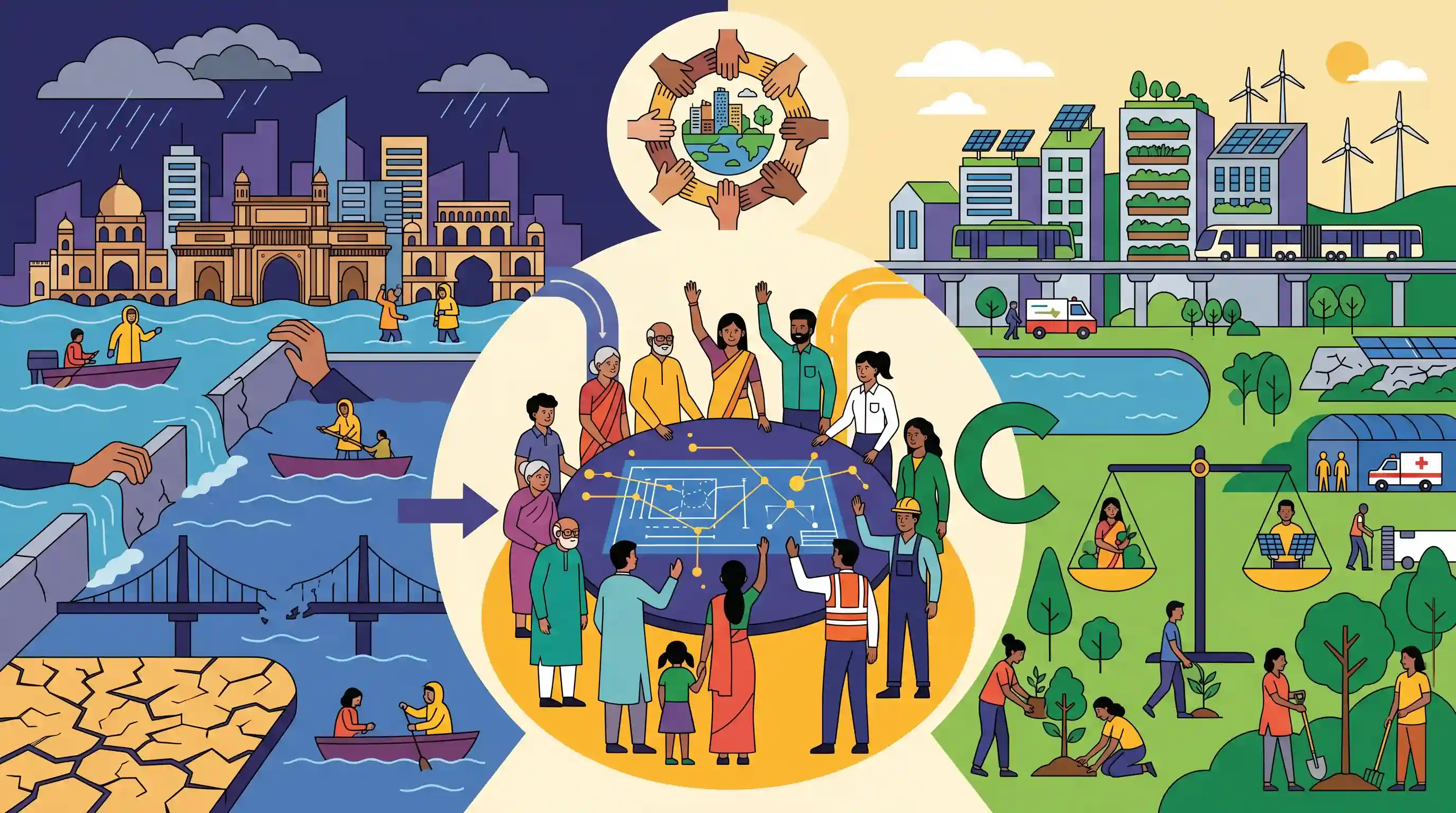
The upcoming Mumbai Climate Week (MCW) will center its focus on the distinct climate change challenges faced by the Global South, adopting a heavily citizen-centric approach. By prioritizing community engagement, the event seeks to foster inclusive local climate action plans and bolster urban resilience. This is particularly relevant for coastal megacities like Mumbai, which are highly susceptible to climate impacts such as urban flooding and rising sea levels, reinforcing the need for sustainable urban planning and climate justice.
Key Points
- The Mumbai Climate Week (MCW) focuses on climate change challenges uniquely affecting the Global South.
- The event emphasizes a 'citizen-centric' approach, advocating for active community participation in local climate action and resilience building.
- It aims to tackle critical urban climate vulnerabilities such as coastal flooding, extreme weather events, and sustainable urban planning.
- The initiative highlights a growing trend of cities developing localized climate action plans to address global environmental issues at the grassroots level.
Important Terms
Mumbai Climate Action Plan (MCAP)

A 30-year roadmap launched in 2022 aiming for net-zero emissions by 2050. It focuses on six sectors: energy, mobility, waste, greening, air quality, and flood management.
UPSC context
GS Paper 3 (Environment); tests knowledge of local climate mitigation strategies and India's net-zero commitments.
Global South
Nations in Asia, Africa, and Latin America characterized by shared histories of colonialism, economic marginalization, and high vulnerability to climate change despite low historical emissions.
UPSC context
GS Paper 2 (International Relations); relevant for India's role as a leader of developing nations and climate equity.
Urban Resilience
The capacity of an urban system to maintain continuity and bounce back after climate-induced shocks (like flooding) through resilient infrastructure, social cohesion, and effective governance.
UPSC context
GS Paper 1 (Urbanization) and GS Paper 3 (Disaster Management); assesses sustainable city planning and disaster preparedness.
Brihanmumbai Municipal Corporation (BMC)
Asia's wealthiest municipal body and the nodal agency for implementing the MCAP; it manages civic infrastructure and disaster response for Mumbai.
UPSC context
GS Paper 2 (Governance/Local Self-Government); tests the role of Urban Local Bodies (ULBs) in climate governance.
Climate Justice
An ethical framework viewing climate change as a political and social issue rather than just environmental, emphasizing 'historical responsibility' and the 'polluter pays' principle.
UPSC context
GS Paper 3 (Environment); core to arguments on equity and Common But Differentiated Responsibilities (CBDR).
Prelims Trap
"Mumbai's local climate action plan targets net-zero carbon emissions by 2070, perfectly aligning with India's national timeline."
Mumbai's Climate Action Plan aims for net-zero by 2050. This is deliberately set two decades ahead of India's national Panchamrit target of 2070.
Static Concepts Connected
What constitutes 'Compound Flooding' in coastal megacities?
- Meteorological triggers: High-intensity, short-duration localized monsoon rainfall that suddenly overwhelms municipal drainage capacities.
- Oceanic factors: Rising mean sea levels and extreme high tides pushing against riverine and storm-water outflows, preventing natural drainage.
- Anthropogenic causes: Unplanned urban sprawl, concreting over natural percolation sinks, and the systemic reclamation of wetlands and mangroves.
What is the principle of Common But Differentiated Responsibilities (CBDR-RC)?
- Core philosophy: All states must protect the environment, but developed nations bear a heavier burden due to their disproportionate historical greenhouse gas emissions.
- Right to development: Acknowledges that developing countries (Global South) require "carbon space" for economic growth and poverty eradication.
- Financial obligations: Mandates that developed nations lead in providing non-debt-inducing climate finance and technology transfer to vulnerable countries.
Cross-Topic Patterns
Urban Flooding + Sponge City guidelines
Coastal resilience seamlessly connects Geography (urban heat islands) and Disaster Management (NDMA guidelines), heavily emphasizing nature-based solutions like restoring urban wetlands and the 'Sponge City' model.
Global South Leadership + G20 diplomacy
The Mumbai event reinforces India's diplomatic push—accelerated during its G20 presidency—to position climate justice, CBDR-RC, and equitable climate finance as core pillars of Global South advocacy.

Sub-national climate targets (like Mumbai's 2050 net-zero) paired with 'compound flooding' mechanics are high-probability for 2026 Prelims.
Linked PYQs · 4
Linked PYQs · 4
- 2016MainsGS1
Major cities of India are becoming more vulnerable to flood conditions. Discuss.
- 2020MainsGS1
Account for the huge flooding of million cities in India including the smart ones like Hyderabad and Pune. Suggest lasting remedial measures.
- 2020MainsGS3
Explain intra-generational and inter-generational issues of equity from the perspective of inclusive growth and sustainable development.
- 2024MainsGS3
What role do environmental NGOs and activists play in influencing Environmental Impact Assessment (EIA) outcomes for major projects in India? Cite four examples with all important details.
