Urban Climate Resilience and Global South Adaptation Strategies
Source:Indian Express ↗
Why It Matters
Urban climate change and the role of the Global South are recurring themes in UPSC. This event provides an excellent case study for Mains answers on how local governments and civil society can collaborate on climate adaptation, particularly for vulnerable coastal megacities.
Summary
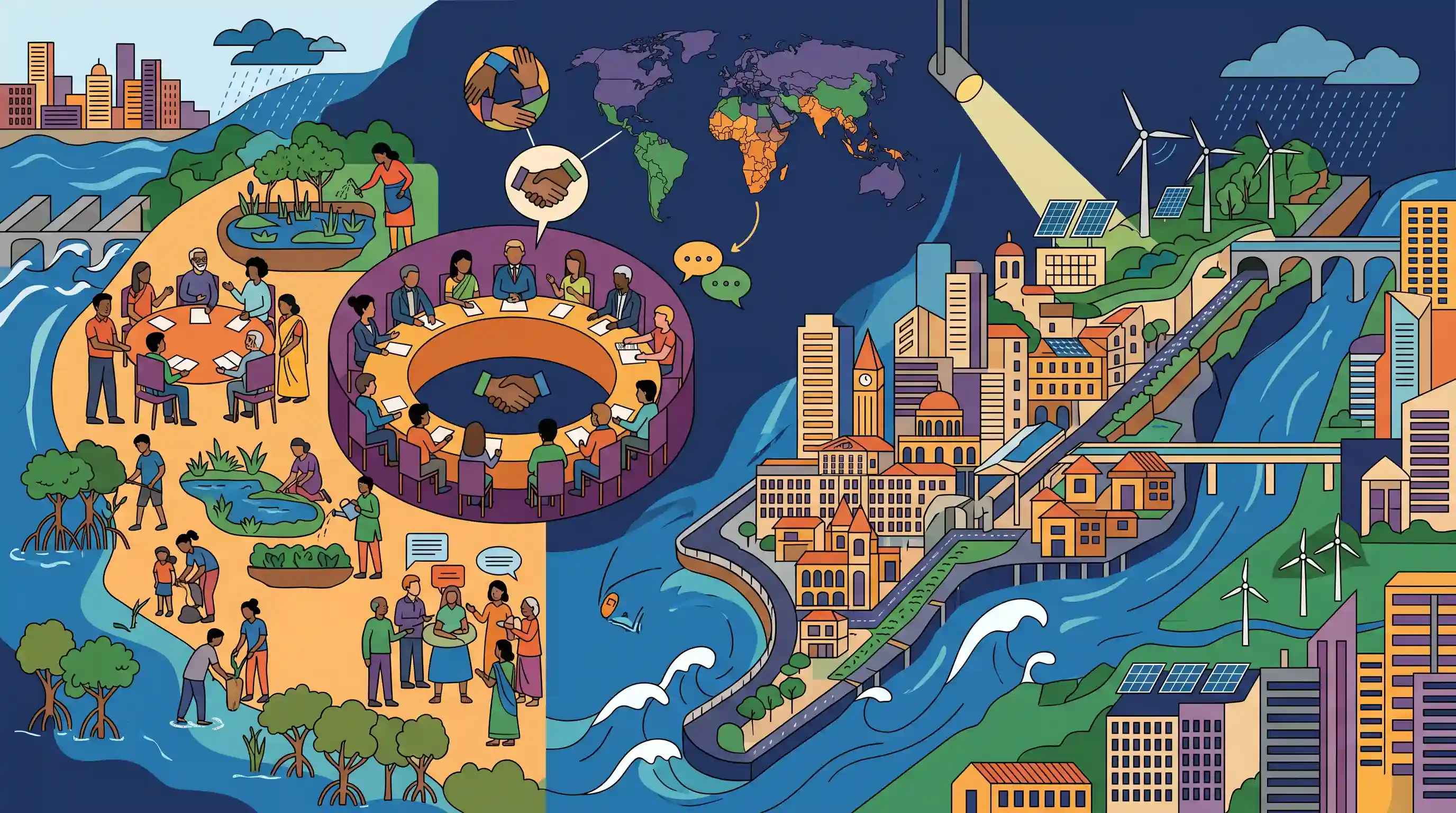
The upcoming Mumbai Climate Week (MCW) aims to spotlight the specific climate challenges and adaptation needs of the Global South. By emphasizing a citizen-centric approach, the initiative seeks to move beyond traditional top-down policymaking to foster active local and civil society participation in climate action. Hosted in Mumbai—a coastal megacity highly vulnerable to climate-induced disasters like flooding—the event underscores the critical need for localized, inclusive strategies that balance environmental resilience with the developmental realities of developing nations.
Key Points
- Mumbai Climate Week (MCW) will focus specifically on the climate challenges faced by nations and cities in the Global South.
- The event emphasizes a transition from top-down policy-making to citizen-centric climate action, encouraging local participation.
- As a coastal megacity, Mumbai serves as a prime context for addressing urban climate vulnerabilities like flooding and sea-level rise.
- The initiative highlights the necessity of localized adaptation strategies that align with the developmental realities of developing countries.
Important Terms
Mumbai Climate Week (MCW)

India's first citizen-led multi-stakeholder platform (inaugural Feb 2026) dedicated to accelerating localized climate action and solutions tailored for the developmental and environmental realities of the Global South.
UPSC context
GS Paper 3 (Environment). Tests awareness of local climate initiatives and India’s leadership in Global South advocacy.
Global South
A geopolitical grouping of developing nations (Asia, Africa, Latin America) sharing common challenges like poverty and high climate vulnerability despite low historical contributions to global emissions.
UPSC context
GS Paper 2 (International Relations). Central to climate justice, North-South finance, and India’s leadership in multilateral forums.
Citizen-Centric Governance
A public administration model prioritizing citizens' needs and participation in decision-making, emphasizing transparency, accountability, and responsiveness as benchmarks of effective governance.
UPSC context
GS Paper 2 (Governance). Key theme linked to 2nd Administrative Reforms Commission (ARC) reports on responsive administration.
Urban Climate Resilience
The ability of urban systems to withstand and recover from climate shocks like flooding and heatwaves through resilient infrastructure, proactive risk-management, and inclusive adaptation strategies.
UPSC context
GS Paper 3 (Disaster Management). Evaluates understanding of urban vulnerabilities and the Sendai Framework for sustainable cities.
Coastal Megacity
A massive metropolitan area located on a coastline, facing unique socio-economic risks and severe vulnerabilities from rising sea levels, storm surges, and climate-induced flooding.
UPSC context
GS Paper 1 (Urbanization) and Paper 3. Focuses on managing large populations in environmentally fragile coastal zones.
Climate Diplomacy
The use of diplomatic tools to address climate change through international negotiations, aiming to balance national interests with global goals like emission reductions and climate finance.
UPSC context
GS Paper 2 (International Relations). Tests knowledge of environmental treaties and India's positioning in global climate summits.
Prelims Trap
"Under the Mumbai Climate Action Plan, the city aims to achieve net-zero emissions by 2070."
Mumbai's MCAP targets net-zero emissions by 2050, which is two full decades ahead of India's national commitment of 2070 (Panchamrit).
Static Concepts Connected
What are the key NDMA guidelines for managing Urban Flooding?
- Early Warning: Establishment of localized Early Warning Systems and Doppler Weather Radars to predict intense, short-duration rainfall.
- Drainage Design: Desilting of drains pre-monsoon and separating storm-water drainage networks from the standard municipal wastewater systems.
- Catchment Protection: Protection of natural wetlands, floodplains, and lakes to act as natural sponges absorbing excess urban runoff.
How does the 74th Constitutional Amendment empower ULBs for environmental resilience?
- 12th Schedule: The 12th Schedule explicitly lists "protection of the environment and promotion of ecological aspects" as a municipal function.
- Urban Planning: It entrusts municipalities with urban planning, including town planning, allowing them to mandate climate-resilient zoning and infrastructure.
Cross-Topic Patterns
Urban Flooding + Sponge Cities
Coastal vulnerability links directly to the 'Sponge City' concept (permeable infrastructure) often tested across GS1 (Urbanization) and GS3 (Disaster Management).
Global South + Climate Finance
Initiatives like MCW reinforce India's leadership of the Global South, bridging GS2 diplomacy with GS3 climate negotiations (Loss and Damage Fund).

A multi-statement Prelims question contrasting national vs city-level net-zero targets (e.g., India 2070 vs Mumbai 2050) is highly probable.
Linked PYQs · 5
Linked PYQs · 5
- 2024MainsGS3
Flooding in urban areas is an emerging climate-induced disaster. Discuss the causes of this disaster. Mention the features of two such major floods in the last two decades in India. Describe the policies and frameworks in India that aim at tackling such floods.
- 2017MainsGS3
'Climate change' is a global problem. How India will be affected by climate change? How Himalayan and coastal states of India will be affected by climate change?
- 2017PrelimsGS1
With reference to 'Global Climate Change Alliance', which of the following statements is/are correct? 1. It is an initiative of the European Union. 2. It provides technical and financial support to targeted developing countries to integrate climate change into their development policies and budgets. 3. It is coordinated by World Resources Institute (WRI) and World Business Council for Sustainable Development (WBCSD). Select the correct answer using the code given below:
- 2024MainsGS2
The Citizens' charter has been a landmark initiative in ensuring citizen-centric administration. But it is yet to reach its full potential. Identify the factors hindering the realisation of its promise and suggest measures to overcome them.
- 2021MainsGS2
Can Civil Society and Non-Governmental Organizations present an alternative model of public service delivery to benefit the common citizen? Discuss the challenges of this alternative model.
