Need for Dedicated Air Quality Custodian in Mumbai
Source:Indian Express ↗
Why It Matters
This case study is highly relevant for GS3 (Environment) and GS1/GS2 (Urbanization/Governance) as it exposes the gap between macro-level Air Quality Index (AQI) monitoring and micro-level urban realities. It underscores how zoning violations and informal commercial activities create localized health hazards ('ghost pollutants') that require dedicated municipal-level institutional mechanisms, rather than just national policies like NCAP.
Summary
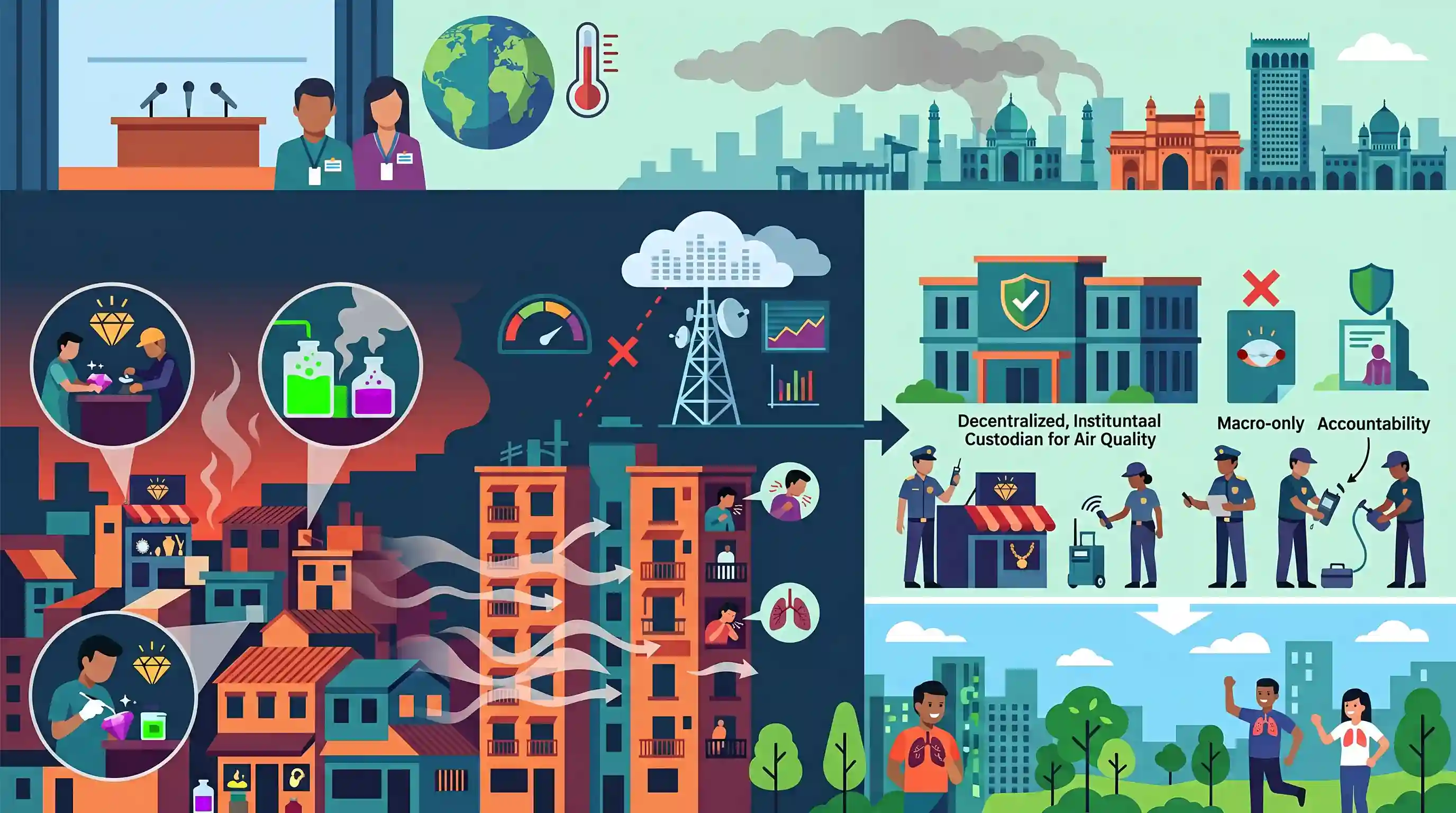
During the Mumbai Climate Week, experts emphasized the critical need for a dedicated institutional custodian for air quality in Mumbai, similar to the Commission for Air Quality Management (CAQM) in the NCR. The urgency is underscored by localized urban planning failures, such as in Bhuleshwar, where unregulated commercial activities like jewellery polishing use toxic acids. These 'ghost pollutants' permeate residential zones, causing severe respiratory issues like asthma. The situation highlights the limitations of macro-level air quality monitoring and calls for decentralized, accountable urban governance to implement pollution control measures effectively.
Key Points
- Experts at Mumbai Climate Week highlighted the urgent need for a dedicated institutional custodian to manage and monitor Mumbai's air quality.
- The case of Bhuleshwar illustrates the hazard of 'ghost pollutants'—toxic fumes from unregulated jewellery acid used in commercial polishing within residential areas.
- There is a significant governance deficit at the micro-level, as city authorities lack unified nodal agencies to tackle localized, informal polluting industries.
- Exposure to such unregulated localized emissions has led to severe health impacts, including a documented rise in asthma and respiratory ailments among residents.
Important Terms
Commission for Air Quality Management (CAQM)

A statutory body established in 2021 to coordinate and oversee air quality management in the National Capital Region (NCR) and adjoining areas, possessing overarching powers to issue binding directions.
UPSC context
GS2: Statutory bodies; GS3: Environmental pollution. Essential for understanding institutional frameworks and centralized vs. decentralized pollution governance.
National Clean Air Programme (NCAP)
A national strategy launched by MoEFCC in 2019 targeting a 40% reduction in Particulate Matter (PM10 and PM2.5) concentrations by 2026 across 131 non-attainment cities.
UPSC context
GS3: Environmental Pollution & Degradation. A primary scheme for air quality targets and city-specific action plans in India.
Non-attainment Cities
Cities that have consistently failed to meet National Ambient Air Quality Standards (NAAQS) for a period of five years, necessitating targeted interventions under India’s National Clean Air Programme.
UPSC context
GS3: Environmental Degradation. Key classification for urban centers requiring priority environmental funding and air quality monitoring.
Airshed Management
A geographical area where a shared volume of air is subject to similar topography and weather, requiring integrated pollution management that transcends individual municipal or administrative boundaries.
UPSC context
GS3: Environmental Conservation. Represents a shift from localized to regional environmental planning, a frequent theme in UPSC Mains.
Ghost Pollutants
Localized, unregulated toxic pollutants (such as acid fumes or volatile chemicals) that often escape macro-level monitoring (like PM2.5/PM10 sensors) but cause significant health damage in residential zones.
UPSC context
GS3: Public Health & Pollution. Highlights the limitations of standard monitoring and the need for hyperlocal air quality sensing.
Mumbai Climate Week
A multi-stakeholder platform in Mumbai (inaugurated Feb 2026) focused on accelerating urban climate resilience, citizen-led action, and decentralized governance for air quality in the Global South.
UPSC context
GS3: Environmental Conservation; Urbanization. Example of city-level climate diplomacy and decentralized environmental governance.
Prelims Trap
"CAQM regulates air quality across all million-plus metropolitan cities in India."
CAQM's statutory jurisdiction is strictly limited to the National Capital Region (NCR) and adjoining areas. Mumbai and other metros rely on their respective SPCBs.
Static Concepts Connected
How does CAQM's statutory mandate differ from the CPCB?
- Statutory Origin: CAQM was established under the CAQM Act 2021, whereas the CPCB was constituted much earlier under the Water (Prevention and Control of Pollution) Act, 1974.
- Jurisdiction Scope: CAQM's mandate is restricted specifically to the NCR and adjoining areas, while the CPCB exercises pan-India authority.
- Overriding Power: In case of a regulatory clash within the NCR region, CAQM’s directives legally supersede those of the CPCB or respective State Pollution Control Boards.
What are the core parameters of the National Clean Air Programme (NCAP)?
- Core Target: It targets a 40% reduction in particulate matter (PM10 and PM2.5) concentrations by 2025-26, using 2017 as the baseline year for comparison.
- City Selection: It specifically focuses on 131 'non-attainment cities' that consistently failed to meet the National Ambient Air Quality Standards (NAAQS) over a consecutive five-year period.
Cross-Topic Patterns
Zoning Laws & the Informal Economy
The Bhuleshwar 'ghost pollutants' issue bridges GS1 Urbanization (failed land-use planning) and GS3 Economy (unregulated informal MSMEs), showing how mixed zoning exacerbates micro-level toxicity.
Parastatal Bodies vs 74th CAA
Advocating for a CAQM-like statutory body in Mumbai highlights the continuous bypass of Urban Local Bodies (ULBs), revealing systemic weaknesses in 74th CAA decentralized municipal governance.

Expect a 2026 question comparing CAQM's statutory powers with SPCBs, alongside the emerging concept of 'ghost pollutants' in urban areas.
Linked PYQs · 4
Linked PYQs · 4
- 2021MainsGS3
Describe the key points of the revised Global Air Quality Guidelines (AQGs) recently released by the World Health Organisation (WHO). How are these different from its last update in 2005? What changes in India's National Clean Air Programme are required to achieve these revised standards?
- 2022PrelimsGS1
In the context of WHO Air Quality Guidelines, consider the following statements: 1. The 24-hour mean of PM2.5 should not exceed 15 µg/m³ and annual mean of PM2.5 should not exceed 5 µg/m³. 2. In a year, the highest levels of ozone pollution occur during the periods of inclement weather. 3. PM10 can penetrate the lung barrier and enter the bloodstream. 4. Excessive ozone in the air can trigger asthma. Which of the statements given above are correct?
- 2016PrelimsGS1
In the cities of our country, which among the following atmospheric gases are normally considered in calculating the value of Air Quality Index? 1. Carbon dioxide 2. Carbon monoxide 3. Nitrogen dioxide 4. Sulfur dioxide 5. Methane Select the correct answer using the code given below.
- 2013MainsGS1
Discuss the various social problems which originated out of the speedy process of urbanization in India.
