Bela Gram Becomes Maharashtra First Net Zero Village via Panchayat
Source:The Hindu ↗
Why It Matters
Understanding the intersection of local governance (PRIs) and climate action is crucial for UPSC aspirants. It highlights community-driven sustainable development, the effective utilization of funds like the District Mineral Fund, and the grassroots energy transition required for India to meet its national net-zero commitments and international SDGs.
Summary
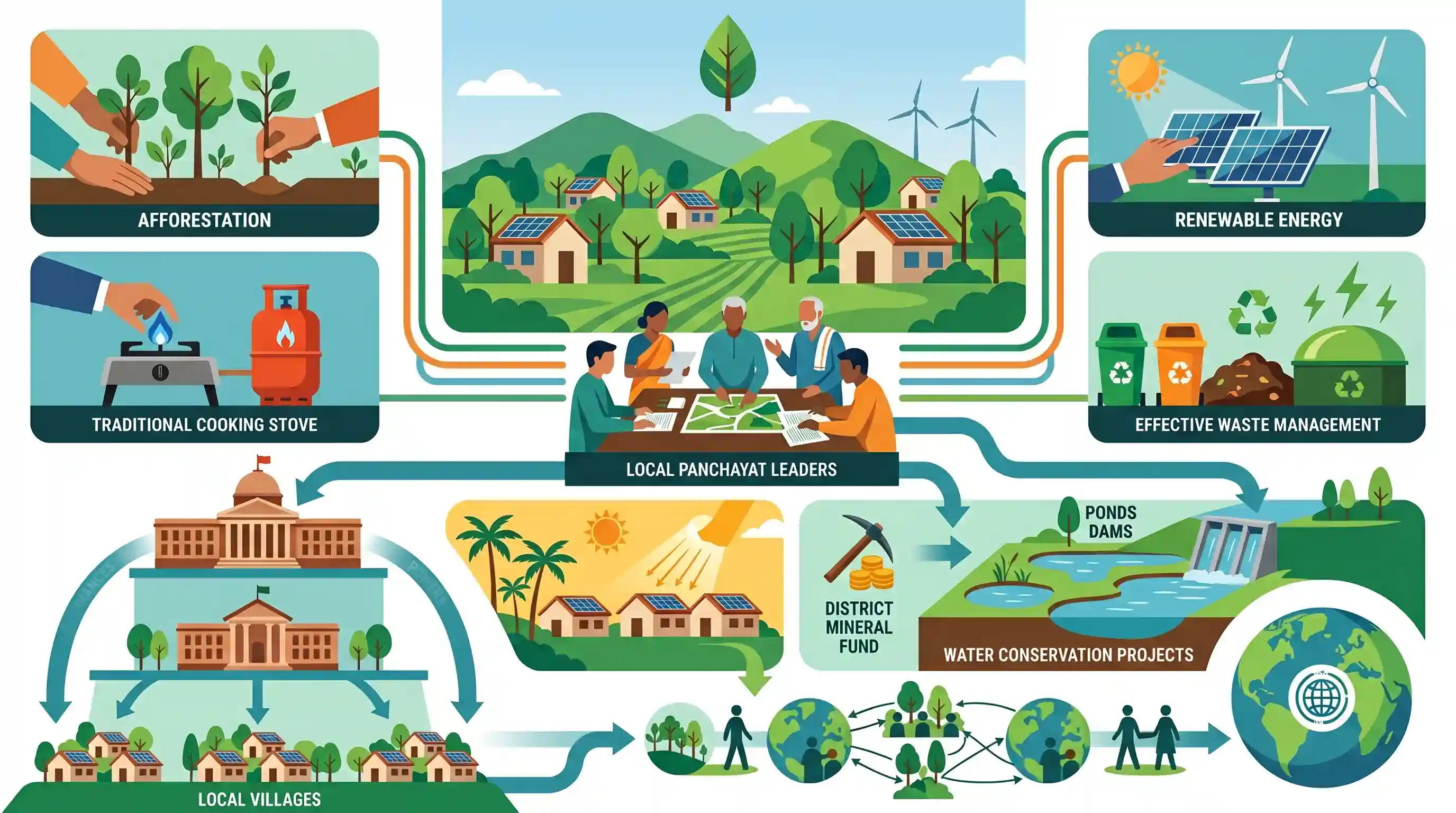
Maharashtra's Bela Gram has emerged as India's first net-zero village, demonstrating the pivotal role of Panchayati Raj Institutions in localized climate action. Highlighted at Mumbai Climate Week 2026, the village's success is attributed to large-scale afforestation, the adoption of solar energy, transition to LPG, and effective waste management led by local Panchayat leaders. Similar success stories across India—from Kerala's solar transitions to Jharkhand's use of the District Mineral Fund for water conservation—illustrate that empowering local governance can effectively address socio-economic and climate realities, paving the way for scalable grassroots climate resilience ahead of the proposed COP33 in 2028.
Key Points
- Bela Gram in Maharashtra's Bhandara district became India's first net-zero panchayat through local leadership and grassroots participation.
- The panchayat successfully transitioned to renewable energy, replaced smoky chulhas with LPG, installed solar panels, and promoted waste segregation to eliminate single-use plastics.
- Other states demonstrated similar community-led climate initiatives, such as Kerala's Perinjanam becoming a Solar Gramam and Jharkhand's Siyari village using the District Mineral Fund (DMF) for solar lift irrigation and water conservation.
- Grassroots leaders emphasize that local bodies (Panchayats) are essential in shaping effective, localized, and evidence-based climate action plans.
- The success stories highlighted at Mumbai Climate Week 2026 advocate for integrating local governance models into broader climate platforms, aligning with India's targets for the proposed COP33 in 2028.
Important Terms
Panchayati Raj Institutions (PRI)

The three-tier system of local self-government in India, constitutionalized via the 73rd Amendment Act, 1992, comprising Gram, Block, and District-level Panchayats.
UPSC context
GS Paper II: Local Governance; tests understanding of decentralization and grassroots leadership in national missions like climate action.
District Mineral Fund (DMF)
A non-profit statutory trust established in mining-affected districts to fund projects for the welfare and developmental needs of local communities and affected areas.
UPSC context
GS Paper II & III: Governance/Economy; tests knowledge of resource utilization via the Pradhan Mantri Khanij Kshetra Kalyan Yojana.
Rashtriya Panchayat Puraskar
National awards conferred annually by the Ministry of Panchayati Raj to recognize Panchayats that excel in the 'Localization of Sustainable Development Goals' (LSDGs).
UPSC context
GS Paper II: Governance; tests awareness of incentives for local-level performance and competitive federalism in rural development.
Mines and Minerals (Development and Regulation) Amendment Act 2015
Legislation that introduced mandatory competitive auctions for mineral licenses and established District Mineral Foundations (DMF) to benefit mining-affected people.
UPSC context
GS Paper III: Infrastructure/Economy; tests understanding of regulatory reforms and transparency in the extractive industry sector.
COP33
The 33rd UN Climate Change Conference, which India bid to host for 2028 to showcase its leadership in green transition and Global South advocacy.
UPSC context
GS Paper III: Environment/International Relations; tests knowledge of global climate governance and India's role in international diplomacy.
Global Energy Alliance for People and Planet (GEAPP)
A global philanthropic alliance focused on ending energy poverty and accelerating green energy transitions through public-private-philanthropic partnerships in emerging economies.
UPSC context
GS Paper III: Environment/Energy; tests awareness of international partnerships supporting India’s renewable energy and grid modernization goals.
Prelims Trap
District Mineral Foundation (DMF) funds are governed and utilized directly by the Union Ministry of Mines.
DMFs are non-profit statutory trusts established by State Governments at the district level under the MMDR Act, 2015, not by the Union Government.
Static Concepts Connected
What is the statutory backing and purpose of the District Mineral Foundation (DMF)?
- Statutory origin: Mandated under the Mines and Minerals (Development and Regulation) Amendment Act, 2015.
- State jurisdiction: Created by State Governments as non-profit trusts in every district affected by mining-related operations.
- Core objective: To fund projects (like water conservation and healthcare) for the benefit of persons and areas affected by mining operations.
Which ecological subjects are devolved to Panchayats under the 11th Schedule?
- Article 243G: Lists 29 subjects over which state legislatures can devolve power to Panchayats.
- Green subjects: Explicitly includes social forestry, farm forestry, minor forest produce, minor irrigation, water management, and non-conventional energy sources.
Cross-Topic Patterns
PRI Devolution + Climate Finance
Tapping into non-traditional localized funds like the DMF for grassroots climate resilience bridges GS2 (devolution of powers to local bodies) with GS3 (climate finance).
Solar Prosumers + PM Surya Ghar
Kerala's 'Solar Gramam' decentralized model aligns directly with the PM Surya Ghar Muft Bijli Yojana, shifting citizens from energy consumers to grid-feeding 'prosumers'.

Expect a GS2/GS3 Mains question on 'Localizing Climate Action' via PRIs, or a Prelims pair-matching of green panchayats (Bela, Palli).
Linked PYQs · 5
Linked PYQs · 5
- 2024MainsGS2
Analyse the role of local bodies in providing good governance at local level and bring out the pros and cons merging the rural local bodies with the urban local bodies.
- 2015MainsGS2
In absence of a well-educated and organized local level government system, 'Panchayats' and 'Samitis' have remained mainly political institutions and not effective instruments of governance. Critically discuss.
- 2022MainsGS3
Do you think India will meet 50 percent of its energy needs from renewable energy by 2030 ? Justify your answer. How will the shift of subsidies from fossil fuels to renewables help achieve the above objective ? Explain.
- 2018MainsGS3
“Access to affordable, reliable, sustainable and modern energy is the sine qua non to achieve Sustainable Development Goals (SDGs).” Comment on the progress made in India in this regard.
- 2025MainsGS3
Mineral resources are fundamental to the country's economy and these are exploited by mining. Why is mining considered an environmental hazard? Explain the remedial measures required to reduce the environmental hazard due to mining.
