Mumbai can emerge as key gateway for climate finance says Fadnavis
Source:Indian Express ↗
Why It Matters
Funding is one of the most significant bottlenecks in climate action. Understanding how financial hubs like Mumbai can mobilize green finance is critical for GS3 topics related to environmental conservation, disaster management, and sustainable economic development.
Summary
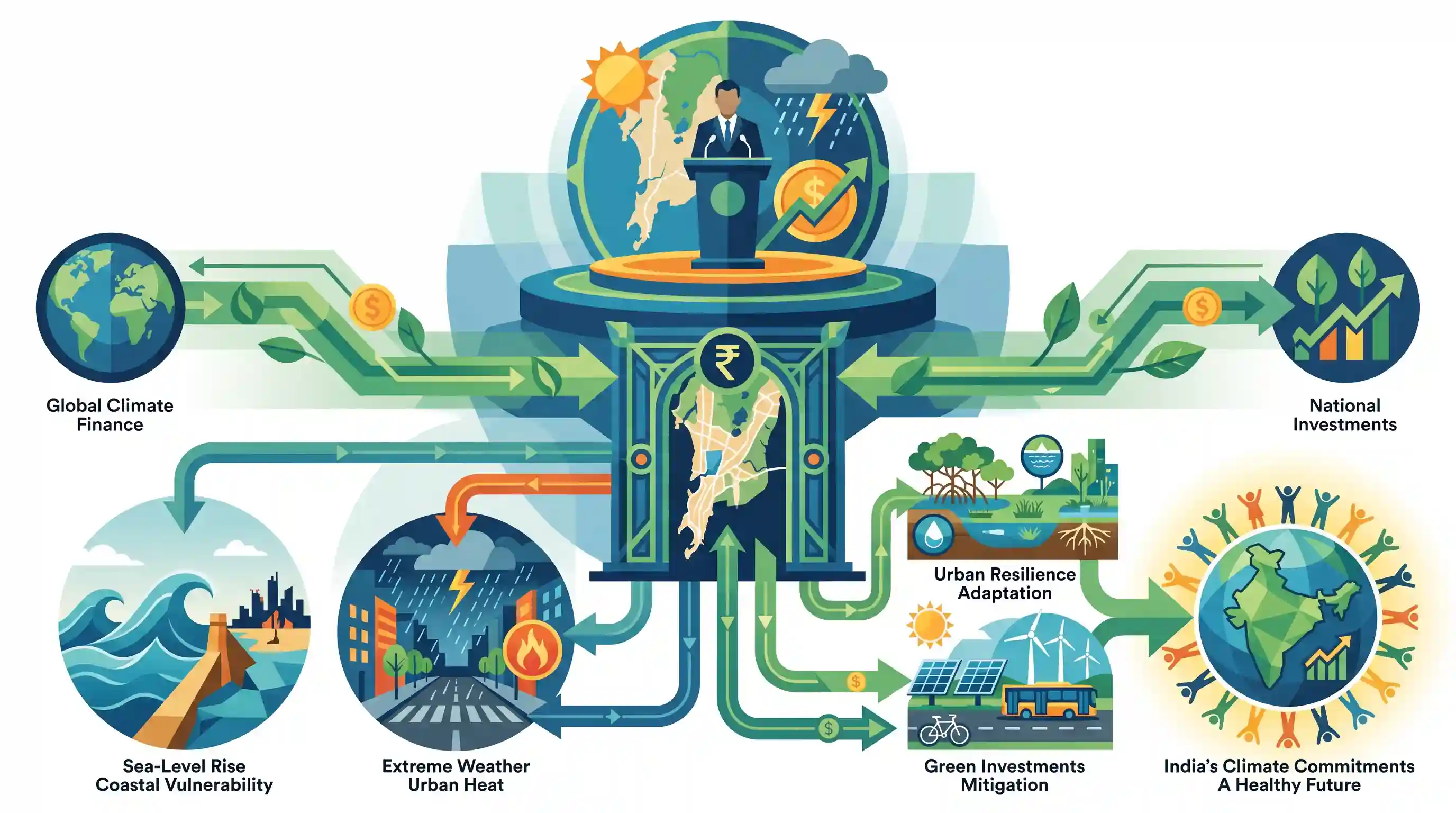
Speaking at the Mumbai Climate Week (MCW) 2026 Summit, Maharashtra Deputy Chief Minister Devendra Fadnavis stated that Mumbai has the potential to become India's premier gateway for climate finance. Leveraging its status as the nation's financial capital, Mumbai can attract and channel the vast green investments required for climate resilience, adaptation, and mitigation. This vision emphasizes the necessity of robust funding mechanisms to combat urban vulnerabilities like extreme weather and sea-level rise while advancing India's broader climate commitments.
Key Points
- Maharashtra's Deputy Chief Minister Devendra Fadnavis pitched Mumbai as a potential gateway for climate finance at the Mumbai Climate Week (MCW) 2026 Summit.
- As India's financial capital, Mumbai is uniquely positioned to mobilize both domestic and international green investments.
- These funds are essential for building climate resilience, urban adaptation, and supporting India's transition to a low-carbon economy.
- The initiative underscores the growing need to integrate climate action with formal financial frameworks to address vulnerabilities such as urban flooding and sea-level rise.
Prelims Trap
The RBI has officially designated Mumbai as India's exclusive nodal gateway for mobilizing international climate finance.
This is a trap. The gateway status was a political vision pitched by Maharashtra's Deputy CM, not a statutory designation or RBI policy.
Static Concepts Connected
What are the primary institutional mechanisms for global climate finance?
- Green Climate Fund: Set up by UNFCCC in 2010 to help developing nations limit/reduce GHG emissions and adapt to climate impacts.
- Global Environment Facility: Established on the eve of the 1992 Rio Earth Summit to provide grants for tackling pressing environmental problems.
- Adaptation Fund: Finances projects that help vulnerable communities in developing countries adapt to climate change, initially established under the Kyoto Protocol.
How are Sovereign Green Bonds (SGrBs) structured in India?
- Definition: Government debt instruments used exclusively to fund projects that have positive environmental and climate impacts.
- Framework: India’s framework aligns with ICMA Green Bond Principles; projects are evaluated by a dedicated Green Finance Working Committee.
- Key Exclusions: Proceeds are used for renewable energy, clean transportation, and green buildings, but exclude large hydro (>25MW) or fossil fuels.
Cross-Topic Patterns
Urban flooding + Municipal Green Bonds
Tackling urban coastal vulnerabilities directly links GS1 urbanization with GS3 disaster management, requiring localized green debt instruments like municipal green bonds to fund adaptation.
Corporate ESG + RBI Green Deposits
Mumbai's status as a financial hub connects climate adaptation to formal banking regulations, such as the RBI's framework for Green Deposits and SEBI's BRSR norms.

Expect a GS3 Mains question evaluating the role of municipal green bonds and private climate finance in mitigating urban flooding.
Linked PYQs · 3
Linked PYQs · 3
- 2024MainsGS3
Flooding in urban areas is an emerging climate-induced disaster. Discuss the causes of this disaster. Mention the features of two such major floods in the last two decades in India. Describe the policies and frameworks in India that aim at tackling such floods.
- 2021MainsGS3
Describe the major outcomes of the 26th session of the Conference of the Parties (COP) to the United Nations Framework Convention on Climate Change (UNFCCC). What are the commitments made by India in this conference?
- 2025MainsGS3
Write a review on India's climate commitments under the Paris Agreement (2015) and mention how these have been further strengthened in COP26 (2021). In this direction, how has the first Nationally Determined Contribution intended by India been updated in 2022?
