Ghatkopar Landslide Prone Area Evacuation and Urban Risks
Source:freepressjournal ↗
Why It Matters
Provides a real-world case study for MPSC aspirants on the intersection of urban disaster management, overlapping institutional jurisdictions (municipal vs. state/central land ownership), and the social challenges of relocating vulnerable populations in a mega-city.
Summary
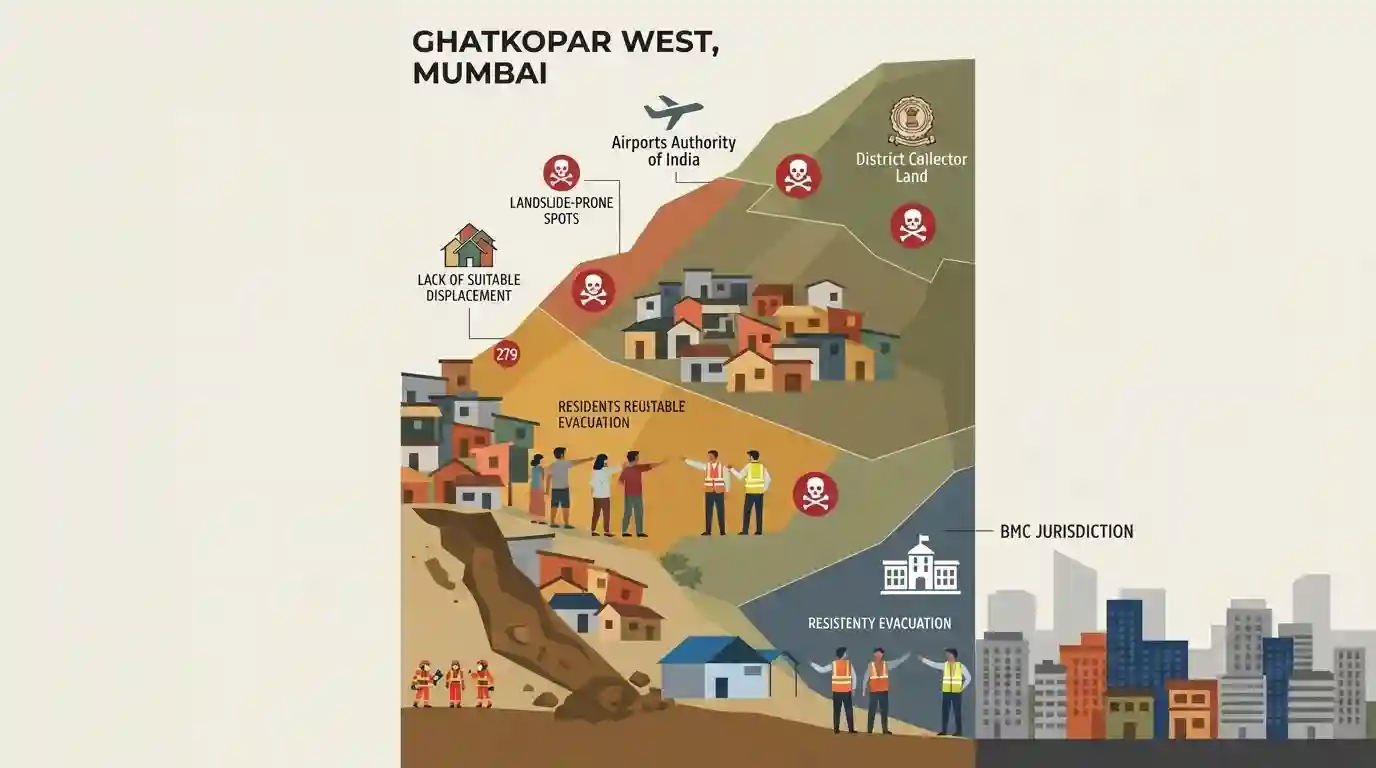
The Brihanmumbai Municipal Corporation (BMC) has initiated the evacuation of residents from Ashok Nagar in Ghatkopar West, a landslide-prone settlement where a recent collapse resulted in eight fatalities. Despite the provision of temporary shelter at a local school, many residents are refusing to vacate, underscoring the socio-economic complexities of slum rehabilitation. The incident draws attention to Mumbai's broader urban vulnerability, with 279 identified landslide-prone spots largely located on lands under the jurisdiction of the district collector and the Airports Authority of India, highlighting the structural governance challenges urban local bodies face in disaster management.
Key Points
- The BMC has begun evacuating families from the landslide-prone Ashok Nagar area in Ghatkopar West following a recent landslide that killed eight people.
- Mumbai has identified approximately 279 landslide-prone locations, the majority of which are situated on lands owned by the district collector or the Airports Authority of India (AAI).
- Evacuation efforts are facing resistance from local residents, complicating the BMC's disaster response despite arranging temporary accommodations at a nearby school.
- The situation highlights the complex multi-jurisdictional challenges in Mumbai's urban governance, where the municipal corporation manages disaster response on lands it does not own.
- The lack of infrastructure like retaining walls in these informal settlements exacerbates their vulnerability during the monsoon season.
Important Terms
Brihanmumbai Municipal Corporation (BMC)

The civic governing body of Mumbai, responsible for local administration, infrastructure, disaster management, and public health.
UPSC context
Vital for MPSC GS Paper 2 (Local Self-Government) and examining urban administrative challenges.
Airports Authority of India (AAI)
A statutory body under the Ministry of Civil Aviation that develops and manages civil aviation infrastructure and owns significant urban land across India.
UPSC context
Relevant for MPSC GS Paper 3 (Infrastructure) and GS Paper 2 (Statutory bodies & inter-agency governance).
Slum Rehabilitation Authority (SRA)
A state-level statutory body in Maharashtra established to implement housing schemes, clear slums, and provide dignified accommodations for slum dwellers in urban areas.
UPSC context
Highly relevant for MPSC GS Paper 1 (Urbanization issues) and GS Paper 3 (Infrastructure development).
Urban Landslides
The sudden collapse of soil or rock on city hillsides, typically triggered by heavy monsoon rains, severely affecting vulnerable and informal settlements.
UPSC context
Core topic in MPSC GS Paper 1 (Geography of Maharashtra) and GS Paper 3 (Disaster Management).
Prelims Trap
The BMC holds ownership and development authority over all landslide-prone sites identified within Mumbai's municipal boundaries.
Most landslide-prone spots lie on lands owned by the State Collector, Forest Department, or central bodies (AAI), limiting BMC's direct structural intervention capacity.
Static Concepts Connected
What is the composition and statutory basis of the MSDMA?
- Statutory Origin: Constituted on May 24, 2006, under Section 14 of the Central Disaster Management Act, 2005.
- Ex-officio Chair: Chaired ex-officio by the Chief Minister of Maharashtra, with a maximum of nine members.
- Executive Body: The State Executive Committee (SEC), assisting the MSDMA, is headed by the Chief Secretary of Maharashtra.
What are the geological and geographic factors driving landslides in Mumbai?
- Lithology: Highly weathered Deccan Trap basalt slopes prone to rapid saturation and shear strength loss.
- Vulnerability Hotspot: S-Ward (Bhandup-Vikhroli) contains over 50% of Mumbai's identified landslide-prone spots, the highest in the city.
Cross-Topic Patterns
Urban Land Governance + Disaster Vulnerability
Overlapping jurisdictions of Central (AAI), State (Collector), and local (BMC) authorities delay the execution of urgent landslide-mitigation projects like retaining walls.
Climate Action + Slum Rehabilitation
The MCAP 2022 highlights how socio-economic vulnerability forces informal settlements onto unstable hill slopes, making disaster mitigation inseparable from housing policy.

MPSC GS-1/GS-4 may combine questions on MSDMA's structure with Maharashtra's landslide-prone physical geography and MCAP 2022 priorities.
Linked PYQs · 3
Linked PYQs · 3
- 2022MPSC_PRELIMSGS1
Which of the following, according to the World Bank, are critical issues to be addressed in India's urbanisation ? (a) Poor local governance (b) Weak finances (c) Inappropriate planning leading to high costs (d) Rapidly deteriorating environment
- 2021MPSC_PRELIMSGS1
The Mumbai Metropolitan Region spread over 6,328 sq.km. consists of ________ Municipal Corporations.
- 2018MPSC_PRELIMSGS1
Recommendations of the Sixth Report of Second Administrative Reforms Commission on Local Government are a. Set up unified metropolitan transport authority in all cities of one million plus population. b. Constitute a local body ombudsman. c. Direct election of the Mayors. d. Set up District Councils and the Collector would work as the Chief Secretary. Answer Options :
