Customs Seizures of Hydroponic Weed at Mumbai Airport
Source:Indian Express ↗
Why It Matters
The incident highlights the evolving and deceptive modus operandi used by transnational organized crime networks to smuggle narcotics and high-value items. It underscores the critical role of intelligence-led border management and profiling by enforcement agencies in addressing internal security threats posed by international drug trafficking under the NDPS Act framework.
Summary
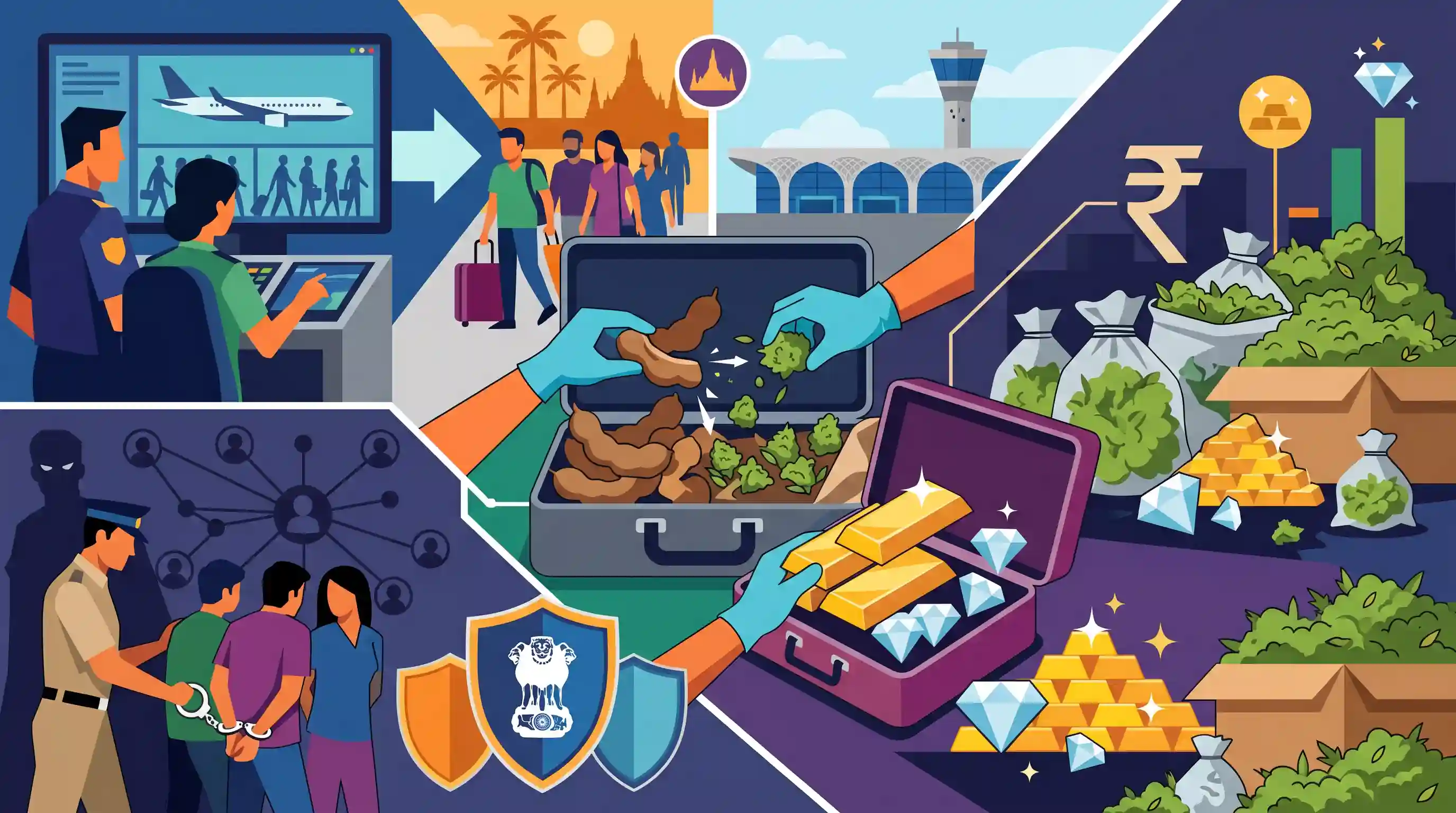
The Mumbai Customs Department recently seized approximately Rs 43 crore worth of hydroponic weed and Rs 2.4 crore in gold and diamonds at the Chhatrapati Shivaji Maharaj International Airport over the course of a week. Acting on specific intelligence and spot profiling, officials intercepted multiple passengers arriving from Bangkok. The smugglers utilized deceptive concealment methods, hiding the narcotics inside lumps of tamarind in their luggage. The individuals were arrested under the Narcotic Drugs and Psychotropic Substances (NDPS) Act.
Key Points
- The Customs department seized hydroponic weed worth Rs 43 crore and gold/diamonds worth Rs 2.40 crore at Mumbai airport over a one-week period.
- Multiple passengers traveling from Bangkok to Mumbai were intercepted based on spot profiling and specific intelligence.
- Smugglers concealed the contraband inside lumps of tamarind in their trolley bags to evade detection.
- The accused were arrested under the Narcotic Drugs and Psychotropic Substances (NDPS) Act.
Important Terms
Narcotic Drugs and Psychotropic Substances (NDPS) Act, 1985

India's primary legislation (1985) regulating narcotics and psychotropic substances. It prohibits unauthorized production, possession, and trafficking, prescribing stringent penalties including rigorous imprisonment and asset forfeiture for offenders.
UPSC context
GS Paper III (Internal Security/Organized Crime). Tests knowledge of legal frameworks countering drug trafficking and border security threats.
Directorate of Revenue Intelligence (DRI)
The apex anti-smuggling agency under the Central Board of Indirect Taxes and Customs (CBIC). It enforces the Customs Act and NDPS Act to combat international trade fraud and trafficking.
UPSC context
GS Paper III (Security Forces and Agencies). Relevant for their mandate in managing economic frontiers and preventing illicit trade.
Hydroponic Weed
High-potency cannabis cultivated in nutrient-rich water instead of soil. It contains significantly higher THC levels (30-40%) than regular varieties, making it highly addictive and commercially valuable for smugglers.
UPSC context
GS Paper III (Internal Security). Represents modern trends in drug trafficking and challenges in border detection.
Customs Act, 1962
The primary legal framework for controlling imports and exports in India. It empowers officials to search, seize, and arrest individuals involved in smuggling or duty evasion.
UPSC context
GS Paper III (Border Management). Essential for understanding the regulatory mechanisms protecting India's economic sovereignty.
Golden Triangle
A notorious narcotics-producing region comprising parts of Myanmar, Laos, and Thailand. It is a major global source of heroin and synthetic drugs smuggled into India via air and land routes.
UPSC context
GS Paper III (Internal Security/Border Management). Crucial for analyzing transnational threats and the nexus between organized crime and regional instability.
Prelims Trap
Under the NDPS Act, the burden of proof always rests on the prosecution, as is standard in criminal law.
Section 37 of the NDPS Act reverses the burden of proof for 'commercial quantity' offenses. The accused must prove their innocence to secure bail.
Static Concepts Connected
What distinguishes the Golden Triangle and Golden Crescent in global narcotics?
- Golden Crescent: Comprises Iran, Afghanistan, and Pakistan, forming the primary opiate smuggling threat along India's northwestern borders.
- Golden Triangle: Comprises Myanmar, Laos, and Thailand, acting as a major source of synthetic drugs and illicit narcotics entering via India's northeast and direct air routes.
How does hydroponic cultivation apply to modern drug trafficking?
- Soil-less growth: Plants grow in nutrient-rich water solutions indoors, allowing precise control over light, temperature, and nutrients without needing soil.
- Potency spike: Cartels use hydroponics to cultivate premium cannabis with THC concentrations up to 40%, drastically higher than traditionally grown plants.
Cross-Topic Patterns
Narcotics + Hawala + Gold Smuggling
Seizing drugs alongside gold and diamonds reveals how organized crime syndicates merge logistical channels, using the same routes to facilitate money laundering and finance narco-terrorism.
Scent-Masking & Customs Technology
Smugglers hiding contraband inside pungent organics like tamarind to blind K-9 sniffer dogs underscores the urgent need for AI-driven Non-Intrusive Inspection (NII) technologies at transit hubs.

Expect a multi-statement Prelims question mixing the geography of the Golden Triangle with the reversed burden of proof under the NDPS Act.
Linked PYQs · 3
Linked PYQs · 3
- 2024MainsGS3
Explain how narco-terrorism has emerged as a serious threat across the country. Suggest suitable measures to counter narco-terrorism.
- 2022MainsGS3
Discuss the types of organised crimes. Describe the linkages between terrorists and organised crime that exist at the national and transnational levels.
- 2023MainsGS3
The use of unmanned aerial vehicles (UAVs) by our adversaries across the borders to ferry arms/ammunitions, drugs, etc., is a serious threat to the internal security. Comment on the measures being taken to tackle this threat.
