Railways achieves second mountain tunnel breakthrough in Palghar
Source:Indian Express ↗
Why It Matters
High-speed rail projects reflect massive capital investments essential for rapid economic growth, touching upon GS3 (Infrastructure) and GS2 (Bilateral Relations via Japanese assistance). Additionally, overcoming geographical hurdles like the Western Ghats connects to GS1 (Geography).
Summary
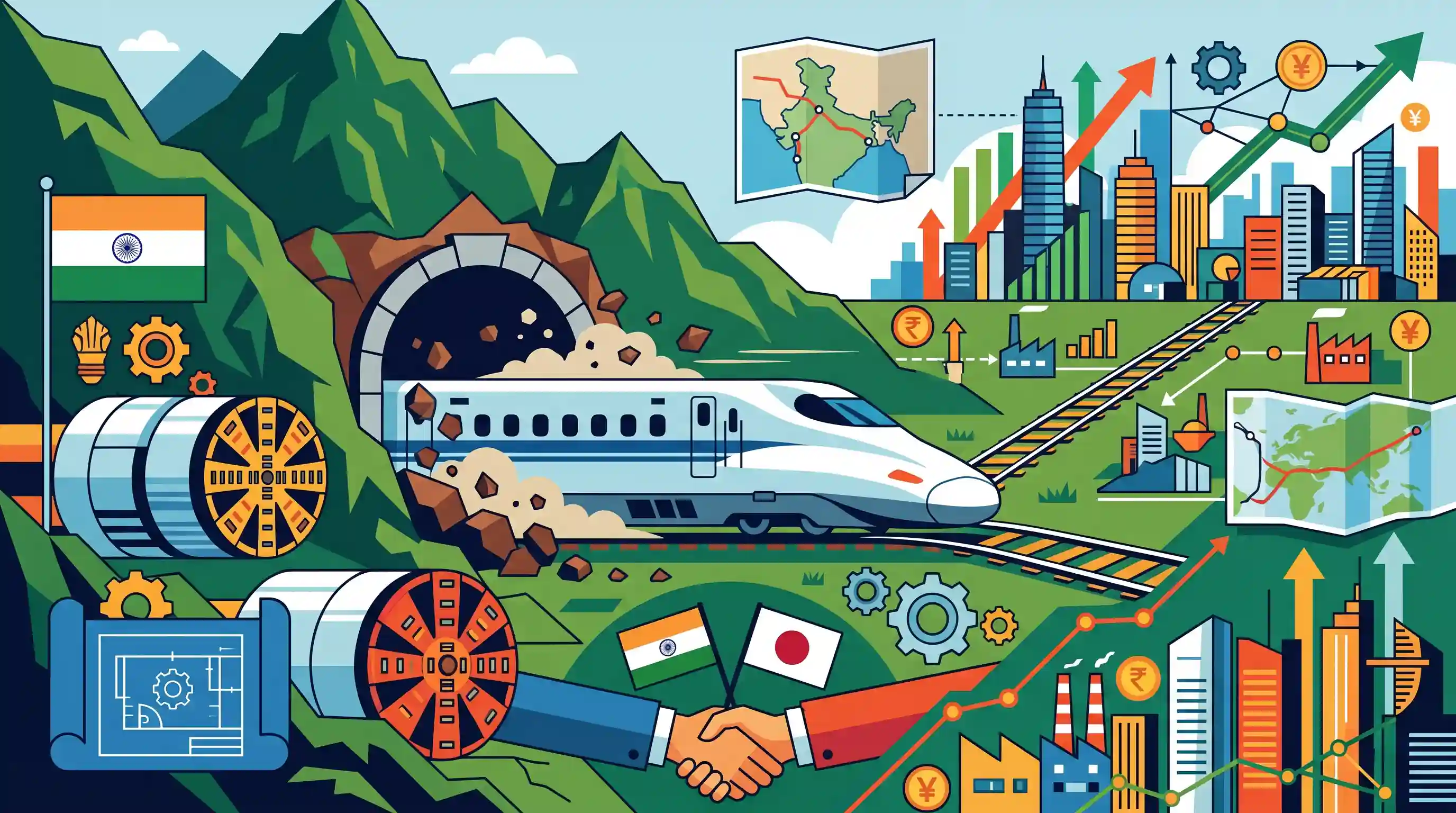
The Mumbai-Ahmedabad High-Speed Rail (MAHSR) project has reached a major milestone with the Indian Railways achieving a second mountain tunnel breakthrough in the Palghar district. Executed in the geographically challenging terrain of the Western Ghats, this engineering feat underscores India's advancing capabilities in large-scale infrastructure development. The bullet train project is a flagship initiative of India-Japan bilateral cooperation, supported by Japanese Shinkansen technology and JICA funding. Upon completion, it aims to transform inter-city mobility, catalyze regional economic growth, and lay the foundation for a wider high-speed rail network across the country.
Key Points
- The Indian Railways successfully achieved a second mountain tunnel breakthrough in Palghar for the Mumbai-Ahmedabad Bullet Train (MAHSR) Project.
- This engineering milestone demonstrates India's capability to execute complex tunneling and infrastructure projects in the challenging terrain of the Western Ghats.
- The MAHSR project is a cornerstone of India-Japan strategic partnership, utilizing Japanese Shinkansen technology and financial backing from JICA.
- The development of high-speed rail infrastructure is anticipated to drastically reduce travel time, boost regional economic integration, and serve as a blueprint for future mobility corridors in India.
Important Terms
Mumbai-Ahmedabad High Speed Rail (MAHSR) Project

India's first high-speed rail corridor (508 km) linking Mumbai and Ahmedabad. It utilizes Japanese Shinkansen technology to achieve speeds of 320 km/h, significantly reducing travel time between the two financial hubs.
UPSC context
GS III: Infrastructure (Railways). Tests understanding of flagship mega-projects, investment models, and regional economic integration.
National High Speed Rail Corporation Limited (NHSRCL)
A Special Purpose Vehicle (SPV) established in 2016 to finance, construct, and manage high-speed rail corridors in India. It is a joint venture between the Central Government and Maharashtra/Gujarat states.
UPSC context
GS II: Statutory and regulatory bodies; GS III: Infrastructure. Tests knowledge of institutional frameworks for large-scale infrastructure implementation.
Japan International Cooperation Agency (JICA)
Japan's governmental agency providing the majority of funding (via ODA loans) and technical expertise for the MAHSR project. It plays a critical role in India-Japan strategic and economic partnership.
UPSC context
GS II: India-Japan Bilateral Relations. Tests understanding of Official Development Assistance (ODA) and international cooperation in infrastructure.
Shinkansen Technology
Japan's world-renowned high-speed rail system characterized by high safety (zero passenger fatalities), punctuality, and advanced 'slab track' technology, which is being transferred to India for the MAHSR project.
UPSC context
GS III: Science and Technology. Tests awareness of technology transfer and indigenization under the 'Make in India' initiative.
New Austrian Tunnelling Method (NATM)
A modern tunneling technique used in the Western Ghats (Palghar) where rock mass acts as a load-bearing component. It involves real-time monitoring and flexible support like shotcrete and rock bolts.
UPSC context
GS III: Infrastructure/Environment. Relevant for questions on engineering challenges in ecologically sensitive zones like the Western Ghats.
Prelims Trap
The Mumbai-Ahmedabad High-Speed Rail is funded through a financial grant from the Japanese government.
MAHSR is financed via an Official Development Assistance (ODA) loan from Japan, not a free grant. It carries a nominal interest rate and must be repaid.
Static Concepts Connected
What is Official Development Assistance (ODA)?
- Definition: Government aid provided by advanced economies designed specifically to promote the economic development and welfare of developing nations.
- Concessional terms: ODA involves either outright grants or "soft loans" with highly concessional interest rates and longer grace periods compared to commercial market borrowing.
- JICA's role: The Japan International Cooperation Agency (JICA) is India's largest bilateral ODA partner, financing massive projects like metros, freight corridors, and the MAHSR.
What characterizes the geography of the Northern Western Ghats (Sahyadris)?
- Geological makeup: Composed primarily of basaltic lava flows from the Deccan Traps, creating a rugged, step-like topography that complicates sub-surface tunneling.
- Landslide vulnerability: Highly vulnerable to landslides during intense South-West monsoon rainfall, requiring advanced slope-stabilization for major engineering works.
- Major passes: Historical and modern connectivity relies heavily on natural gaps like the Thal Ghat (Mumbai-Nashik) and Bhor Ghat (Mumbai-Pune).
Cross-Topic Patterns
Infra projects in eco-sensitive zones
The Palghar tunnel highlights the continuous friction between executing mega-infrastructure and enforcing ecological conservation in the Western Ghats, directly recalling the Gadgil and Kasturirangan committee frameworks.
Tech-transfer & tropical adaptation
Importing Japanese Shinkansen technology demands extensive 'tropicalization', adapting zero-fatality high-speed rail systems to withstand India's 50°C heat, dust, and heavy monsoon humidity.

JICA's ODA loans for Indian mega-infra paired with Japanese tech-transfers (Shinkansen) is ripe for a multi-statement prelims question.
Linked PYQs · 4
Linked PYQs · 4
- 2021MainsGS3
“Investment in infrastructure is essential for more rapid and inclusive economic growth.” Discuss in the light of India's experience.
- 2022MainsGS3
Why is Public Private Partnership (PPP) required in infrastructural projects ? Examine the role of PPP model in the redevelopment of Railway Stations in India.
- 2019MainsGS2
‘The time has come for India and Japan to build a strong contemporary relationship, one involving global and strategic partnership that will have a great significance for Asia and the world as a whole.’ Comment.
- 2021MainsGS1
Differentiate the causes of landslides in the Himalayan region and Western Ghats.
