Mumbai Ahmedabad Bullet Train Project Advances to Electrification
Source:Indian Express ↗
Why It Matters
The Mumbai-Ahmedabad High-Speed Rail is a landmark mega-project that tests India's capacity for advanced technology absorption, large-scale infrastructure execution, and leveraging foreign ODA (from Japan). It is a vital example for GS-3 Infrastructure and GS-2 Bilateral Relations.
Summary
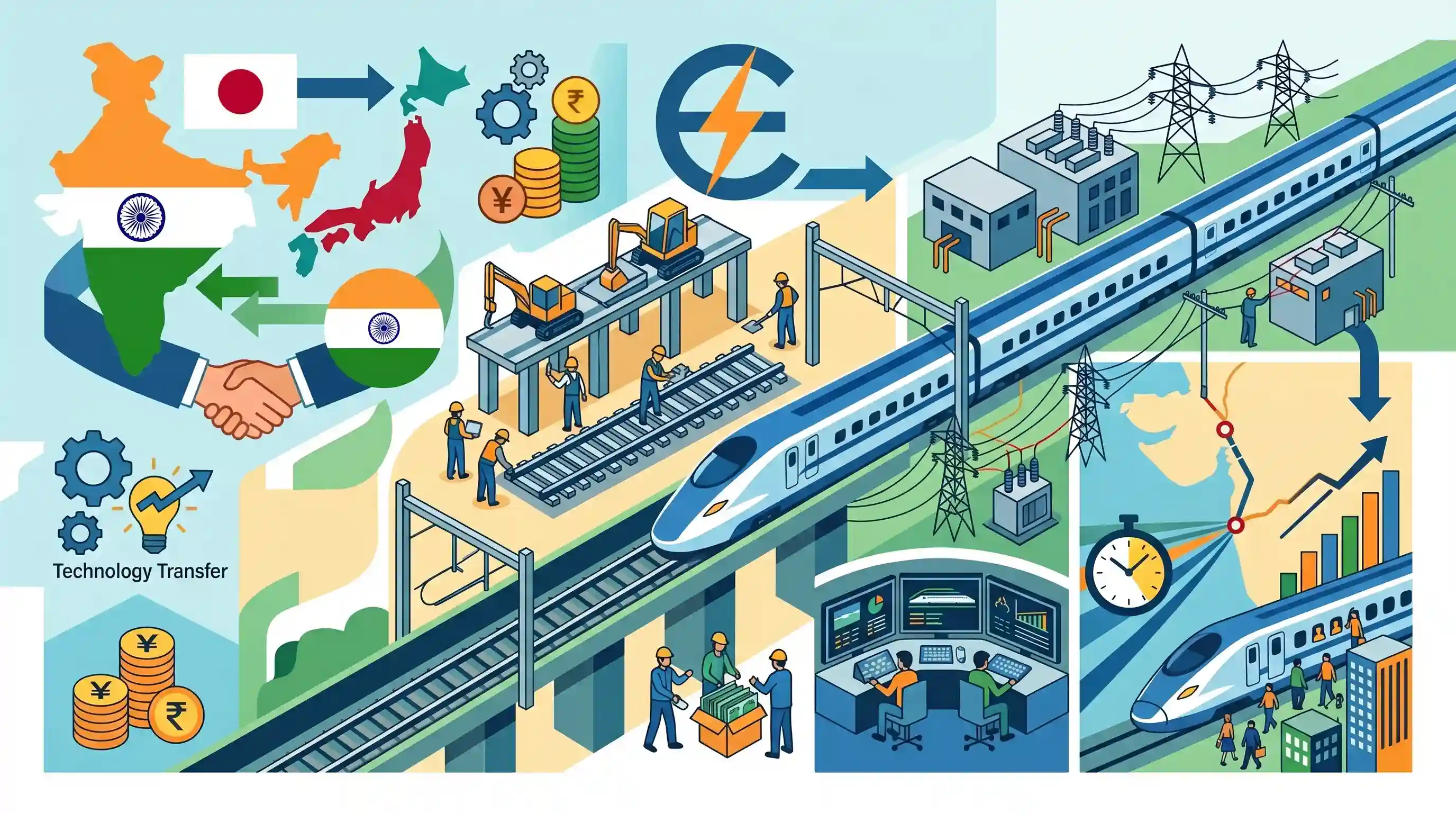
The Mumbai-Ahmedabad High-Speed Rail (MAHSR) project, India's inaugural bullet train initiative, has reached a significant milestone by progressing to the electrification stage. Executed by the National High Speed Rail Corporation Limited (NHSRCL) and backed by an ODA loan from the Japan International Cooperation Agency (JICA), the project employs advanced Japanese Shinkansen technology. The installation of a specialized traction power supply system underscores India's push towards modernizing its transport infrastructure. The project is expected to enhance regional connectivity, drive economic growth, and demonstrate successful technology transfer through robust India-Japan bilateral ties.
Key Points
- India's first high-speed rail project, the Mumbai-Ahmedabad bullet train, has entered a crucial phase by advancing towards electrification and traction power supply system installation.
- The project utilizes Japan's renowned Shinkansen technology, which involves specialized Over Head Equipment (OHE) capable of sustaining high-speed operations safely.
- It is being executed by the National High Speed Rail Corporation Limited (NHSRCL) and financially supported by an Official Development Assistance (ODA) loan from the Japan International Cooperation Agency (JICA).
- This milestone reflects steady progress in India's infrastructure modernization, promising reduced travel times, technology transfer, and deeper India-Japan strategic partnership.
Important Terms
Mumbai-Ahmedabad High Speed Rail (MAHSR) project

India's first bullet train project, a 508-km corridor connecting Mumbai and Ahmedabad. It uses Japanese technology to achieve speeds of 320 km/h, aiming to revolutionize regional connectivity and economic integration.
UPSC context
GS Paper III: Infrastructure (Railways). Relates to modernization of transport, regional development, and the implementation of mega-projects.
National High Speed Rail Corporation Limited (NHSRCL)
A Special Purpose Vehicle (SPV) formed in 2016 to implement high-speed rail projects in India. It involves equity participation from the Central Government and the states of Gujarat and Maharashtra.
UPSC context
GS Paper II: Statutory and Quasi-judicial bodies. Important for understanding institutional frameworks and SPVs in infrastructure governance.
Japan International Cooperation Agency (JICA)
Japan's government agency responsible for international cooperation. It is the primary financier of the MAHSR project, providing low-interest loans covering over 80% of the total cost.
UPSC context
GS Paper II: Bilateral Relations (India-Japan). Illustrates Japan's role as a critical strategic and developmental partner for India.
Shinkansen Technology
Japan’s world-renowned high-speed rail technology, characterized by extreme punctuality, aerodynamic design, and a record of zero passenger fatalities due to accidents since its 1964 inception.
UPSC context
GS Paper III: Science & Technology. Focuses on technology transfer and adopting global safety standards in Indian infrastructure.
Technology Transfer
The process of sharing technical knowledge and manufacturing expertise. In MAHSR, it involves training Indian engineers and localizing parts of the Shinkansen manufacturing process to support "Make in India."
UPSC context
GS Paper III: Indigenization of Technology. Tests the strategy of using foreign partnerships to build domestic industrial capacity.
Official Development Assistance (ODA)
Financial aid provided by donor governments to promote economic development. The MAHSR project is funded via a highly concessional JICA ODA loan with a 50-year repayment period.
UPSC context
GS Paper III: Indian Economy (Investment Models). Pertains to external financing, debt sustainability, and international aid mechanisms.
Prelims Trap
The MAHSR project is fully funded by the Central Government and executed directly by Indian Railways.
False. It is executed by NHSRCL, an SPV with equity from the Centre, Gujarat, and Maharashtra. Moreover, 81% of funding comes from a JICA ODA loan.
Static Concepts Connected
What defines Official Development Assistance (ODA) in international finance?
- Definition: Concessional financing provided by official agencies to developing countries, primarily aimed at promoting economic development and welfare.
- Grant element: To qualify as ODA, loans must have a concessional character, historically requiring a minimum grant element of at least 25%.
- JICA in India: Japan provides ODA to India via JICA, offering highly concessional terms like the 0.1% interest rate over 50 years for MAHSR.
How does a Special Purpose Vehicle (SPV) function in mega infrastructure projects?
- Entity status: A separate legal entity created to fulfill a narrow, specific objective, such as executing a single mega-project (e.g., NHSRCL for the bullet train).
- Risk isolation: It isolates financial and operational risk, ensuring that project complications do not directly impact the balance sheets of the parent organizations.
- Resource pooling: SPVs allow joint equity participation and risk-sharing among multiple stakeholders, such as the Centre and involved State governments.
Cross-Topic Patterns
Infrastructure SPVs + Cooperative Federalism
NHSRCL involves equity from both the Centre and states (Gujarat, Maharashtra). This mirrors models like GSTN and Metro Rail Corporations where federal financial cooperation is operationalized.
Japan ODA + Strategic Connectivity
JICA's soft loans fund not just MAHSR, but the Western Dedicated Freight Corridor and strategic Northeast connectivity, acting as the economic anchor of the India-Japan Special Strategic Partnership.

Expect a multi-statement question combining NHSRCL's SPV structure (Centre + States) and the specifics of JICA's ODA loan terms.
Linked PYQs · 3
Linked PYQs · 3
- 2021MainsGS3
“Investment in infrastructure is essential for more rapid and inclusive economic growth.” Discuss in the light of India's experience.
- 2019MainsGS2
‘The time has come for India and Japan to build a strong contemporary relationship, one involving global and strategic partnership that will have a great significance for Asia and the world as a whole.’ Comment.
- 2025PrelimsGS1
Consider the following statements : I. Indian Railways have prepared a National Rail Plan (NRP) to create a 'future ready' railway system by 2028. II. 'Kavach' is an Automatic Train Protection system developed in collaboration with Germany. III. 'Kavach' system consists of RFID tags fitted on track in station section. Which of the statements given above are not correct?
