Mumbai Ahmedabad High Speed Rail Corridor Launch Approaching
Source:Indian Express ↗
Why It Matters
The project represents a technological leap for Indian Railways, highlighting the transition towards high-speed transport infrastructure. It serves as a prominent case study for India-Japan strategic partnership and foreign infrastructure funding.
Summary
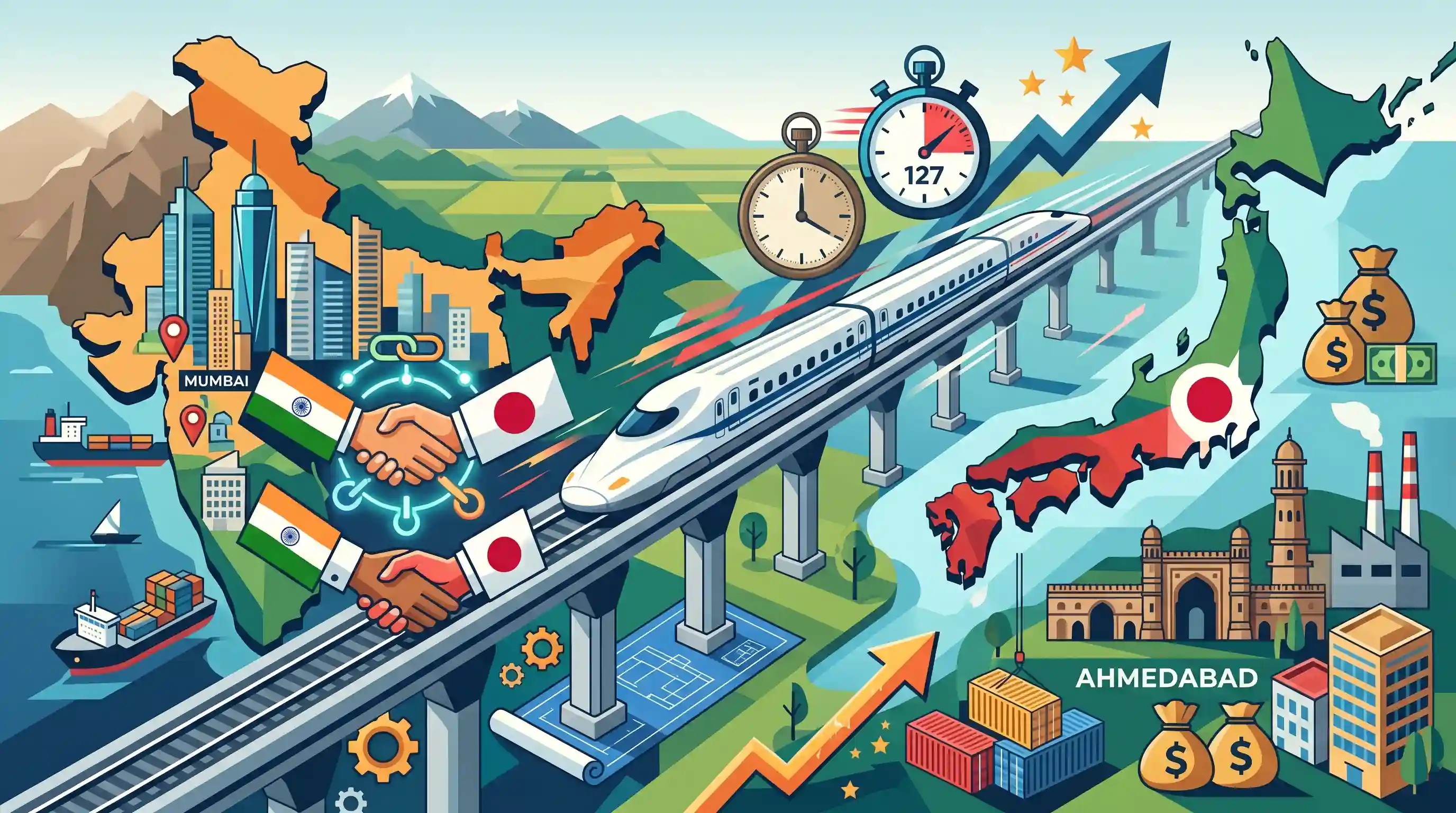
Union Railway Minister Ashwini Vaishnaw has announced that India's inaugural bullet train service between Mumbai and Ahmedabad is nearing launch. Built with Japanese Shinkansen technology and funding assistance from JICA, the high-speed rail corridor will shrink the travel time between the two commercial hubs to just 127 minutes, marking a major milestone in India's infrastructure development.
Key Points
- India's first bullet train service, operating on the Mumbai-Ahmedabad High-Speed Rail (MAHSR) corridor, is set to begin operations soon.
- The high-speed train will cover the 508-km distance between Mumbai and Ahmedabad in just 127 minutes, drastically reducing current travel times.
- The project utilizes Japanese Shinkansen technology and is largely funded through an Official Development Assistance (ODA) loan from the Japan International Cooperation Agency (JICA).
- The corridor aims to transform regional connectivity, creating an integrated economic zone between Maharashtra and Gujarat while modernizing India's railway infrastructure.
Important Terms
Mumbai-Ahmedabad High-Speed Rail Corridor (MAHSR)

India's first high-speed rail project spanning 508 km, designed to connect Mumbai and Ahmedabad at speeds of 320 km/h using Japanese Shinkansen technology.
UPSC context
GS Paper III (Infrastructure). Tests knowledge of mega-projects, regional economic integration, and transport modernization.
National High-Speed Rail Corporation Limited (NHSRCL)
A Special Purpose Vehicle (SPV) formed in 2016 to finance, construct, and manage India’s high-speed rail corridors, involving equity from the Centre and State governments.
UPSC context
GS Paper III (Investment Models). Crucial for understanding the institutional framework and governance of large-scale public infrastructure.
Japan International Cooperation Agency (JICA)
A Japanese governmental agency providing technical and financial assistance through low-interest ODA loans, covering approximately 81% of the MAHSR project's cost.
UPSC context
GS Paper II (International Relations). Highlights India-Japan strategic partnership and the role of foreign aid in domestic development.
Shinkansen Technology
Japan's high-speed rail system renowned for its safety record, punctuality, and aerodynamic efficiency; it uses specialized slab track systems instead of traditional ballast.
UPSC context
GS Paper III (Science & Technology). Relates to technology transfer, Indigenization, and safety standards in advanced transport.
Special Purpose Vehicle (SPV)
A separate legal entity created to fulfill a specific, time-bound project objective while isolating financial risk from the parent organization or government.
UPSC context
GS Paper III (Economy). Frequently tested regarding infrastructure financing, Public-Private Partnerships (PPP), and project management.
Prelims Trap
NHSRCL is a wholly-owned Central Public Sector Enterprise under the Ministry of Railways.
NHSRCL is not wholly central; it is a joint-sector Special Purpose Vehicle (SPV) with equity participation from the Ministry of Railways and the states of Gujarat and Maharashtra.
Static Concepts Connected
What are the core principles of Transit-Oriented Development (TOD)?
- High Density: Concentrating residential and commercial infrastructure within a 500-800 meter walking distance of mass transit hubs.
- Mixed-Use Zoning: Blending residential, commercial, and recreational spaces to minimize commute needs and create integrated economic zones.
- Pedestrian Focus: Designing streets primarily for non-motorized transport (NMT) and pedestrians, significantly reducing private vehicle dependency.
How does Official Development Assistance (ODA) function in India's context?
- Definition: Concessional bilateral or multilateral loans and grants designed specifically to promote the economic development and welfare of developing nations.
- Key Provider: Japan (via JICA) is India's largest bilateral donor, providing highly concessional long-term loans (e.g., 0.1% interest, 50-year tenure for MAHSR).
- Tied Assistance: Bilateral ODA is sometimes "tied," meaning the recipient must source specific technology or equipment from the donor country (e.g., Shinkansen).
Cross-Topic Patterns
High-Speed Rail + Climate Goals (Net Zero)
The shift to electrified mass transit connects directly to India's NDC targets and National Rail Plan 2030, which aims to make Indian Railways a "Net Zero Carbon Emitter" by 2030.
ODA Tech Transfer vs. Domestic R&D
While India secures cheap capital (JICA ODA) and proven tech (Shinkansen), evaluating indigenous capacity building and technology transfer makes for a strong GS-3 contrast with indigenous programs like Vande Bharat.

Expect a multi-statement question combining NHSRCL's joint SPV structure, JICA ODA terms, and TOD's role in the National Rail Plan 2030.
Linked PYQs · 3
Linked PYQs · 3
- 2021MainsGS3
“Investment in infrastructure is essential for more rapid and inclusive economic growth.” Discuss in the light of India's experience.
- 2022MainsGS3
Why is Public Private Partnership (PPP) required in infrastructural projects ? Examine the role of PPP model in the redevelopment of Railway Stations in India.
- 2019MainsGS2
‘The time has come for India and Japan to build a strong contemporary relationship, one involving global and strategic partnership that will have a great significance for Asia and the world as a whole.’ Comment.
