Bullet Train Project to Launch with Indigenous B28 Trainsets
Source:Indian Express ↗
આ શા માટે મહત્વનું છે
The MAHSR project illustrates India's focus on modernizing transport infrastructure through international partnerships (Japan) while simultaneously promoting domestic manufacturing ('Make in India' via BEML's B28 train). This dual approach balances immediate technological needs with long-term self-reliance.
સારાંશ
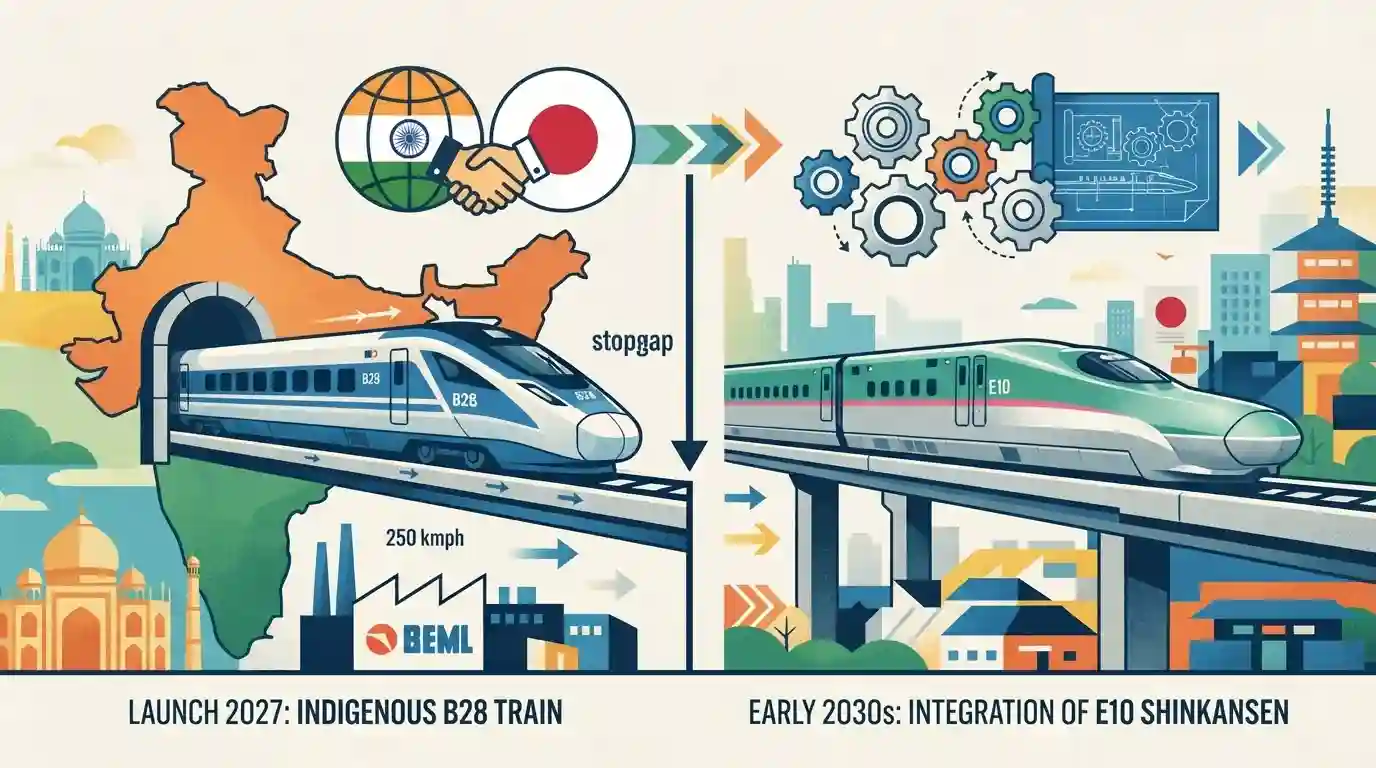
India's first high-speed rail corridor between Mumbai and Ahmedabad will launch operations in 2027 using the indigenously built 'B28' bullet train, manufactured by BEML. While the project is a collaborative effort with Japan, the integration of Japanese next-generation E10 Shinkansen trains is scheduled for the early 2030s, as they remain under development. The indigenous B28 trainsets will run at an operational speed of 250 kmph, serving as a stopgap and highlighting India's growing capabilities in manufacturing advanced railway infrastructure.
મુખ્ય મુદ્દા
- The first section of the 508-km-long Mumbai-Ahmedabad High Speed Rail (MAHSR) corridor is expected to open in 2027.
- Operations will initially commence with the 'B28' (Bharat-made) bullet train, an indigenously developed high-speed train manufactured by BEML.
- The B28 train is expected to be ready by March 2027, boasting a design speed of 280 kmph and an operational speed of 250 kmph.
- Japan will introduce its next-generation E10 series Shinkansen trains to the corridor in the early 2030s, as the model is currently under development.
- The decision highlights India's push for indigenisation in railway technology while maintaining close infrastructure cooperation with Japan.
મહત્વપૂર્ણ શબ્દો
Mumbai-Ahmedabad High Speed Rail (MAHSR)

India's first under-construction high-speed rail corridor connecting Mumbai and Ahmedabad, spanning 508 km. It utilizes Japanese Shinkansen technology with financial assistance from the Japan International Cooperation Agency (JICA).
UPSC context
GS3: Infrastructure (Railways). Tests knowledge of mega-infrastructure projects, bilateral technological collaborations, and challenges in execution.
National High Speed Rail Corporation Limited (NHSRCL)
A Special Purpose Vehicle incorporated in 2016 under the Ministry of Railways, with equity participation from the Central Government, Gujarat, and Maharashtra, to finance, construct, and manage high-speed rail corridors.
UPSC context
GS3: Infrastructure and SPVs. Tests understanding of public sector organizations and institutional mechanisms for executing massive public works.
BEML Limited
A Schedule 'A' Miniratna public sector undertaking under the Ministry of Defence that manufactures heavy equipment for mining, construction, defence, and railway sectors, including India's first indigenously designed high-speed train, B28.
UPSC context
GS3: Indigenization of Technology. Tests understanding of domestic manufacturing capability and public sector contributions to infrastructure.
Make in India
A flagship national program launched in 2014 to transform India into a global design and manufacturing hub, targeting 25% of GDP from manufacturing and fostering domestic technology indigenization.
UPSC context
GS3: Indian Economy and Industrial Policy. Tests knowledge of manufacturing reforms, employment generation, and technological self-reliance.
Ministry of External Affairs (MEA)
The Indian government ministry responsible for conducting foreign relations, representing the country in global forums, and managing bilateral cooperation, including diplomatic aspects of international infrastructure partnerships.
UPSC context
GS2: Bilateral Relations. Tests understanding of diplomatic negotiations, bilateral commitments, and handling international aspects of domestic mega-projects.
પ્રિલિમ્સ ટ્રેપ
The Mumbai-Ahmedabad High-Speed Rail corridor is designed to run seamlessly on the existing Indian Railways Broad Gauge network.
UPSC may state that the high-speed rail corridor will run on existing Broad Gauge tracks to ensure connectivity with conventional trains. In reality, it uses dedicated Standard Gauge (1,435 mm) tracks, making it physically isolated.
સંલગ્ન સ્થિર ખ્યાલો
What are the primary railway track gauges used in India and their specifications?
- Broad Gauge (BG): Measures 1,676 mm (5 ft 6 in) and constitutes over 95% of the total Indian Railways network route length.
- Standard Gauge (SG): Measures 1,435 mm (4 ft 8.5 in); standard globally for high-speed rail and widely used in Indian urban metro systems.
- Metre & Narrow Gauge: Include Metre Gauge (1,000 mm) and Narrow Gauge (762 mm / 610 mm), now mostly confined to UNESCO heritage hilly routes.
How does Official Development Assistance (ODA) function under JICA?
- Core Definition: Resource flows to developing countries provided by official agencies to promote economic development, carrying concessional financial terms.
- Concessionality: Features highly concessional terms like 0.1% interest rates, 50-year repayment tenures, and 15-year grace periods for major transit projects.
- Procurement Terms: Can be 'tied' (requiring procurement from donor country) or 'untied', with JICA progressively utilizing more untied models to promote local competitive bidding.
આંતર-વિષય પેટર્ન
Infrastructure + Bilateral Diplomacy (India-Japan)
Concessional funding from JICA for MAHSR and Northeast road networks cements infrastructure as the cornerstone of the India-Japan Special Strategic and Global Partnership.
Indigenisation + Defence PSU Diversification
BEML (a Defence PSU) developing the civilian B28 train showcases how defense and heavy-engineering capabilities are leveraged for high-tech rail indigenisation.

UPSC 2026 may test technical details of high-speed rail, such as standard gauge adoption, alongside JICA's concessional ODA loan terms.
સંલગ્ન PYQ · 3
સંલગ્ન PYQ · 3
- 2019MainsGS2
‘The time has come for India and Japan to build a strong contemporary relationship, one involving global and strategic partnership that will have a great significance for Asia and the world as a whole.’ Comment.
- 2021MainsGS3
“Investment in infrastructure is essential for more rapid and inclusive economic growth.” Discuss in the light of India's experience.
- 2025PrelimsGS1
Consider the following statements : I. Indian Railways have prepared a National Rail Plan (NRP) to create a 'future ready' railway system by 2028. II. 'Kavach' is an Automatic Train Protection system developed in collaboration with Germany. III. 'Kavach' system consists of RFID tags fitted on track in station section. Which of the statements given above are not correct?
