Bullet Train Fares to Rival Rail and Air Travel Costs
Source:Indian Express ↗
Why It Matters
The bullet train project is a flagship infrastructure initiative. Understanding its pricing and economic viability is crucial for evaluating large-scale public transportation investments and their potential to drive economic integration between urban centers.
Summary
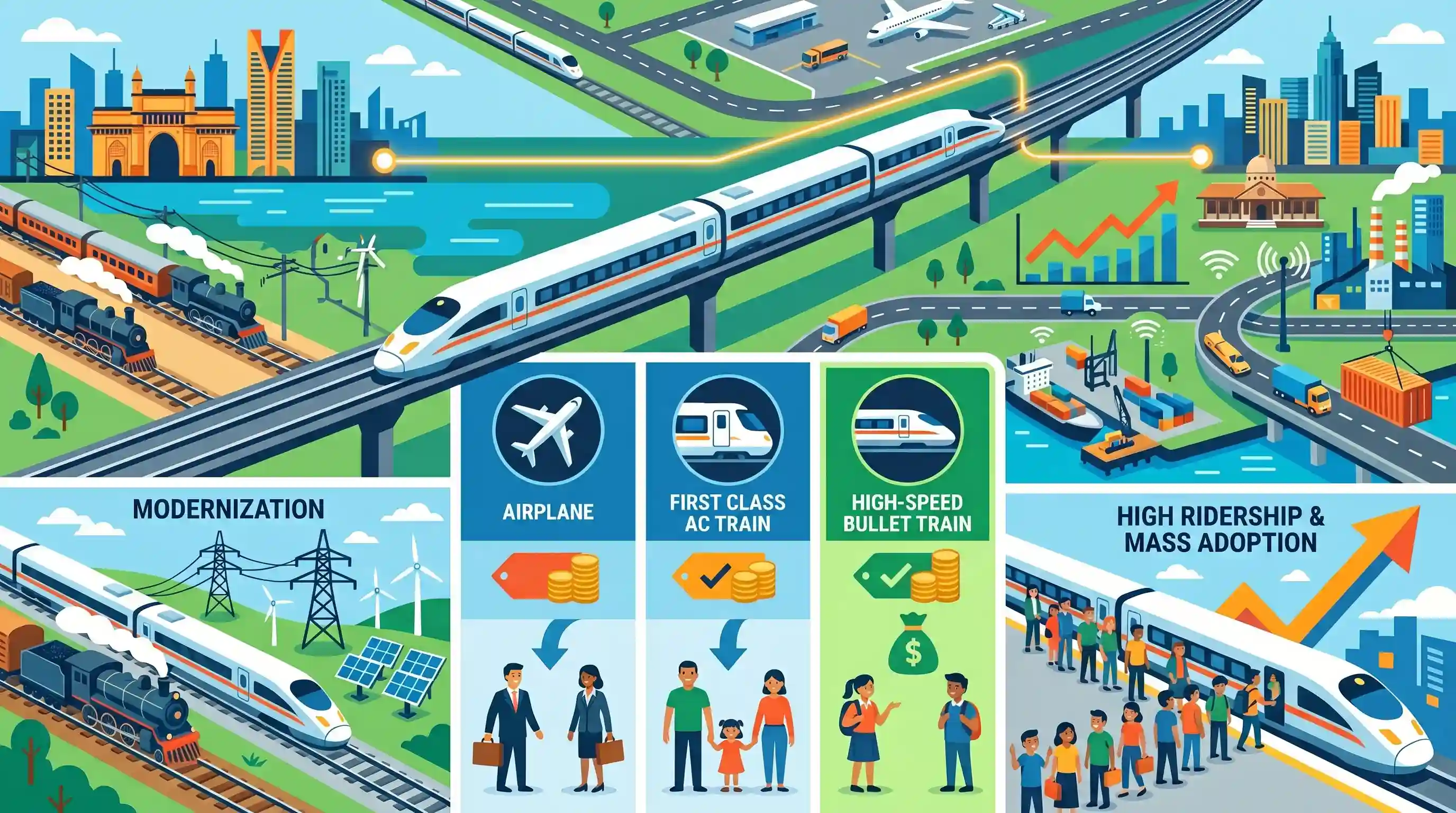
Union Railway Minister Ashwini Vaishnaw has stated that passenger fares for the upcoming Mumbai-Ahmedabad High-Speed Rail (MAHSR) bullet train will be kept competitive with existing first-class AC train and airline fares. This pricing strategy is intended to ensure high ridership by making the high-speed transit system an attractive and economically viable alternative for travelers between the two major economic hubs. The project underscores a major leap in India's transport infrastructure modernization, balancing high capital investment with market-competitive pricing to promote mass adoption.
Key Points
- Fares for the Mumbai-Ahmedabad bullet train will be structured to be competitive with current airfares and first-class AC train tickets.
- The pricing strategy aims to make high-speed rail an attractive and viable alternative for inter-city commuters.
- The MAHSR project represents a significant technological and infrastructure upgrade for India's transportation sector.
Important Terms
Mumbai-Ahmedabad High-Speed Rail (MAHSR)

India’s first high-speed rail corridor (508 km) connecting Mumbai and Ahmedabad. It utilizes Japanese technology to achieve operational speeds of 320 km/h, reducing travel time to approximately 2-3 hours.
UPSC context
GS-3 (Infrastructure: Railways). Tests knowledge of major connectivity projects and the modernization of India's transport network.
National High Speed Rail Corporation Limited (NHSRCL)
A Special Purpose Vehicle incorporated in 2016 to finance, construct, and manage high-speed rail corridors. It is a joint venture between the Central Government and Gujarat/Maharashtra states.
UPSC context
GS-3 (Infrastructure/Governance). Relevant for understanding specialized implementation agencies and joint-sector equity models for mega-projects.
Shinkansen Technology
The Japanese high-speed rail system renowned for its 'slab track' (ballastless) design, aerodynamic trains, and a zero-fatality safety record since 1964. It forms the technical basis for India's bullet train.
UPSC context
GS-3 (Science & Tech/Infrastructure). Important for international technology transfer and the engineering adaptations required for Indian climatic conditions.
Special Purpose Vehicle (SPV)
A legal entity created for a specific, narrow objective—like implementing the bullet train project—to isolate financial risks from the parent organization and streamline project execution.
UPSC context
GS-3 (Economy/Infrastructure). Focuses on modern project management and financing structures used in large-scale public initiatives.
Transit-Oriented Development (TOD)
An urban planning strategy creating high-density, mixed-use areas around transit stations to maximize public transport access and stimulate local economic growth through projects like 'Project-SMART.'
UPSC context
GS-1 (Urbanization) and GS-3 (Infrastructure). Crucial for analyzing integrated urban development and station-area economic planning.
Japan International Cooperation Agency (JICA)
The primary Japanese governmental agency providing concessional Official Development Assistance (ODA) loans and technical expertise for the MAHSR project, covering approximately 81% of total project costs.
UPSC context
GS-2 (International Relations). Essential for analyzing the India-Japan strategic partnership and the role of foreign funding.
Prelims Trap
"The National High Speed Rail Corporation Limited (NHSRCL) is a wholly-owned Central Public Sector Enterprise."
NHSRCL is not wholly owned by the Centre. It is a Special Purpose Vehicle (SPV) with equity participation from the Ministry of Railways and the states of Gujarat and Maharashtra.
Static Concepts Connected
What defines Official Development Assistance (ODA) in infrastructure funding?
- Primary Objective: Must be provided by official agencies specifically to promote the economic development and welfare of developing nations.
- Concessional Nature: Must include a grant element of at least 25%, featuring significantly lower interest rates and longer grace periods than commercial loans.
What is Transit-Oriented Development (TOD) in urban planning?
- Compact Communities: Creating high-density, walkable, and mixed-use urban spaces centered around major transit nodes to reduce urban sprawl.
- Multi-Modal Integration: Designing stations as multi-modal hubs that seamlessly connect high-speed rail with local urban transport systems like metros and buses.
Cross-Topic Patterns
JICA ODA + Tech Transfer models
MAHSR mirrors the early Delhi Metro model by combining Japan's highly concessional ODA financing with vital technology transfer, such as the Shinkansen system and J-Slab ballastless tracks.
SPVs and Cooperative Federalism
The NHSRCL model highlights cooperative federalism in mega-infrastructure, splitting equity among the Ministry of Railways, Gujarat, and Maharashtra to share financial risk and streamline land acquisition.

Expect a Prelims question pairing NHSRCL's Centre-State SPV structure with the concessional criteria of Official Development Assistance.
Linked PYQs · 2
Linked PYQs · 2
- 2022MainsGS3
Why is Public Private Partnership (PPP) required in infrastructural projects ? Examine the role of PPP model in the redevelopment of Railway Stations in India.
- 2021MainsGS3
“Investment in infrastructure is essential for more rapid and inclusive economic growth.” Discuss in the light of India's experience.
