Mumbai Ahmedabad Bullet Train project reaches key milestone
Source:we-news ↗
Why It Matters
The introduction of high-speed rail technology represents a major leap in India's transport infrastructure, directly impacting regional economic integration, logistics efficiency, and urban planning.
Summary
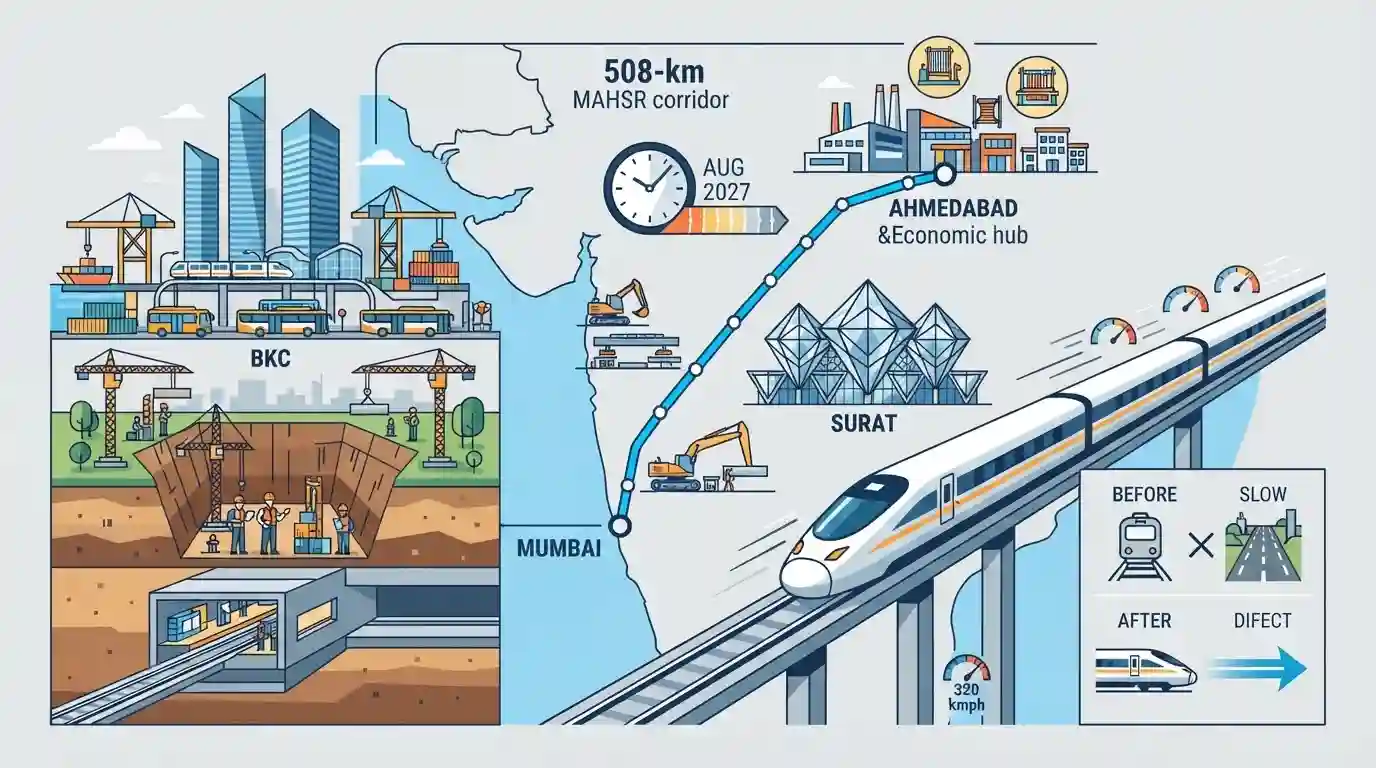
The Mumbai-Ahmedabad High-Speed Rail (MAHSR) corridor is making significant progress, with phased operations targeted to begin by August 2027. Major infrastructural milestones include near-complete excavation at the underground Bandra Kurla Complex (BKC) station in Mumbai and the completion of the structural framework for Surat's diamond-themed station. The 508-km corridor, featuring 12 stations and trains operating at speeds up to 320 kmph, is expected to transform regional connectivity, providing stakeholders in Ahmedabad and other Gujarat hubs rapid access to Mumbai's financial and port networks.
Key Points
- The Mumbai-Ahmedabad High-Speed Rail (MAHSR) corridor aims for a phased operational launch by August 2027.
- The Bandra Kurla Complex (BKC) station in Mumbai is situated nearly 30 metres underground, with excavation work currently nearing completion.
- Surat's bullet train station has completed its structural framework and roofing, featuring architecture inspired by the local diamond industry.
- Operating at a top speed of 320 kmph, the 508-km corridor will drastically reduce travel time and improve access between Gujarat's industrial hubs and Mumbai's financial markets.
Prelims Trap
The Mumbai-Ahmedabad High-Speed Rail runs exclusively through the states of Maharashtra and Gujarat.
Aspirants often miss the UT. The 508-km corridor spans Maharashtra, Gujarat, AND the Union Territory of Dadra and Nagar Haveli.
Static Concepts Connected
What are the key technical and financial frameworks of the MAHSR project?
- Shinkansen Technology: Utilizes Japan's E5 Shinkansen system, known for its zero-fatality record and operational speeds of up to 320 kmph.
- Implementation Agency: Executed by National High-Speed Rail Corporation Limited (NHSRCL), a joint venture between the Central Government and participating states.
- JICA Funding: Heavily financed via Official Development Assistance (ODA) loans from the Japan International Cooperation Agency (JICA) at highly concessional rates.
How does the bullet train corridor map onto India's regional economic geography?
- Industrial Corridor Integration: It mirrors the alignment of the Western Dedicated Freight Corridor and the Delhi-Mumbai Industrial Corridor (DMIC).
- Urban Agglomeration: It compresses travel time between the Mumbai Metropolitan Region and Gujarat's Golden Corridor (Vapi-Surat-Vadodara-Ahmedabad), forming a mega economic agglomeration.
Cross-Topic Patterns
Infrastructure + India-Japan Bilateral Ties
MAHSR frequently appears alongside other JICA-funded projects (like Western DFC) as the cornerstone of the India-Japan Special Strategic and Global Partnership.
Economic Geography + Local Urban Branding
Surat's diamond-themed station reflects a push for localized aesthetic integration in infrastructure, directly linking to Gujarat's gem industry dominance and the Surat Diamond Bourse.

Expect a multi-statement question combining MAHSR's exact routing (don't forget the UT), JICA ODA funding, and Shinkansen technology.
Linked PYQs · 3
Linked PYQs · 3
- 2025GPSC_PRELIMSGS1
According to the Socio-Economic Review, 2024-2025 of Gujarat, Gujarat comes in ______ category in Logistic Ease Across Different States (LEADS), 2024.
- 2024GPSC_PRELIMSGS1
A goods train leaves a station at a certain time and at a fixed speed. After 6 hours, an express train leaves the same station and moves in the same direction as the goods train, at a uniform speed of 90 kmph. This train crosses the goods train in 4 hours. What is the speed of the goods train?
- 2026GPSC_PRELIMSGS1
Consider the following statements regarding India's inland water transport infrastructure: 1. National Waterway 1 (NW-1) is the longest navigable inland waterway in the country, extending from Prayagraj to Haldia along the Ganga-Bhagirathi-Hooghly river system. 2. The Jal Marg Vikas Project (JMVP), implemented with technical and financial assistance from the World Bank, is primarily focused on capacity augmentation of the Brahmaputra River (NW-2). 3. The West Coast Canal (NW-3) maintains a highly consistent navigable draft year-round, facilitated by the natural topography of estuarine backwaters (Koyals) in Kerala. Which of the above statement/s is/are correct?
