Mumbai plans lake overflow recycling to boost water supply
Source:Indian Express ↗
Why It Matters
This development serves as a prime case study for Mains GS1 and GS3 answers regarding sustainable urban water management, rainwater harvesting, and integrated flood mitigation strategies in major Indian metropolitan cities facing acute water and climate stresses.
Summary
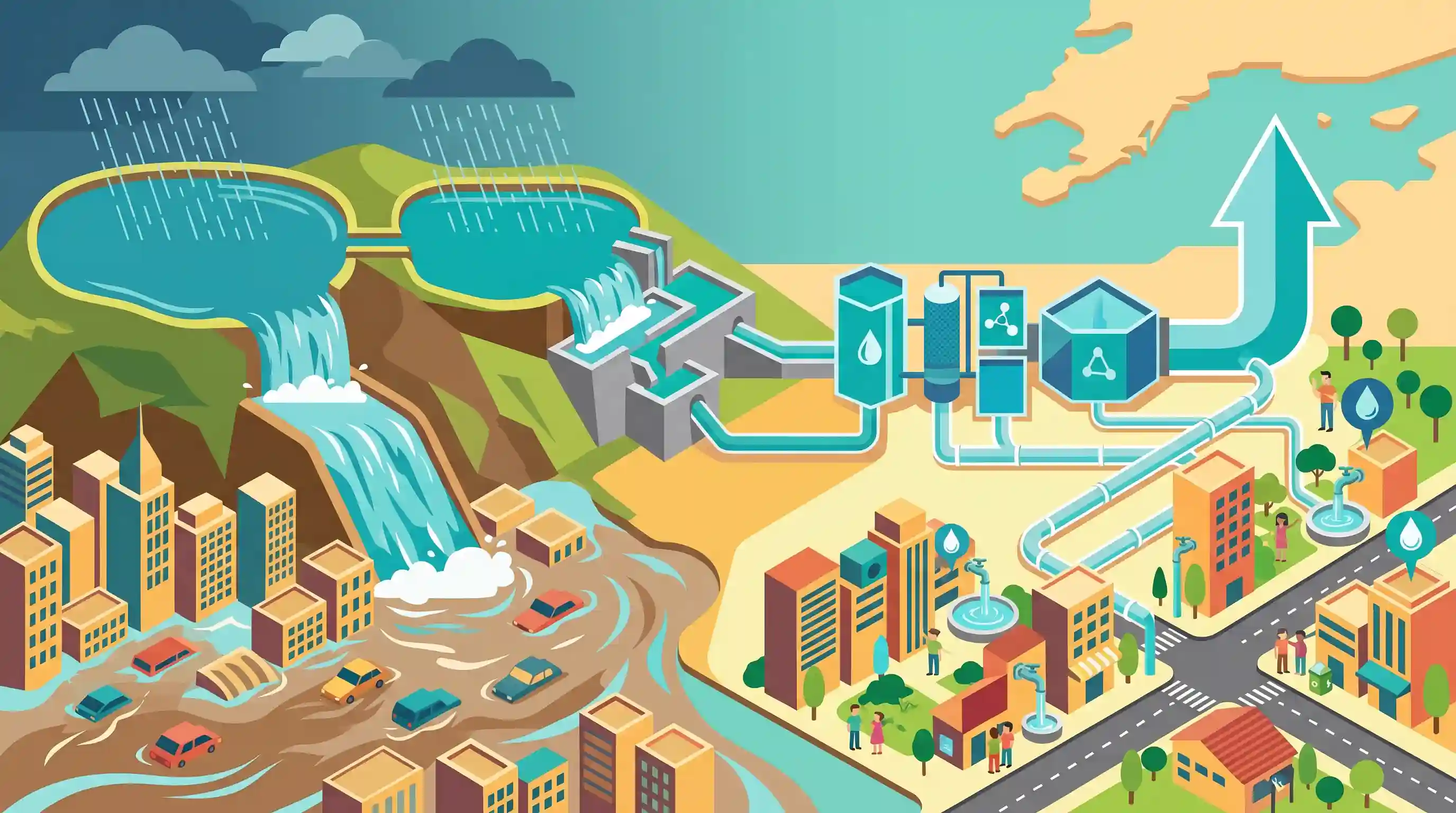
The Brihanmumbai Municipal Corporation (BMC) is initiating a project to recycle overflowing water from Tulsi and Vihar lakes to generate an additional 7,200 million litres per day (MLD) of water for Mumbai. This dual-purpose strategy aims to augment the city's drinking water supply while mitigating urban flooding caused by monsoon overflows, offering a sustainable model for urban water management.
Key Points
- Mumbai plans to generate an additional 7,200 MLD of water by recycling the seasonal overflow from the Tulsi and Vihar lakes.
- Both lakes are located within the Sanjay Gandhi National Park and are critical, albeit smaller, components of Mumbai's traditional water supply network.
- The initiative aims to address urban water scarcity by capturing and treating monsoon runoff that would otherwise be wasted.
- By managing lake overflow, the project also serves as a strategic flood mitigation measure, reducing the risk of waterlogging in downstream metropolitan areas during heavy rains.
Important Terms
Brihanmumbai Municipal Corporation (BMC)

The governing local body of Mumbai, responsible for civic infrastructure and administration. It is one of India's largest municipal corporations, managing the city's complex water supply and disaster management systems.
UPSC context
GS Paper 2: Governance/Local Bodies; tests understanding of municipal administration and its role in delivering essential urban services.
Urban Water Management
An integrated approach to managing a city's water cycle, including supply and drainage. It aims to ensure water security while mitigating risks like flooding through sustainable infrastructure and conservation.
UPSC context
GS Paper 1: Urbanization; GS Paper 3: Environment. Focuses on sustainable solutions to the water-demand gap in metropolitan areas.
Tulsi and Vihar Lakes
Two of the seven primary reservoirs supplying potable water to Mumbai. Located within Sanjay Gandhi National Park, they are unique for being situated within the city's municipal limits.
UPSC context
GS Paper 1: Indian Geography. Tests knowledge of major water bodies and their ecological significance in urban ecosystems.
Urban Flooding
The inundation of property in built-up environments caused by rainfall overwhelming the capacity of drainage systems. It is often exacerbated by lack of open soil for groundwater recharge.
UPSC context
GS Paper 3: Disaster Management. Key topic regarding climate change resilience and the impact of concretization on urban drainage.
Mithi River
A major river in Mumbai that originates from the overflow of Tulsi and Vihar lakes. It acts as a critical storm-water drain but is prone to severe urban flooding.
UPSC context
GS Paper 3: Disaster Management. Relevant for case studies on urban flooding and river rejuvenation projects.
Prelims Trap
"The Mithi River originates from the deep Sahyadri ranges outside Mumbai, completely independent of the city's lakes."
Aspirants often mistake the Mithi River's origin. It actually originates from Vihar Lake and the overflow of Tulsi Lake, located entirely within Mumbai's city limits.
Static Concepts Connected
What are the primary rivers originating within Mumbai's city limits?
- Mithi River: Originates from Vihar Lake and receives overflow from Tulsi Lake, notoriously known for severe urban flooding.
- Dahisar River: Originates from the overflow of Tulsi Lake in Sanjay Gandhi National Park, flowing through the northern suburbs.
What are the core pillars of a Circular Water Economy in urban spaces?
- Resource Recovery: Treating and reusing wastewater or seasonal stormwater runoff instead of discharging it into the sea.
- Reduced Extraction: Lowering reliance on distant dams and linear water extraction by maximizing localized water potential.
- Dual-purpose Mitigation: Capturing peak monsoon runoff directly addresses the downstream waterlogging caused by high urban concretization.
Cross-Topic Patterns
Urban Flooding & NDMA Guidelines
The dual-purpose strategy perfectly aligns with NDMA guidelines on urban flooding, which emphasize stormwater harvesting and preserving natural drainage to mitigate the impacts of heavy concretization.
Intra-city Protected Areas & Hydrology
Sanjay Gandhi National Park (Mumbai) and Guindy NP (Chennai) highlight the unique role of intra-city protected areas, serving as crucial urban watersheds and flood-buffers amid extreme anthropogenic pressure.

Map questions pairing urban rivers (Mithi, Adyar) with their source lakes and intra-city National Parks are highly expected in 2026.
Linked PYQs · 4
Linked PYQs · 4
- 2018MainsGS1
The ideal solution of depleting ground water resources in India is water harvesting system." How can it be made effective in urban areas?
- 2020MainsGS1
Account for the huge flooding of million cities in India including the smart ones like Hyderabad and Pune. Suggest lasting remedial measures.
- 2024MainsGS3
Flooding in urban areas is an emerging climate-induced disaster. Discuss the causes of this disaster. Mention the features of two such major floods in the last two decades in India. Describe the policies and frameworks in India that aim at tackling such floods.
- 2021MainsGS1
What are the environmental implications of the reclamation of water bodies into urban land use ? Explain with examples.
