Centre Strategy and PMLA Measures Against Digital Arrest Frauds
Source:Indian Express ↗
Why It Matters
Digital arrest frauds are emerging cyber-threats that highlight the intersection of telecom vulnerabilities, financial fraud, and cybercrime. The inter-ministerial efforts to utilize the PMLA, BIVS, and RBI SOPs present critical governance and security measures against money mules, directly relevant for GS3 Cyber Security and Money Laundering topics.
Summary
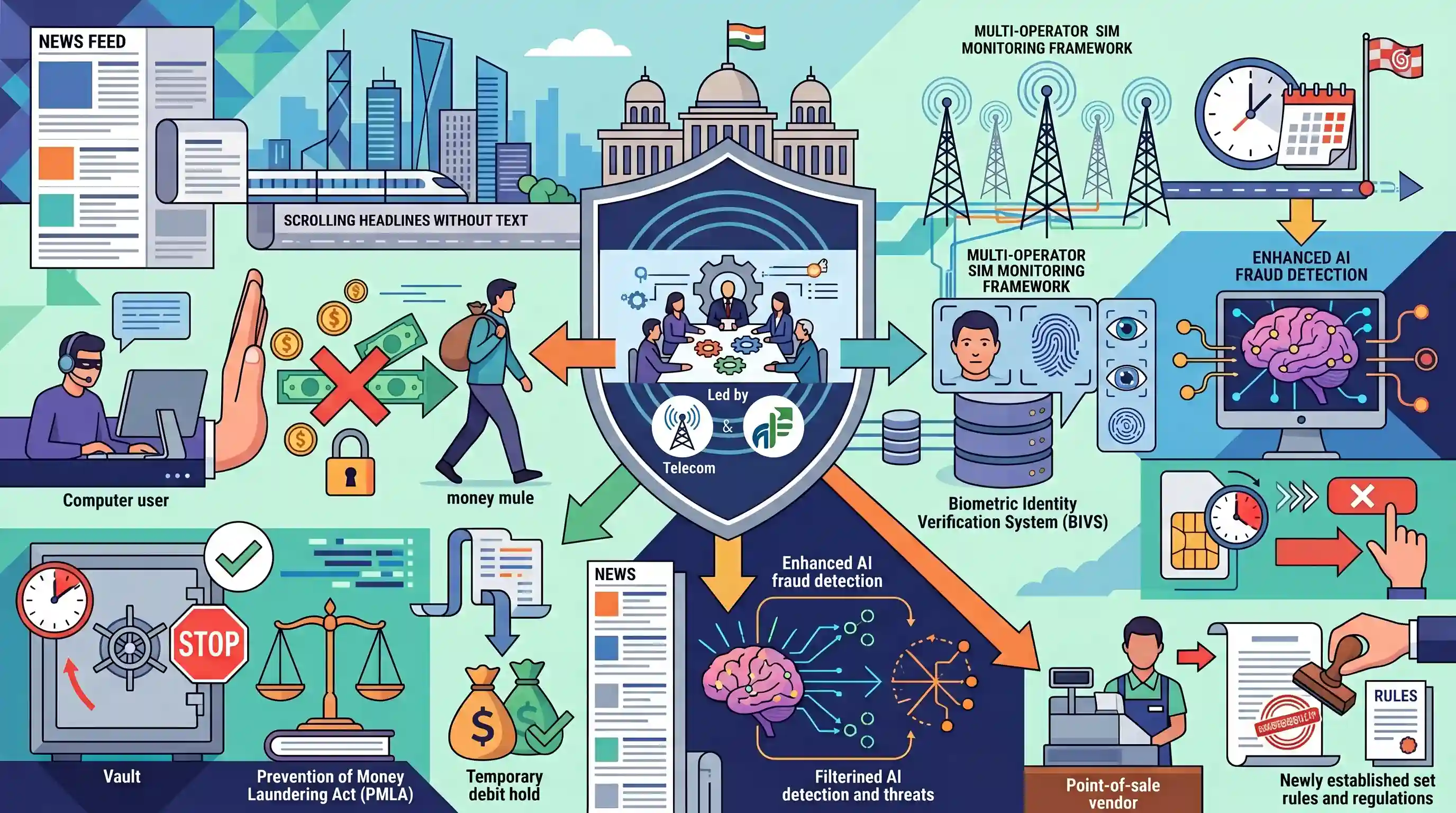
The central government has informed the Supreme Court about a multi-pronged strategy to combat "digital arrest" frauds, money mules, and cyber-enabled crimes. Key proposals include implementing temporary debit holds on suspicious accounts via an RBI-proposed SOP and invoking the Prevention of Money Laundering Act (PMLA). An Inter-Departmental Committee (IDC), led by the MHA, is working with telecom service providers (TSPs) and the Department of Telecommunications (DoT). Plans entail launching a Biometric Identity Verification System (BIVS) to establish a cross-operator SIM monitoring framework by December 2026. Efforts also include enhancing AI-based fraud detection, reducing the time taken to block suspicious SIM cards to 2-3 hours, and establishing accountability for point-of-sale vendors under new telecommunication rules.
Key Points
- The Centre aims to use the Prevention of Money Laundering Act (PMLA) against "digital arrest" fraud networks.
- RBI has proposed an SOP to place temporary debit holds on suspicious accounts to curb "money-mule" activities.
- An Inter-Departmental Committee (IDC) led by MHA is coordinating with telecom operators and WhatsApp to mitigate fraud.
- DoT is accelerating the Telecommunications (User Identification) Rules to launch a Biometric Identity Verification System (BIVS) with cross-operator SIM visibility by late 2026.
- AI-based detection will be enhanced to block suspicious SIM cards within 2-3 hours, alongside ensuring strict compliance by point-of-sale vendors.
Important Terms
Prevention of Money Laundering Act-2002 (PMLA)

A law enacted to prevent money laundering and enable the confiscation of proceeds from crime. It imposes record-keeping obligations on financial institutions and empowers the Enforcement Directorate to investigate economic offences.
UPSC context
GS Paper-III (Money Laundering). Tests knowledge of legal frameworks for combating financial crimes and the powers of central investigative agencies.
Inter-Departmental Committee (IDC)
A high-level panel led by the Ministry of Home Affairs (MHA) created to address 'digital arrest' frauds. It identifies legislative gaps and coordinates real-time responses across various ministries and agencies.
UPSC context
GS Paper-III (Cyber Security). Tests understanding of institutional mechanisms for inter-agency coordination in tackling emerging internal security threats.
Digital Arrest
A cyber-extortion scam where fraudsters impersonate law enforcement officials via video calls to falsely accuse victims of crimes, placing them in 'virtual custody' to demand money.
UPSC context
GS Paper-III (Cyber Security). Relevant for current affairs topics on emerging cyber threats, psychological extortion techniques, and digital vulnerabilities.
Biometric Identity Verification System (BIVS)
A planned cross-operator monitoring framework using biometric data to verify user identities. It aims to prevent the fraudulent issuance of SIM cards used in cyber-enabled extortion and fraud.
UPSC context
GS Paper-III (Cyber Security). Tests awareness of technological and biometric solutions for securing national communication infrastructure.
Telecommunications (User Identification) Rules
Regulations notified under the Telecommunications Act 2023 focused on verifying subscriber identities. They establish accountability for point-of-sale vendors and aim to curb spoofing and fraudulent SIM usage.
UPSC context
GS Paper-III (Digital Governance/Cyber Security). Tests knowledge of regulatory reforms in the telecom sector to enhance user accountability.
Reserve Bank of India (RBI)
India's central bank, responsible for regulating the banking sector. In cybercrime contexts, it proposes Standard Operating Procedures (SOPs) like temporary debit holds to prevent money-mule activities.
UPSC context
GS Paper-III (Indian Economy/Cyber Security). Tests understanding of the central bank's role in financial regulation and consumer protection.
Department of Telecommunications (DoT)
The nodal government department for telecom policy. It implements anti-fraud measures like AI-based detection systems and reduces timelines for blocking suspicious SIM cards to combat cybercrime.
UPSC context
GS Paper-III (Internal Security). Tests knowledge of executive departments' roles in securing communication networks and implementing anti-fraud technology.
Prelims Trap
"Digital arrest is a statutory provision under the Information Technology Act for detaining suspected cybercriminals."
'Digital arrest' is not a legitimate legal procedure. It is a cyber extortion scam where fraudsters impersonate law enforcement via video calls. Aspirants often confuse it with statutory preventive detention.
Static Concepts Connected
What are the core provisions of the Prevention of Money Laundering Act (PMLA), 2002?
- Scheduled Offenses: It applies to proceeds generated from specific offenses listed in the PMLA schedule, such as narcotics, terrorism, and now evolving cyber-extortion crimes.
- Burden of Proof: Unusually, the burden of proof rests heavily on the accused to demonstrate that the suspected proceeds are untainted.
- Enforcement Directorate: The Enforcement Directorate (ED) is the primary agency authorized to investigate offenses and attach properties under the PMLA framework.
What role do 'Money Mules' play in cyber financial crimes?
- Definition: Individuals whose bank accounts are used by criminals to receive and transfer illicit funds, often unknowingly duped via fake job offers.
- Layering Phase: They operate primarily at the 'layering' stage of money laundering, obfuscating the original source of cyber-fraud proceeds through multiple transfers.
- Regulatory Response: RBI mitigates this via strict KYC norms, temporary debit holds on suspicious accounts, and AI tools like MuleHunter.AI.
Cross-Topic Patterns
DLT in Telecom Security
Links blockchain (Digital Ledger Technology) applications in the GS3 Science syllabus to internal security mechanisms (SIM visibility) meant to curb identity spoofing and cyber terrorism.
Expansion of PMLA to cybercrime
Connects traditional money laundering frameworks (like ED's mandate) to modern cybercrimes, showing how tech-driven extortion and 'money mules' now trigger PMLA schedules.

Expect a multi-statement Prelims question merging 'Money Mules', DLT applications in telecom (BIVS), and PMLA's scope in cybercrime.
Linked PYQs · 5
Linked PYQs · 5
- 2020MainsGS3
Discuss different types of cyber crimes and measures required to be taken to fight the menace.
- 2021MainsGS3
Discuss how emerging technologies and globalisation contribute to money laundering. Elaborate measures to tackle the problem of money laundering both at national and international levels.
- 2017MainsGS3
Discuss the potential threats of Cyber attack and the security framework to prevent it.
- 2020PrelimsGS1
In India, under cyber insurance for individuals, which of the following benefits are generally covered, in addition to payment for the loss of funds and other benefits? 1. Cost of restoration of the computer system in case of malware disrupting access to one's computer 2. Cost of a new computer if some miscreant wilfully damages it, if proved so 3. Cost of hiring a specialized consultant to minimize the loss in case of cyber extortion 4. Cost of defence in the Court of Law if any third party files a suit Select the correct answer using the code given below:
- 2024MainsGS3
Describe the context and salient features of the Digital Personal Data Protection Act, 2023.
