Mule Accounts Money Trail and Cyber Fraud Investigation Challenges
Source:The Hindu ↗
ఇది ఎందుకు ముఖ్యం
Understanding mule accounts is vital for analyzing modern financial cyber crimes, internal security challenges, and the effectiveness of India's regulatory frameworks against digital fraud.
సారాంశం
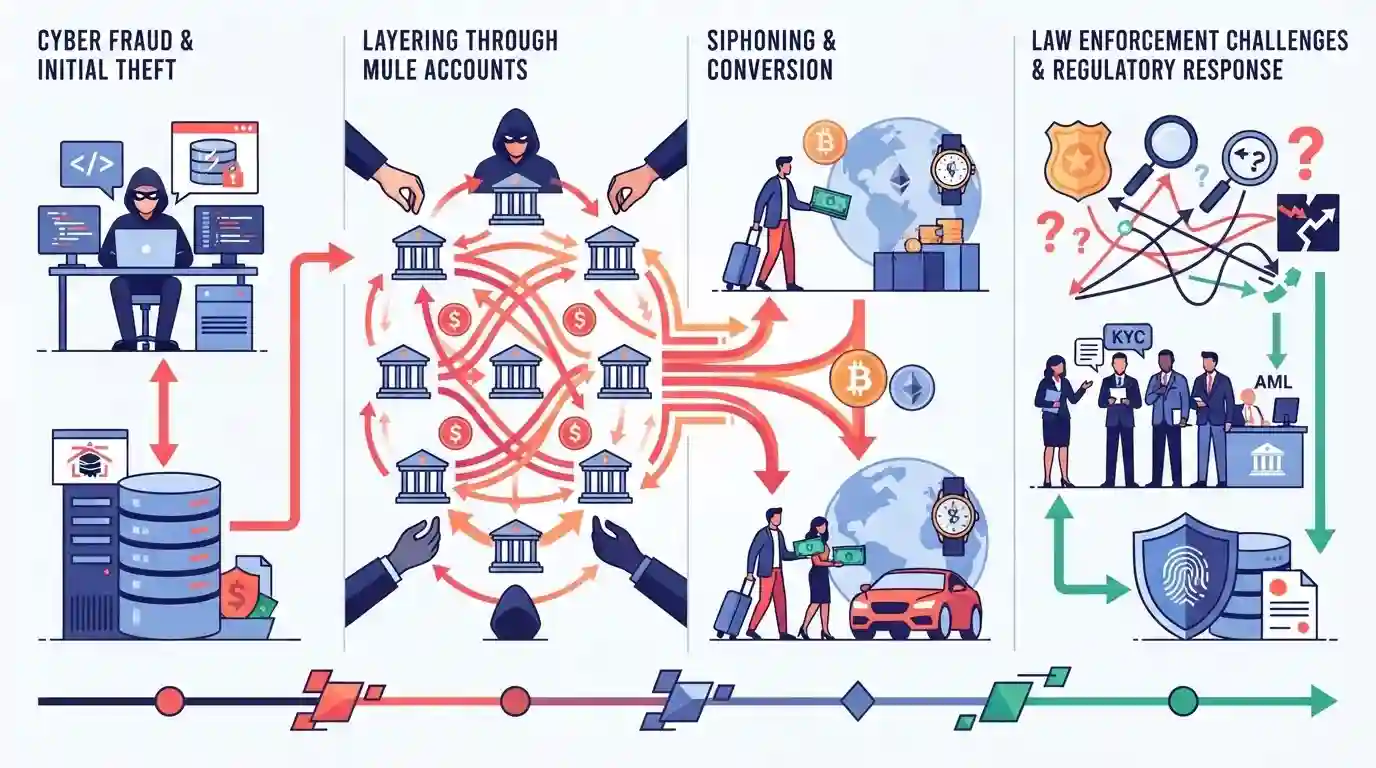
The article examines the mechanics of 'mule accounts' as the primary money trail vehicle used by cyber fraudsters to park, layer, and siphon off defrauded funds, highlighting the challenges for law enforcement and the regulatory measures required to tackle digital financial crimes.
ముఖ్య అంశాలు
- Mule accounts are bank accounts used by cyber fraudsters to launder and siphon off illegally obtained money, often opened using fake or rented identities.
- The money trail in cyber frauds heavily relies on these layered networks of mule accounts to obscure the final destination of funds.
- Law enforcement and regulatory bodies face significant challenges in detecting and freezing these accounts due to rapid, multi-tier transfers across digital banking platforms.
- Tighter KYC compliance, AI-driven fraud detection, and inter-agency coordination are critical to curbing the proliferation of mule accounts.
ముఖ్యమైన పదాలు
Reserve Bank of India

India's central banking institution which regulates the monetary system, issues currency, and sets regulatory frameworks for commercial banks, including guidelines to tackle cyber fraud and money mule accounts.
UPSC context
UPSC Prelims/Mains (GS Paper 3 - Economy & Banking): Tests knowledge of central bank regulations, financial stability, and digital banking security frameworks.
Supreme Court of India
The apex judicial authority of India which interprets the Constitution and issues binding directives to executive agencies, such as mandating standard operating procedures for combating cyber fraud and mule accounts.
UPSC context
UPSC Mains (GS Paper 2 - Polity & Governance / GS Paper 3 - Internal Security): Tests understanding of judicial intervention in digital rights and cyber crime governance.
ప్రిలిమ్స్ ఉచ్చు
regulatory frameworks mandate freezing entire bank accounts indiscriminately upon any suspected cyber fraud transaction
Aspirants often assume regulatory bodies mandate freezing the entire bank account for any suspicious transaction, whereas RBI guidelines emphasize temporary debit holds on specific disputed amounts to protect legitimate access.
అనుసంధానమైన స్థిర భావనలు
What are the primary institutional mechanisms in India to combat digital financial fraud and cyber crimes?
- I4C & Portal: It is a centralized portal launched by the Ministry of Home Affairs to enable citizens to report all types of cyber crimes, focusing on financial frauds.
- Pratibimb App: A specialized tool launched under I4C to map the real-time geographic locations of cyber fraudsters using mobile tower dumps and CDRs.
- Financial Cyber Fraud Helpline: An initiative by RBI and banks to enable immediate reporting and freezing of fraudulent transactions to prevent the siphoning of funds.
అంతర-అంశ నమూనాలు
Digital Fraud vs. Fintech Regulatory Compliance
While RBI mandates strict KYC to curb mule accounts, these compliance costs disproportionately burden fintech startups compared to traditional scheduled commercial banks.
Cyber Fraud and Organized Internal Security Syndicates
The use of coerced or rented identities for opening mule accounts highlights deep socio-economic vulnerabilities exploited by organized cyber crime syndicates.

RBI's selective debit-hold guidelines vs wholesale account freezing will likely feature in a 2-statement Prelims MCQs.
అనుసంధాన PYQలు · 3
అనుసంధాన PYQలు · 3
- 2022MainsGS3
What are the different elements of cyber security ? Keeping in view the challenges in cyber security, examine the extent to which India has successfully developed a comprehensive National Cyber Security Strategy.
- 2023MainsGS3
What is the status of digitalization in the Indian economy? Examine the problems faced in this regard and suggest improvements.
- 2023MainsGS3
What are the internal security challenges being faced by India? Give out the role of Central Intelligence and Investigative Agencies tasked to counter such threats.
