Punjab Universal Health Scheme and Public Infrastructure Initiatives
Source:Indian Express ↗
Why It Matters
The article serves as a strong state-level case study (Punjab model) for UPSC aspirants on how a government can integrate primary healthcare, universal health coverage, preventive mechanisms, and advanced technologies (like AI in disease screening) to comprehensively overhaul public health infrastructure.
Summary
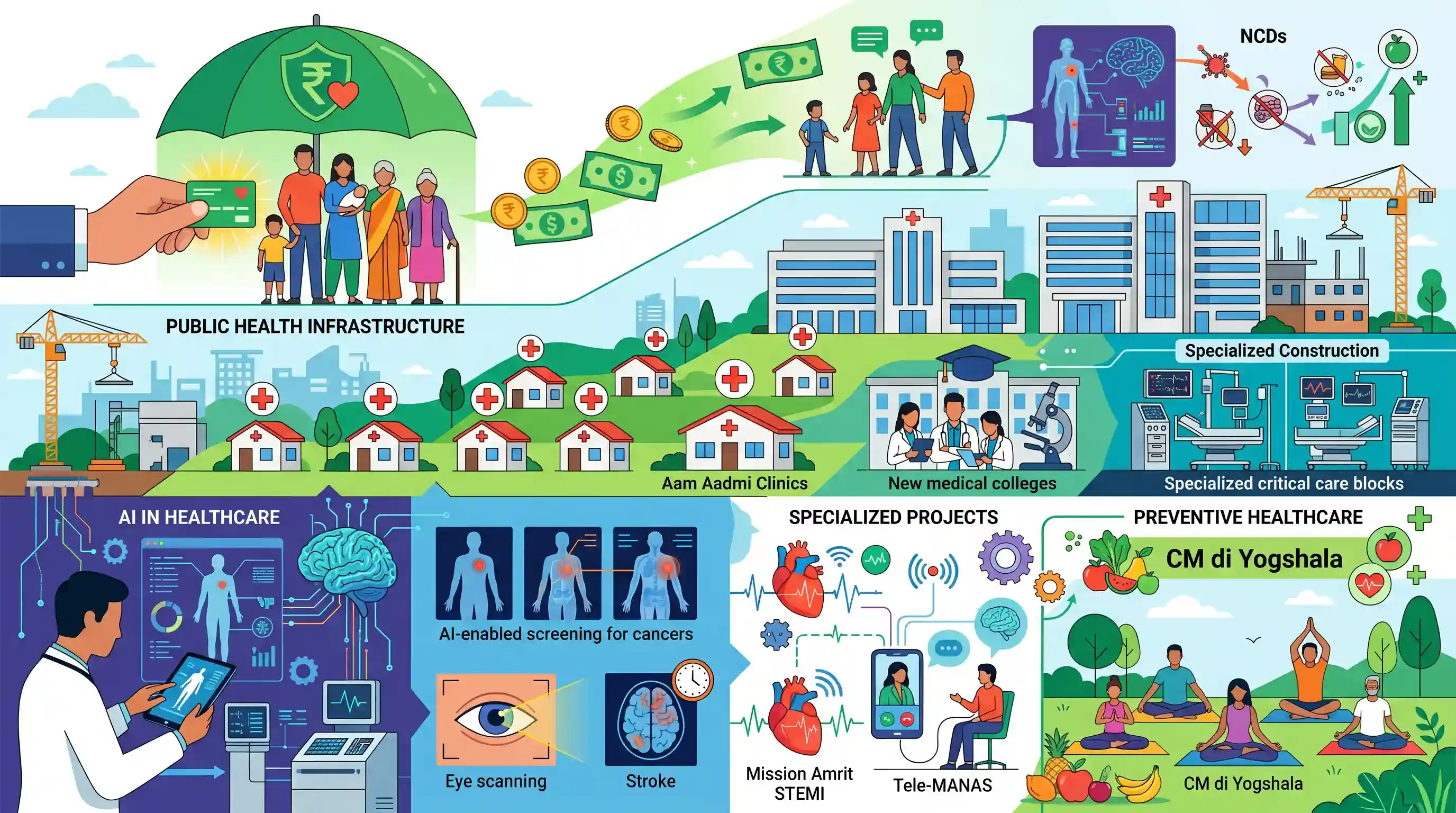
Punjab's health minister detailed the success of the 'Mukh Mantri Sehat Yojana', which has provided free medical treatment worth Rs 191 crore to 1.60 lakh people, offering coverage up to Rs 10 lakh per family. The state's broader public health overhaul includes the operationalization of 883 Aam Aadmi Clinics, the establishment of 9 new medical colleges, and the creation of 22 critical care blocks. Punjab is also heavily integrating technology and preventive measures into its healthcare system, launching AI-enabled screening for cancers and eye issues, an AI-managed stroke project, 'Mission Amrit STEMI' for cardiac emergencies, and the Tele-MANAS helpline for mental health. The 'CM di Yogshala' project further promotes preventive healthcare.
Key Points
- Punjab's 'Mukh Mantri Sehat Yojana' offers health coverage up to Rs 10 lakh, already providing free treatment to 1.60 lakh people worth Rs 191 crore.
- The state has established 883 Aam Aadmi Clinics, delivering free primary healthcare to over 1.69 crore people.
- Technological interventions include AI-enabled screening for breast and cervical cancer, and the AI-enabled 'Punjab Stroke Project' operating on a hub-and-spoke model.
- Preventive and specialized care is addressed through 'CM di Yogshala' for daily yoga, 'Mission Amrit STEMI' for cardiac care, and the Tele-MANAS helpline for mental health support.
- Healthcare infrastructure is being expanded with 9 new medical colleges adding 600 MBBS seats, and 22 new critical care blocks being set up across the state.
Important Terms
Mukh Mantri Sehat Yojana

Punjab's universal health insurance scheme providing annual cashless treatment up to ₹10 lakh per family. It covers secondary and tertiary care across government and empanelled private hospitals for all residents.
UPSC context
GS Paper II (Social Justice/Health). Tests knowledge of state-level Universal Health Coverage (UHC) models and public welfare schemes.
Aam Aadmi Clinics
A decentralized primary healthcare model in Punjab providing free consultations, 80+ essential medicines, and 40+ diagnostic tests. These serve as the first point of contact to reduce out-of-pocket medical expenditure.
UPSC context
GS Paper II (Health Infrastructure). Important for discussing primary healthcare strengthening and the ‘Three-Tier’ health system model.
Mission Amrit STEMI
An emergency cardiac care initiative (Acute Myocardial Reperfusion In Time) that provides free thrombolysis treatment, including the costly Tenecteplase injection, for severe heart attacks through a hub-and-spoke model.
UPSC context
GS Paper II & III (Health/Technology). Relevant for emergency medical response, NCD management, and public-private health collaborations.
Punjab Stroke Project
A public health initiative using AI-enabled CT scan analysis (Qure.ai) for rapid diagnosis of ischemic strokes. It offers free 'Mechanical Thrombectomy' procedures within the critical golden hour.
UPSC context
GS Paper III (S&T). Example of AI application in healthcare for improved diagnostic accuracy and emergency intervention.
CM di Yogshala
A wellness initiative providing free yoga and meditation training through certified instructors in public spaces. It focuses on preventive healthcare and reducing lifestyle diseases like hypertension and diabetes.
UPSC context
GS Paper II (Health). Useful for discussing preventive healthcare strategies and the promotion of traditional wellness practices.
Tele-MANAS
A national 24/7 toll-free mental health helpline (Tele Mental Health Assistance and Networking Across States) providing confidential counseling, psychiatric consultations, and referral services.
UPSC context
GS Paper II (Health/Social Justice). Tests awareness of digital health missions and the national response to mental health challenges.
Prelims Trap
Tele-MANAS is a state-specific mental health helpline launched under Punjab's public health overhaul.
Tele-MANAS is a National initiative launched by the Union Government (Budget 2022-23) with NIMHANS as the nodal center. States merely establish and operate the respective state-level cells.
Static Concepts Connected
What differentiates targeted national health insurance (PM-JAY) from universal state health models?
- Coverage (PM-JAY): Targeted at the bottom 40% of the population based on SECC 2011 data, providing Rs 5 lakh per family/year.
- Universal (State Models): Schemes like Punjab's remove socio-economic barriers, offering universal coverage and often higher financial limits (e.g., Rs 10 lakh).
- Funding Dynamics: PM-JAY is a Centrally Sponsored Scheme (CSS) shared 60:40, whereas parallel state extensions are funded 100% by state exchequers.
How does the Hub-and-Spoke model function in public healthcare delivery?
- The Hub: A centralized, highly resourced tertiary hospital handling complex, specialized treatments and centralized data analysis (e.g., AI stroke management).
- The Spokes: Peripheral primary or secondary care centers that conduct initial screening, stabilize patients, and refer severe cases upward.
- Resource Optimization: Maximizes the reach of scarce specialists and expensive medical infrastructure across wide geographical areas efficiently.
Cross-Topic Patterns
Fiscal federalism & health populism
Running parallel universal health schemes bypassing national structures heavily impacts state fiscal deficits, directly linking health governance to FRBM Act constraints and center-state fiscal federalism debates.
AI democratizing primary diagnostics
Deploying AI for stroke and cervical cancer screening at the grassroots (Aam Aadmi Clinics) addresses the acute rural specialist shortage, shifting AI's utility from tertiary care to primary diagnostics.

Tele-MANAS (nodal agency NIMHANS) and the fiscal sustainability of parallel state UHC models are highly probable 2026 exam targets.
Linked PYQs · 4
Linked PYQs · 4
- 2021MainsGS2
“Besides being a moral imperative of a Welfare State, primary health structure is a necessary precondition for sustainable development.” Analyze.
- 2015MainsGS2
Public health system has limitations in providing universal health coverage. Do you think that the private sector could help in bridging the gap? What other viable alternatives would you suggest?
- 2023MainsGS3
Introduce the concept of Artificial Intelligence (AI). How does Al help clinical diagnosis? Do you perceive any threat to privacy of the individual in the use of Al in healthcare?
- 2020MainsGS2
In order to enhance the prospects of social development, sound and adequate health care policies are needed particularly in the fields of geriatric and maternal health care. Discuss.
