MSRTC Mandates EV Charging Points as Green Fleet Transition Lags
Source:Indian Express ↗
Why It Matters
It provides a practical case study for GS3 (Infrastructure & Environment) on the challenges of greening India's public transport sector, contrasting proactive infrastructure policies with the ground-level financial realities of State Transport Undertakings in fleet transition.
Summary
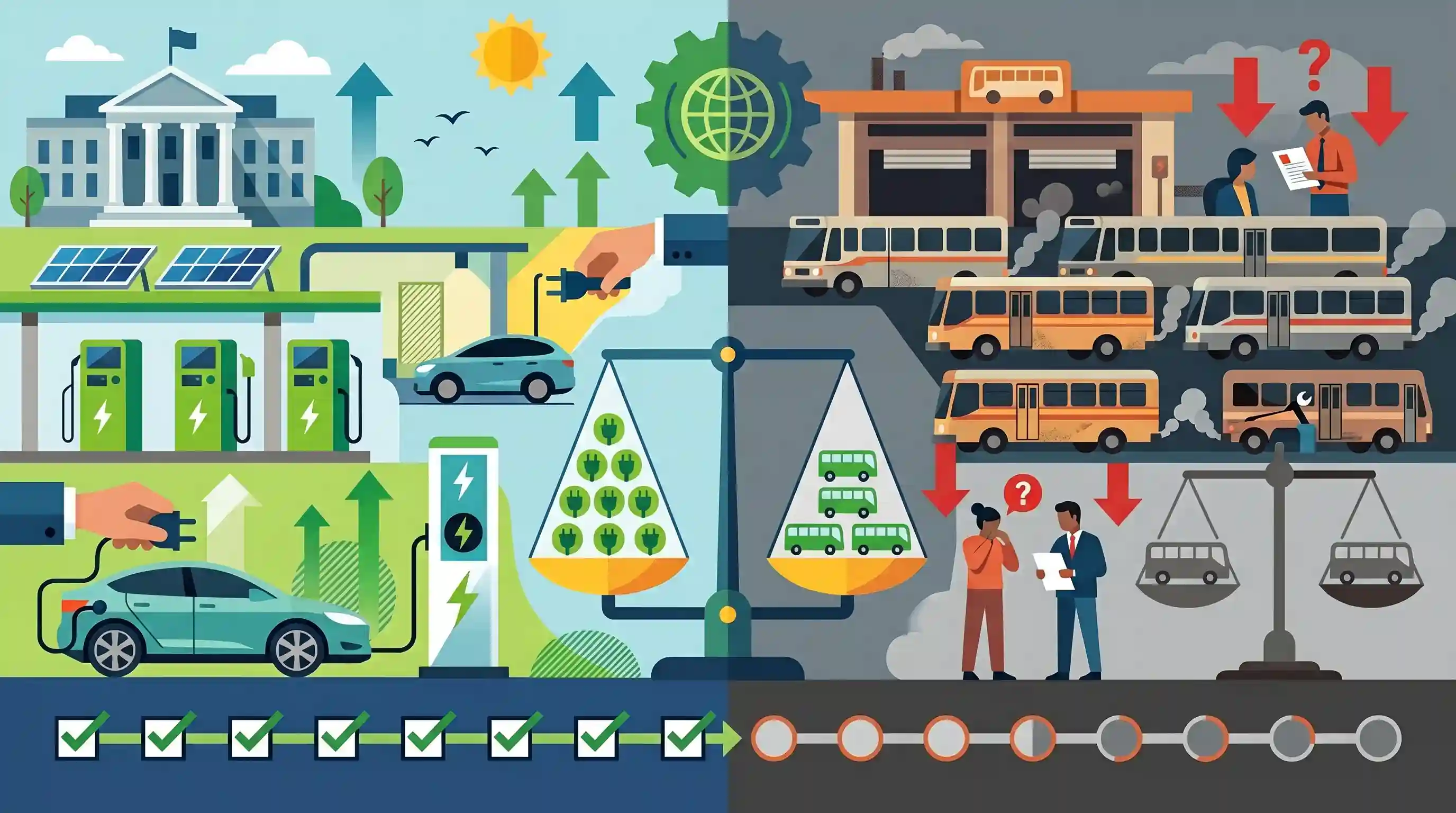
The Maharashtra State Road Transport Corporation (MSRTC) has mandated the installation of electric vehicle (EV) charging points at all new fuel stations established on its land. However, despite this push for green infrastructure, the corporation’s own transition toward an electrified public bus fleet is significantly lagging. This highlights the practical and financial challenges State Transport Undertakings (STUs) face in actually procuring and operating green fleets, demonstrating that building charging infrastructure must be matched by a robust capacity to acquire electric vehicles for a successful clean energy transition in public transport.
Key Points
- The Maharashtra State Road Transport Corporation (MSRTC) has made it mandatory to include EV charging points at all new fuel outlets being set up on its leased land.
- Despite the progressive mandate for EV charging infrastructure, MSRTC's own transition toward an electric 'green' fleet remains sluggish and behind schedule.
- The situation illustrates a common challenge for State Transport Undertakings (STUs): the mismatch between formulating green infrastructure policies and lacking the financial/operational capacity to rapidly electrify their own heavy-vehicle fleets.
- Decarbonizing public transport effectively requires parallel momentum in both infrastructure deployment (charging stations) and vehicle procurement (EV buses).
Important Terms
FAME (Faster Adoption and Manufacturing of Electric Vehicles)

The primary incentive scheme launched in 2015 to promote electric and hybrid vehicle adoption through demand-side subsidies and charging infrastructure development.
UPSC context
GS Paper III (Infrastructure and Environment). Tests knowledge of government interventions for decarbonizing transport.
National Electric Mobility Mission Plan (NEMMP)
A 2013 policy framework providing the roadmap for national fuel security by promoting the manufacturing and adoption of 6-7 million electric/hybrid vehicles.
UPSC context
GS Paper III (Economy/Energy). Important for understanding India's long-term energy transition and mobility policy origins.
Gross Cost Contract (GCC) Model
A procurement model where a private operator owns, maintains, and operates buses, while the public authority pays a fixed fee per kilometer.
UPSC context
GS Paper III (Infrastructure). Essential for questions on Public-Private Partnerships (PPP) and financial sustainability of transport.
State Transport Undertakings (STUs)
Public sector entities, established under the RTC Act 1950, responsible for providing passenger road transport services across various states.
UPSC context
GS Paper II (Governance) and GS III (Infrastructure). Focuses on the role and challenges of public service providers.
PM E-DRIVE Scheme
The successor to FAME-II, launched in 2024 to accelerate EV adoption through incentives for two-wheelers, three-wheelers, and e-buses.
UPSC context
GS Paper III (Economy). Represents the current operational framework for India's electric mobility transition.
Green Mobility
A sustainable transport paradigm focusing on reducing environmental impact through electric vehicles, cleaner fuels (CNG/LNG), and improved public transport efficiency.
UPSC context
GS Paper III (Environment). A recurring theme in climate change mitigation and urban development.
Prelims Trap
Central schemes provide direct funds to STUs for outright purchase and ownership of electric bus fleets.
PM-eBus Sewa uses a Public-Private Partnership (PPP) model where private operators own and run buses. The scheme bypasses STU capital constraints by subsidizing operations, not asset purchases.
Static Concepts Connected
What is the Gross Cost Contract (GCC) model in EV public transport?
- Asset ownership: Private operators purchase, own, and maintain the electric buses, absorbing the high upfront capital expenditure.
- Operational payment: The government or STU pays the private operator a pre-determined per-kilometer rate, shielding the state from technology risks.
What is the role of Unified Metropolitan Transport Authorities (UMTAs)?
- Fragmented governance: Urban mobility in India is disjointed across municipal corporations, state transport undertakings, and metro agencies.
- Integrated execution: UMTAs are statutory bodies recommended by the NUTP to ensure comprehensive mobility planning, funding coordination, and seamless execution.
Cross-Topic Patterns
Fiscal distress + decarbonization goals
The chronic losses of STUs severely restrict state capacity to procure EV fleets, creating a heavy reliance on Central PPP schemes like PM-eBus Sewa to achieve public transport decarbonization.
Public land monetization + green infra
MSRTC's mandate illustrates a strategy of leveraging state-owned land leased to fossil-fuel pumps to passively expand EV charging networks without requiring direct government capital expenditure.

Electric public transport + STU financial distress + GCC models are highly likely to feature as a multi-statement prelims question in 2026.
Linked PYQs · 3
Linked PYQs · 3
- 2023MainsGS3
The adoption of electric vehicles is rapidly growing worldwide. How do electric vehicles contribute to reducing carbon emissions and what are the key benefits they offer compared to traditional combustion engine vehicles?
- 2014MainsGS3
National Urban Transport Policy emphasises on 'moving people' instead of 'moving vehicles'. Discuss critically the success of the various strategies of the Government in this regard.
- 2022MainsGS3
Why is Public Private Partnership (PPP) required in infrastructural projects ? Examine the role of PPP model in the redevelopment of Railway Stations in India.
