US Tariffs Threaten Indian MSME Export Sectors
Source:The Hindu ↗
Why It Matters
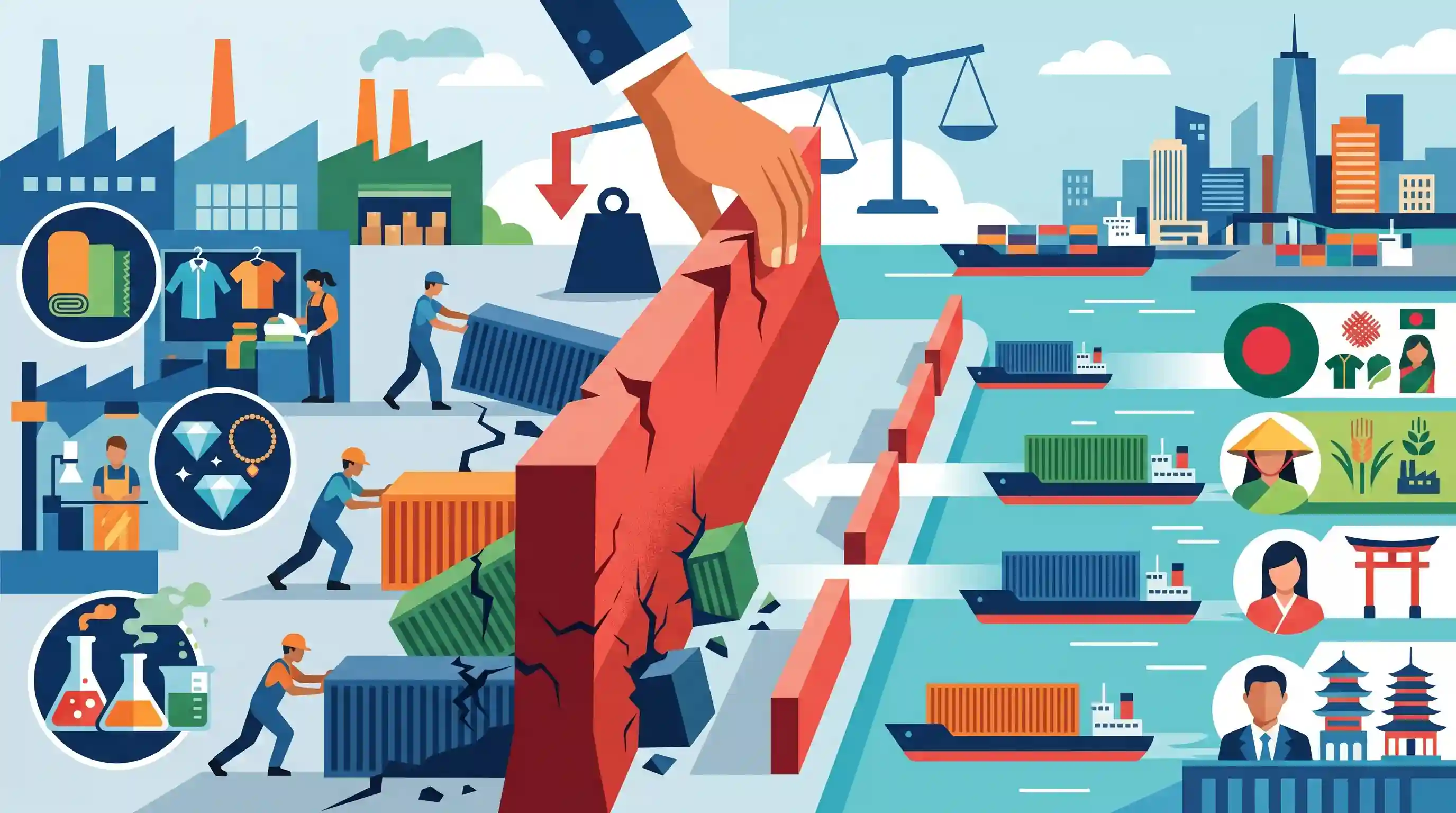
Illustrates the direct vulnerability of India's export-oriented, employment-intensive MSME sector to global protectionist trade policies and tariff wars. Highlights the urgency for export diversification and enhancing manufacturing competitiveness against regional peers.
Summary
A CRISIL Intelligence report highlights that an additional 25% US tariff on Indian goods, raising total tariffs to 50%, will severely disrupt India's MSME sector, which accounts for 45% of total exports. The textiles, gems and jewellery, and chemicals sectors will be the hardest hit, as MSMEs dominate these export-heavy industries. Consequently, Indian exporters are expected to lose competitiveness and market share to countries like Bangladesh, Vietnam, Japan, and South Korea, which enjoy lower tariff rates in the US.
Key Points
- The US is imposing an additional 25% tariff on Indian goods effective August 27, raising the total ad valorem tariff to 50%.
- India's MSME sector, which accounts for around 45% of the country's total exports, will be significantly impacted by the higher US tariffs.
- The MSME-dominated textiles and gems and jewellery sectors, which account for 25% of India's exports to the US, will face severe tariff shocks, particularly diamond exporters in Surat.
- Indian ready-made garments and chemicals face reduced competitiveness in the US market compared to peers like Bangladesh, Vietnam, Japan, and South Korea, which are subject to lower tariffs.
- The impact on MSMEs in the steel sector is expected to be negligible as they primarily produce long products, whereas the US mostly imports flat products from India.
Important Terms
Micro, Small and Medium Enterprises (MSME)

Enterprises classified by investment and turnover. Since April 2025, limits are: Micro (up to ₹2.5cr/₹10cr), Small (up to ₹25cr/₹100cr), and Medium (up to ₹125cr/₹500cr).
UPSC context
GS Paper III: Indian Economy. Vital for employment, exports (45%), and GDP (30%) discussions.
CRISIL Intelligence
A division of CRISIL Limited (an S&P Global company) that provides data, research, and analysis on various sectors, helping assess industry trends and credit risks.
UPSC context
GS Paper III: Economic reports and data-driven analysis for policy evaluation.
Protectionism
Economic policies like tariffs or quotas designed to restrict imports to protect domestic industries from foreign competition.
UPSC context
GS Paper III: International Trade. Tests understanding of global trade barriers and their impact on Indian exports.
Ad Valorem Duty
A tax or duty based on the assessed value of an item, rather than on its weight or quantity.
UPSC context
GS Paper III: Taxation and Trade. Relevant for understanding tariff structures in bilateral trade disputes.
Trade Competitiveness
A nation's ability to produce goods/services at lower costs or higher quality than rivals, often measured by export market share.
UPSC context
GS Paper III: Industrial Policy. Concerns India's export performance against peers like Vietnam and Bangladesh.
Prelims Trap
The MSME steel sector is highly vulnerable to US tariffs as steel is a major Indian export.
While steel is exported, Indian MSMEs mostly produce 'long' steel products. The US mainly imports 'flat' products from India, meaning MSME steel is largely insulated from these specific tariffs.
Static Concepts Connected
What is the difference between specific and ad valorem tariffs?
- Ad valorem tariff: Calculated as a fixed percentage of the estimated value of the imported goods (e.g., the 50% tariff mentioned in the article).
- Specific tariff: A fixed monetary amount levied per physical unit of imported goods (e.g., per kilogram or per item), regardless of its market value.
- Protectionist Impact: Ad valorem tariffs compound with price inflation, making them a more dynamic protectionist tool against high-value exports like gems and jewellery.
What are the structural differences in steel products (Flat vs. Long) in trade?
- Flat products: Sheets, plates, and coils produced by rolling steel. Primarily utilized in capital-intensive sectors like automotive manufacturing, appliances, and shipbuilding.
- Long products: Bars, rods, and structural shapes (like girders). Predominantly used in real estate construction and infrastructure projects.
- MSME production profile: Indian MSMEs dominate the secondary steel sector, primarily making long products for domestic use, leaving them relatively insulated from US flat-steel import tariffs.
Cross-Topic Patterns
Apparel Trade & LDC Graduation Status
Bangladesh enjoys duty-free access to many Western markets due to its Least Developed Country (LDC) status, giving its textile exports a structural tariff advantage over India's MSMEs.
Industrial Hubs & Urban Employment Shocks
The concentration of the gems and jewellery MSME sector in Surat means global trade shocks directly threaten localized urban employment and risk regional economic distress.

MSME export composition (45% share) and nuanced trade impacts (flat vs long steel) are prime targets for a 2026 multi-statement prelims Q.
Linked PYQs · 4
Linked PYQs · 4
- 2018MainsGS3
How would the recent phenomena of protectionism and currency manipulations in world trade affect macroeconomic stability of India?
- 2025MainsGS3
What are the challenges before the Indian economy when the world is moving away from free trade and multilateralism to protectionism and bilateralism? How can these challenges be met?
- 2023MainsGS3
Faster economic growth requires increased share of the manufacturing sector in GDP, particularly of MSMEs. Comment on the present policies of the Government in this regard.
- 2017MainsGS3
Account for the failure of manufacturing sector in achieving the goal of labour-intensive exports. Suggest measures for more labour-intensive rather than capital-intensive exports.
