Agricultural Feeders: MSEDCL Awards Solar Projects Under MSKVY 2.0
Source:indian-infrastructure ↗
Why It Matters
The Mukhyamantri Saur Krushi Vahini Yojana (MSKVY) is a highly tested topic in the MPSC Combined Prelims (e.g., MPSCPRELI2024GS01093). Tracking the progress of its 2.0 phase, including private sector participation and capacity expansions, is crucial for candidates tackling questions on Maharashtra's governance initiatives and rural infrastructure development.
Summary
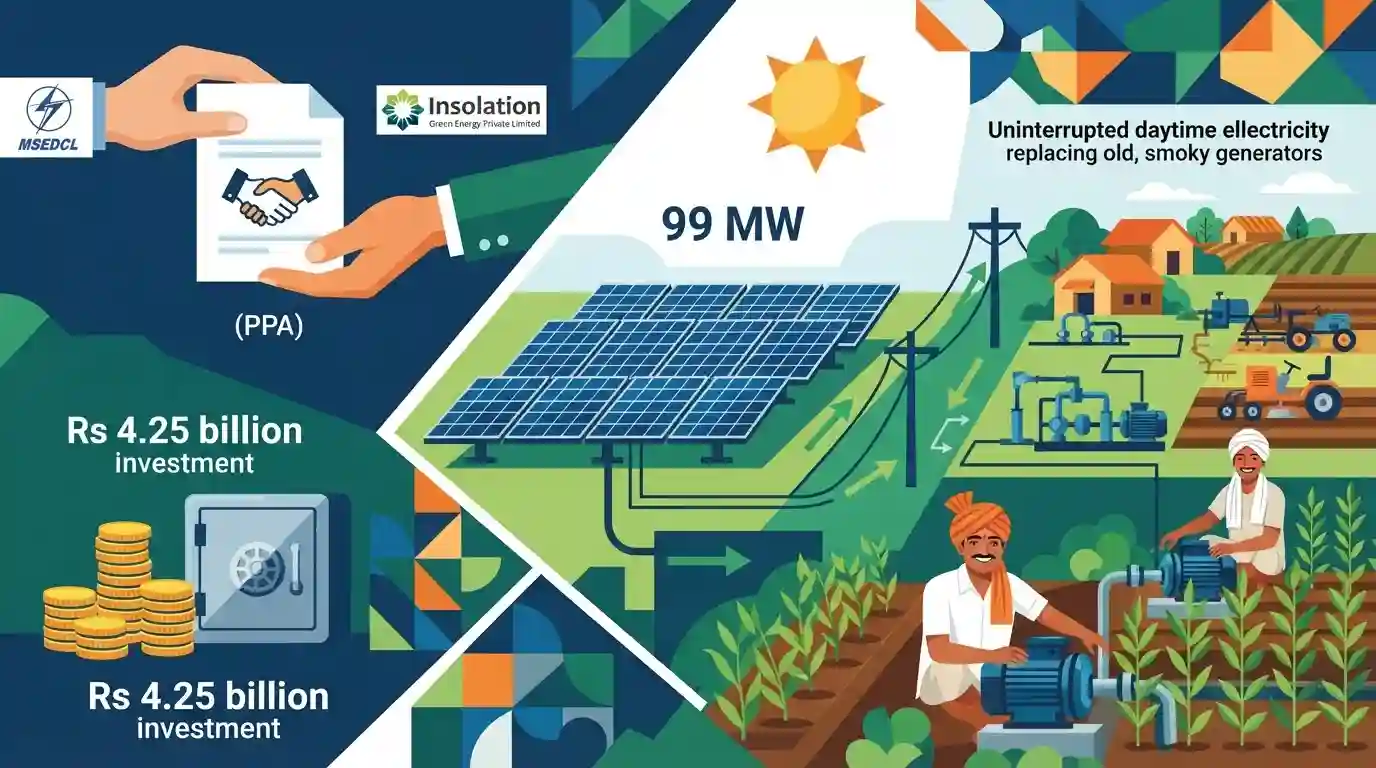
MSEDCL has awarded a 99 MW solar power project to Insolation Green Energy Private Limited (a subsidiary of Insolation Energy Limited) under the Government of Maharashtra's flagship Mukhyamantri Saur Krushi Vahini Yojana 2.0. Requiring an investment of Rs 4.25 billion, the project aims to provide uninterrupted daytime electricity to agricultural feeders. The agreement includes a 25-year Power Purchase Agreement (PPA) at Rs 2.90 per kWh. This development highlights the state's aggressive push toward decentralized renewable energy generation and rural empowerment.
Key Points
- MSEDCL has awarded a 99 MWac (128.7 MWdc) solar power project to Insolation Green Energy under the Mukhyamantri Saur Krushi Vahini Yojana 2.0 (MSKVY 2.0).
- The total investment for this project is estimated at Rs 4.25 billion.
- The project features a 25-year Power Purchase Agreement (PPA) with MSEDCL at a fixed tariff of Rs 2.90 per kWh.
- The primary objective of the MSKVY 2.0 scheme is to ensure a reliable and uninterrupted daytime electricity supply to farmers across Maharashtra by solarizing agricultural feeders.
Important Terms
Mukhyamantri Saur Krushi Vahini Yojana 2.0 (MSKVY 2.0)

Maharashtra government's flagship scheme aiming to provide uninterrupted daytime electricity to agricultural feeders by decentralising solar energy projects.
UPSC context
Crucial for MPSC General Studies III (Economy & Infrastructure), highlighting state schemes for agricultural electrification and renewable energy transition.
Maharashtra State Electricity Distribution Company Limited (MSEDCL)
The primary state-owned electricity distribution utility in Maharashtra, formed in 2005 after the restructuring of the Maharashtra State Electricity Board.
UPSC context
Important for MPSC GS Paper III (Infrastructure/Energy) as the implementing agency for major power distribution and solarisation schemes in Maharashtra.
Power Purchase Agreement (PPA)
A long-term contract between an electricity generator and a buyer, outlining the commercial terms for the sale of power.
UPSC context
Relevant to MPSC GS Paper III (Economy/Energy), testing knowledge of infrastructure financing, renewable energy economics, and government procurement mechanisms.
Prelims Trap
"MSKVY 2.0 aims to distribute individual off-grid solar pumps to farmers to provide 24x7 electricity."
MSKVY 2.0 focuses on grid-connected feeder-level solarization to provide reliable daytime electricity, not individual off-grid pumps or 24x7 power.
Static Concepts Connected
What are the three components of the PM-KUSUM scheme?
- Component A: Installation of decentralized ground-mounted grid-connected renewable power plants (up to 2 MW).
- Component B: Installation of standalone off-grid solar agriculture pumps for individual farmers, replacing diesel pumps.
- Component C: Solarization of existing grid-connected agricultural pumps and feeder-level solarization.
What is the economic rationale for agricultural feeder segregation?
- Load Management: Allows DISCOMs to supply predictable daytime power to agriculture without disrupting 24x7 domestic and industrial supply.
- Loss Reduction: Helps accurately measure agricultural consumption, curbing power theft and unmetered commercial losses.
- Subsidy Optimization: Transparently accounts for agricultural power consumption, enabling better management of state subsidies and DISCOM finances.
Cross-Topic Patterns
MSKVY 2.0 and PM-KUSUM Component C
Maharashtra's MSKVY 2.0 executes central PM-KUSUM Component C, showing how state DISCOMs leverage central mandates to decentralize generation and reduce their agricultural cross-subsidy burden.
Decentralized Solar and DISCOM Viability
Long-term 25-year PPAs at low fixed tariffs help debt-laden DISCOMs reduce average power purchase costs, thereby minimizing the need for steep cross-subsidy surcharges on industrial consumers.

Expect a multi-statement question contrasting MSKVY 2.0 (feeder solarization/daytime power) with individual PM-KUSUM off-grid pumps.
Linked PYQs · 2
Linked PYQs · 2
- 2024MPSC_PRELIMSGS1
Identify the correct statements regarding the Chief Minister Solar Agricultural Channel Scheme. (a) This Scheme was started in June 2017, when Devendra Fadanvis was Chief Minister. (b) The main purpose of this Scheme is to provide supply of electricity to farmers through the agricultural feeder. (c) The government has decided to pay ₹ 50,000 per acre as rent to the farmers under this Scheme. (d) Solar panels are set up on government land up to ten kilometres from the 33 kV substation.
- 2024MPSC_PRELIMSGS1
The largest share of allocation in the Seventh Five Year Plan went to the :
