Environmental Impact Assessment in Marine Vessel Mishaps
Source:The Hindu ↗
Why It Matters
This incident illustrates critical regulatory gaps in managing marine accidents in Indian waters. It is highly relevant for UPSC aspirants as it touches upon the institutional framework for Environmental Impact Assessments (EIA), the jurisdictional boundaries between the MoEFCC and maritime authorities, and the ecological impacts of hazardous pollutants like plastic nurdles (microplastics) and chemicals on marine ecosystems.
Summary
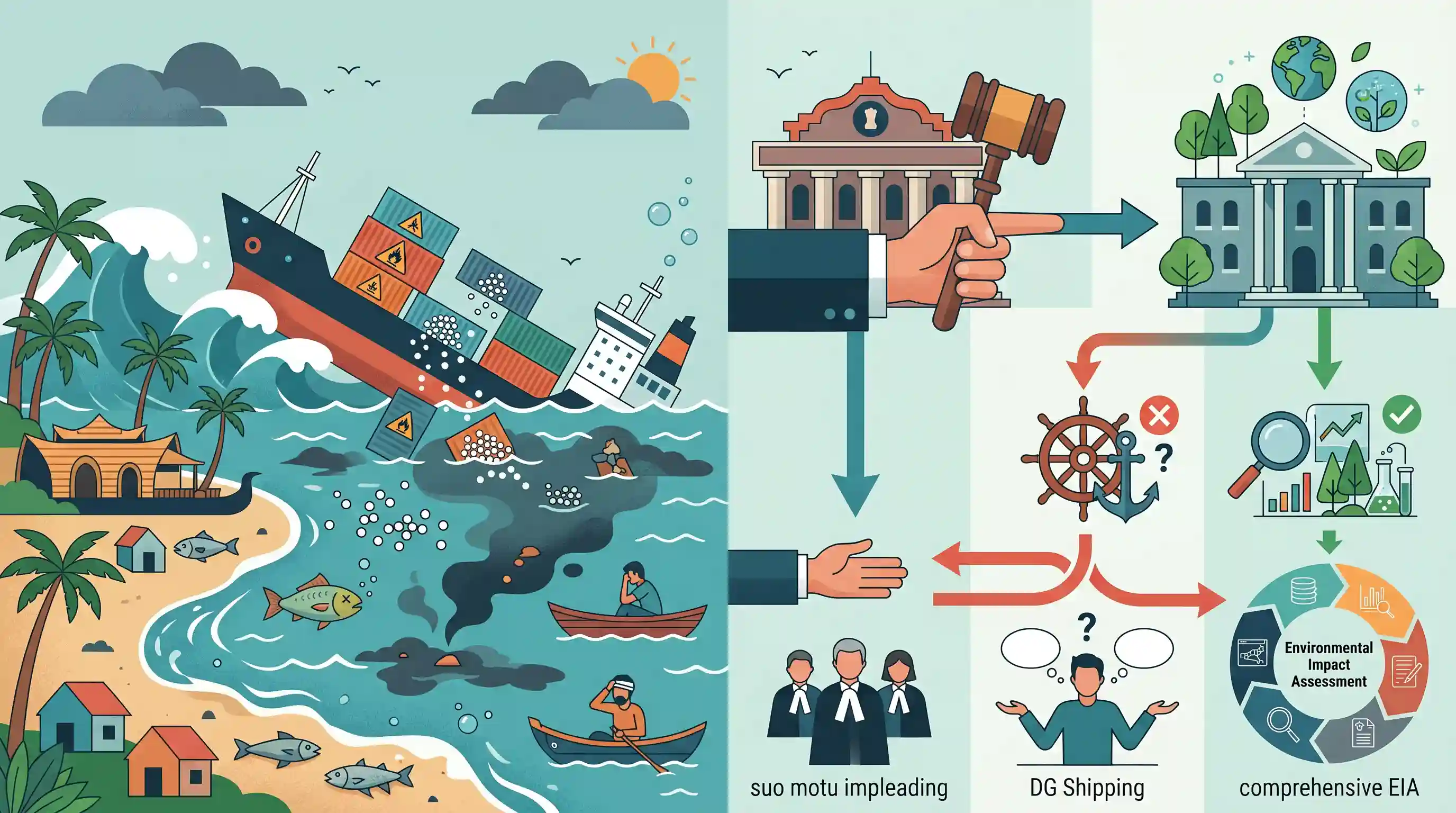
The sinking of the cargo ship MSC Elsa 3 off the coast of Alappuzha, Kerala, has triggered significant environmental and regulatory concerns. The vessel was carrying hazardous cargo, including large quantities of calcium carbide and plastic nurdles, which threaten marine ecology, coastal sustainability, and the livelihoods of local fishing communities. Recognizing the severe ecological risks, the Kerala High Court intervened by suo motu impleading the Ministry of Environment, Forest and Climate Change (MoEFCC). The court emphasized that the Directorate General (DG) of Shipping lacks the mandate and expertise to conduct a comprehensive Environmental Impact Assessment (EIA), underscoring the necessity for specialized environmental agencies to manage and assess the impacts of marine disasters.
Key Points
- The cargo ship MSC Elsa 3 sank off the Alappuzha coast in Kerala, raising alarms over potential marine pollution.
- The ship carried hazardous materials, including 339.20 MT of calcium carbide and plastic nurdles, posing severe threats to marine ecology and coastal sustainability.
- The Kerala High Court suo motu impleaded the MoEFCC, ruling that the DG of Shipping is not the appropriate nodal agency to conduct an Environmental Impact Assessment (EIA) for such incidents.
- The court highlighted the potential contamination of the coastline, the navigational hazards for traditional fishermen, and the need for specialized environmental oversight in marine disasters.
Important Terms
Environmental Impact Assessment (EIA)

A systematic process to identify and evaluate the environmental consequences of proposed projects before approval to ensure sustainable development and minimize ecological harm.
UPSC context
GS3: Environment. Specifically tested under 'Environmental Impact Assessment' and 'Environmental pollution and degradation'.
Directorate General (DG) of Shipping
The apex maritime authority under the Ministry of Ports, Shipping and Waterways, responsible for maritime safety, seafarer welfare, and enforcing the Merchant Shipping Act, 1958.
UPSC context
GS2/GS3: Statutory and Regulatory bodies; Infrastructure (Shipping) and Maritime Security.
Ministry of Environment, Forest and Climate Change (MoEFCC)
The nodal central agency for planning, promoting, and coordinating environmental and forestry programs, including the implementation of the Environment (Protection) Act, 1986.
UPSC context
GS2/GS3: Governance and Environment; nodal ministry for environmental policy and international climate conventions.
Central Pollution Control Board (CPCB)
A statutory organization under MoEFCC, established by the Water Act 1974, responsible for coordinating pollution control activities and advising the Union government.
UPSC context
GS3: Environmental Pollution and Degradation. Core statutory body for pollution monitoring and enforcement.
Indian Coast Guard (ICG)
An armed force under the Ministry of Defence mandated with protecting maritime interests and serving as the central coordinating authority for marine pollution response.
UPSC context
GS3: Internal Security and Disaster Management. Nodal agency for the National Oil Spill Disaster Contingency Plan.
Kerala High Court
The highest judicial authority in Kerala, which can exercise 'suo motu' powers to intervene in public interest matters, such as environmental disasters.
UPSC context
GS2: Judiciary. Focuses on 'Suo Motu' powers, Public Interest Litigation (PIL), and environmental jurisprudence.
Prelims Trap
Directorate General of Shipping is the nodal agency for conducting Environmental Impact Assessments for marine disasters.
DG Shipping enforces MARPOL and maritime safety, but lacks the statutory mandate and ecological expertise for comprehensive EIAs, which falls under MoEFCC.
Static Concepts Connected
How do nurdles and calcium carbide impact marine ecosystems?
- Nurdles (Microplastics): Primary microplastics (1-5mm) that act as toxic sponges, absorbing Persistent Organic Pollutants (POPs) and bioaccumulating in the marine food web.
- Calcium Carbide: Reacts violently with seawater to produce flammable acetylene gas and highly alkaline calcium hydroxide, severely stressing marine organisms.
What is the institutional framework for marine pollution in India?
- Indian Coast Guard: The Central Coordinating Agency for marine oil spills under the National Oil Spill Disaster Contingency Plan (NOS-DCP).
- DG Shipping: Regulates maritime safety and operational ship-source pollution by enforcing MARPOL 73/78 under the Merchant Shipping Act, 1958.
- MoEFCC: Holds the core mandate for assessing ecological damage and conducting comprehensive Environmental Impact Assessments (EIAs).
Cross-Topic Patterns
Microplastics & Stockholm Convention
Because nurdles adsorb Persistent Organic Pollutants (POPs) from seawater, marine plastic spills directly intersect with India's obligations under the Stockholm Convention.
Judicial mapping of mandates
The Kerala HC's suo motu impleading of MoEFCC over DG Shipping highlights judicial intervention to clarify overlapping executive jurisdictions in disaster governance.

Expect a 2026 prelims question contrasting the marine pollution mandates of DG Shipping (MARPOL), Coast Guard (NOS-DCP), and MoEFCC (EIA).
Linked PYQs · 4
Linked PYQs · 4
- 2020MainsGS3
How does the draft Environment Impact Assessment (EIA) Notification, 2020 differ from the existing EIA Notification, 2006?
- 2024MainsGS3
What role do environmental NGOs and activists play in influencing Environmental Impact Assessment (EIA) outcomes for major projects in India? Cite four examples with all important details.
- 2019PrelimsGS1
Why is there a great concern about the 'microbeads' that are released into environment?
- 2024PrelimsGS1
Consider the following statements : Statement-I: Many chewing gums found in the market are considered a source of environmental pollution. Statement-II : Many chewing gums contain plastic as gum base. Which one of the following is correct in respect of the above statements?
