Tamil Nadu Seeks Compensation for Marine Pollution from Shipwreck
Source:The Hindu ↗
Why It Matters
Maritime accidents involving hazardous chemicals and microplastics (nurdles) are a growing threat to India's extensive coastline. This incident is highly relevant for GS3 questions on marine pollution, disaster response frameworks, and GS2/GS3 intersections regarding the NGT's role in enforcing environmental compensation and the polluter pays principle.
Summary
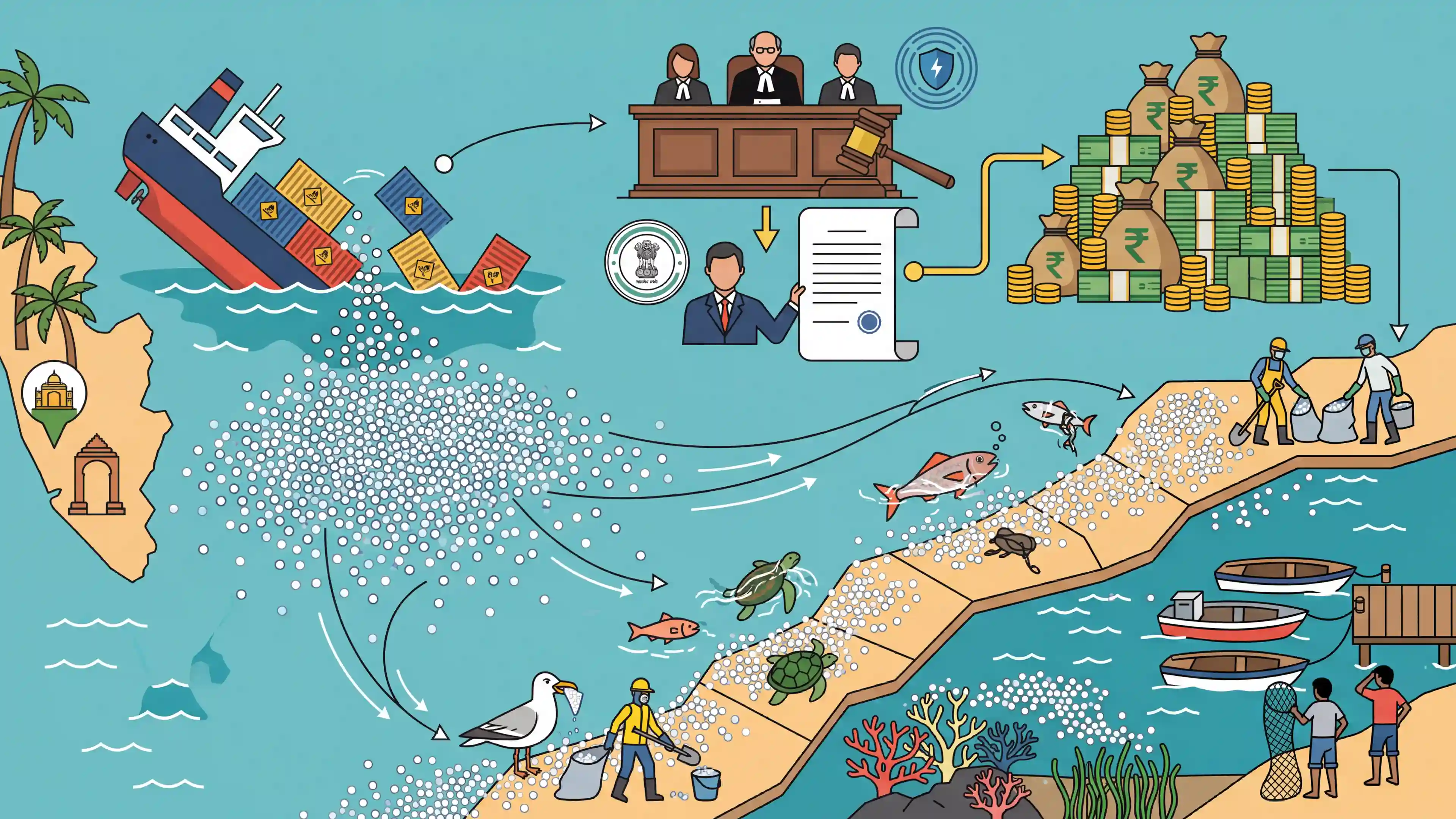
The Union Ministry of Ports, Shipping and Waterways has informed the National Green Tribunal (NGT) that Tamil Nadu is seeking ₹1,041.8 crore in environmental compensation following the sinking of the container ship MSC Elsa 3 off the Kerala coast. The vessel went down with hazardous cargo, releasing a massive amount of plastic pellets (nurdles) that washed up along eight coastal districts in Tamil Nadu. The resulting marine pollution has devastated local coastal ecosystems and severely disrupted the livelihoods of fishing communities. The NGT's suo motu intervention underscores the enforcement of the 'polluter pays' principle and highlights the severe socio-economic and ecological threats posed by maritime disasters.
Key Points
- The container ship MSC Elsa 3 sank in the Arabian Sea off the Kerala coast carrying hazardous cargo and calcium carbide.
- A massive spill of plastic pellets (nurdles) severely polluted 843.7 km of the Tamil Nadu coastline, leading to environmental degradation and livelihood loss for fishing communities.
- Tamil Nadu sought ₹1,041.8 crore as environmental compensation, while Kerala claimed ₹9,531 crore (partially adjusted by the Kerala HC).
- The National Green Tribunal (NGT) took suo motu cognizance of the disaster based on media reports.
- The incident highlights systemic issues in disaster management for maritime shipwrecks and the enforcement of the 'polluter pays' principle.
Important Terms
National Green Tribunal (NGT)

A statutory body established under the National Green Tribunal Act 2010 for the effective and expeditious disposal of cases relating to environmental protection and conservation.
UPSC context
GS Paper 2: Statutory bodies; GS Paper 3: Environmental justice and dispute resolution mechanisms.
Polluter Pays Principle
An environmental law principle requiring those responsible for pollution to bear the costs of management, cleanup, and restoration, rather than society or the environment.
UPSC context
GS Paper 3: Environmental ethics, sustainable development, and landmark judicial principles in India.
Nurdles (Plastic Pellets)
Small pre-production plastic pellets (1–5 mm) used as raw material for manufacturing. Classified as primary microplastics, they are highly persistent and toxic to marine life.
UPSC context
GS Paper 3: Environment (Marine pollution, microplastics, and biodiversity loss).
Union Ministry of Ports, Shipping and Waterways
The nodal government agency responsible for formulating and implementing policies related to shipping, ports, inland water transport, and maritime safety in India.
UPSC context
GS Paper 2: Important aspects of governance, ministries, and departments of the Government.
Suo Motu Cognizance
The power of a court or tribunal to take notice of a matter and initiate legal proceedings on its own, without a formal petition being filed.
UPSC context
GS Paper 2: Judiciary/Tribunals and their proactive role in enforcing fundamental rights.
Prelims Trap
"Nurdles are secondary microplastics formed by the physical breakdown of larger plastic waste in ocean currents."
Nurdles are primary microplastics. They are pre-production raw material pellets deliberately manufactured to melt down into larger plastic items, not degraded waste fragments.
Static Concepts Connected
What are the core environmental principles statutorily mandated under the NGT Act?
- Polluter Pays: The polluting entity must bear the costs of both environmental restoration and compensating the victims of pollution.
- Precautionary Principle: Lack of absolute scientific certainty cannot be used as a reason to postpone measures that prevent environmental degradation.
- Sustainable Development: The tribunal must balance economic development needs with the mandatory preservation of ecology.
How are marine microplastics classified based on their source of origin?
- Primary Microplastics: Intentionally manufactured tiny plastics designed for commercial use, such as 'nurdles' (pre-production pellets) and microbeads in cosmetics.
- Secondary Microplastics: Fragments created by the physical, chemical, and photodegradation of larger plastic waste, like fishing nets and water bottles.
Cross-Topic Patterns
Microplastics + POP Bioaccumulation
Nurdles act as toxic sponges in the ocean, absorbing Persistent Organic Pollutants (POPs). This links marine plastic pollution directly to bioaccumulation and human food security via seafood.
Maritime Disasters + Public Trust Doctrine
States seeking massive compensation rely on the 'Public Trust Doctrine', which mandates that the State acts as a trustee of natural resources like coastal waters for the public's benefit.

Expect a multi-statement question linking 'Nurdles' (primary microplastics), POP bioaccumulation, and NGT's suo-motu powers.
Linked PYQs · 4
Linked PYQs · 4
- 2023MainsGS3
What is oil pollution? What are its impacts on the marine ecosystem? In what way is oil pollution particularly harmful for a country like India?
- 2019PrelimsGS1
Why is there a great concern about the 'microbeads' that are released into environment?
- 2018PrelimsGS1
How is the National Green Tribunal (NGT) different from the Central Pollution Control Board (CPCB)? 1. The NGT has been established by an Act whereas the CPCB has been created by an executive order of the Government. 2. The NGT provides environmental justice and helps reduce the burden of litigation in the higher courts whereas the CPCB promotes cleanliness of streams and wells, and aims to improve the quality of air in the country. Which of the statements given above is/are correct?
- 2024PrelimsGS1
Consider the following statements : Statement-I: Many chewing gums found in the market are considered a source of environmental pollution. Statement-II : Many chewing gums contain plastic as gum base. Which one of the following is correct in respect of the above statements?
