Solid Waste Management: MPCB Approves Deonar Biomining Project
Source:re-mumbai ↗
Why It Matters
The remediation of Deonar, India's oldest operating dump since 1927, is a landmark environmental project for Maharashtra. For MPSC Prelims, it is highly relevant for questions on Solid Waste Management Rules, the role of State Pollution Control Boards, and waste-to-energy technologies (like RDF and biomining) under sustainable urban development.
Summary
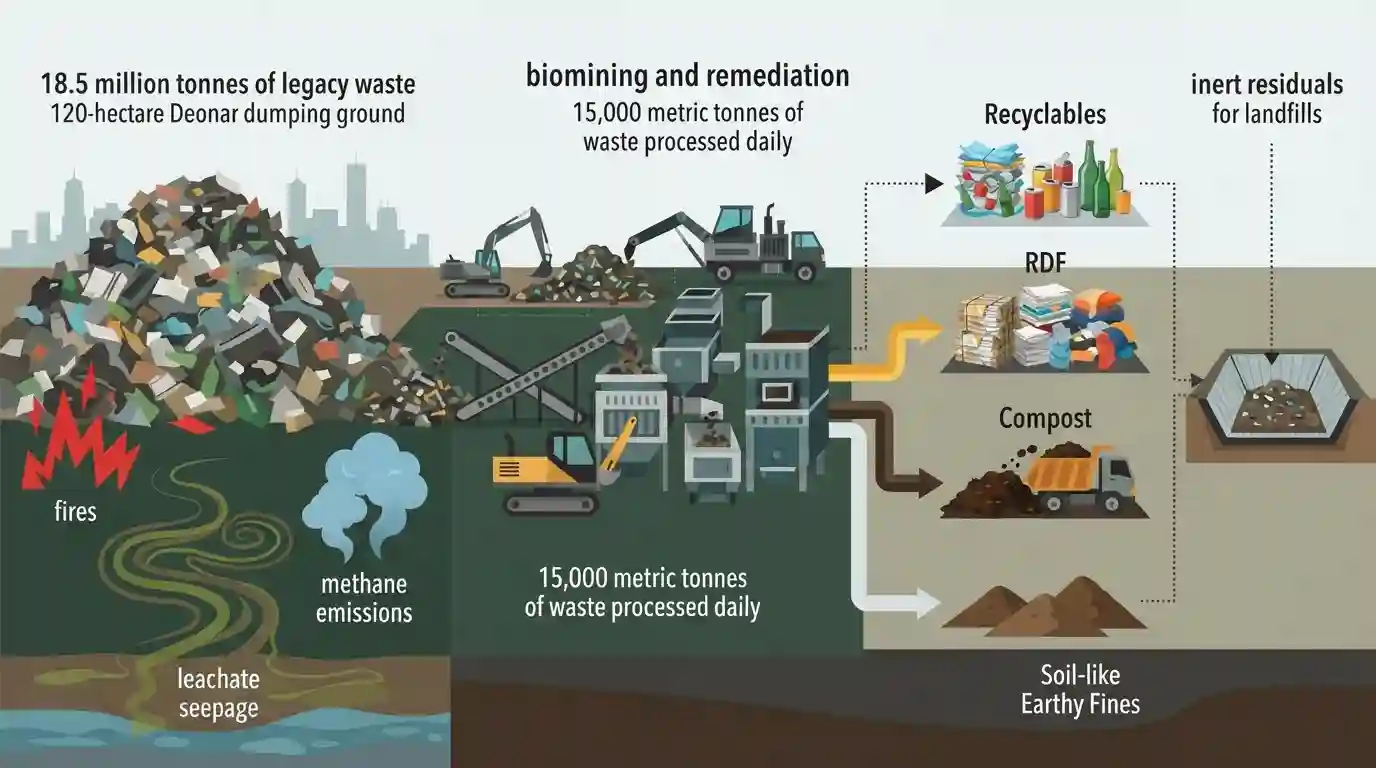
The Maharashtra Pollution Control Board (MPCB) has approved a massive biomining project to clear 18.5 million tonnes of legacy waste at Mumbai's historic 120-hectare Deonar dumping ground. The project, awarded to Navayuga Engineering Ltd, will process 15,000 metric tonnes of waste daily, extracting recyclables, RDF, compost, and soil-like earthy fines, leaving only inert residuals for landfills. This milestone address long-standing environmental hazards like leachate seepage, fires, and methane emissions in Mumbai.
Key Points
- The Maharashtra Pollution Control Board (MPCB) has granted a partial Consent to Operate for the 15,000-tonne-a-day biomining project at Mumbai's Deonar dumping ground.
- The project aims to scientifically process approximately 18.5 million tonnes (185 lakh tonnes) of accumulated legacy waste across a nearly 120-hectare site.
- Deonar is one of India's oldest and largest dumping grounds, operational since 1927, and has been a major source of air pollution (fires, methane emissions) and water pollution (leachate seepage).
- Biomining involves excavating, processing, and segregating legacy waste into Refuse Derived Fuel (RDF), compost, recyclables (plastic, glass, metals, rags), and residual soil-like earthy fines.
- Recoverable and non-recyclable plastic will be routed for road construction, RDF plants, and cement manufacturing, while earthy fines will be utilized for landscaping and greening. Only inert, unusable material will go to a scientific sanitary landfill.
- Navayuga Engineering Ltd won the contract for the remediation project after bidding 3% above the estimated project cost.
- Environmental compliance includes strict monitoring of dust, odour, fire hazards, methane emissions, slope stability, and leachate, especially during the monsoon.
Important Terms
Solid Waste Management Rules, 2016

A national legal framework mandating waste segregation at source, systematic collection, scientific treatment, and safe disposal. It prioritizes biomining, composting, and recycling to reduce dependency on landfills and mitigate urban pollution.
UPSC context
Vital for MPSC GS Paper 3 (Environment) and GS 2 (Governance). Tests knowledge of urban waste policies and civic compliance.
Environment (Protection) Act, 1986
An umbrella legislation enacted post-Bhopal Gas Tragedy. It empowers the Central Government to establish environmental quality standards, restrict hazardous substances, regulate industrial pollution, and mandate scientific waste management frameworks across India.
UPSC context
Crucial for MPSC GS Paper 3 (Environment). Frequently tests statutory frameworks for pollution control, legal mandates, and disaster mitigation strategies.
Maharashtra Pollution Control Board (MPCB)
The state-level statutory authority responsible for implementing environmental laws in Maharashtra. It monitors air and water quality, regulates hazardous waste, issues operational consents for projects, and enforces anti-pollution measures.
UPSC context
Key for MPSC GS Paper 3 and State Administration. Evaluates understanding of state statutory bodies, environmental clearances, and regional pollution enforcement.
Brihanmumbai Municipal Corporation (BMC)
The governing civic body of Greater Mumbai. It manages metropolitan urban administration, public health, sanitation, and essential infrastructure, including handling daily waste generation and overseeing legacy landfill remediation projects like Deonar.
UPSC context
Relevant for MPSC GS Paper 2 (Local Self-Government) and GS 3. Tests knowledge of urban governance, metropolitan challenges, and municipal finance.
Prelims Trap
Biomining of municipal legacy waste uses biological microbes to completely dissolve plastic and solid waste.
In solid waste management, biomining actually involves mechanical excavation, trommel screening, and segregation to recover RDF and soil fines, not dissolving plastics via microbes.
Static Concepts Connected
What is Refuse Derived Fuel (RDF) and its application?
- Definition: Fuel produced by shredding and dehydrating solid waste, consisting largely of combustible components like non-recyclable plastics and biodegradable waste.
- Industrial Application: Used as a substitute for fossil fuels (like coal) in cement kilns, metallurgical processes, and waste-to-energy power plants.
- Policy Mandate: Environmental rules encourage energy-intensive industries within 100 km of an RDF plant to replace a percentage of their conventional fuel with RDF.
What is the statutory backing of State Pollution Control Boards (SPCBs/MPCB)?
- Primary Legislation: Constituted under the Water (Prevention and Control of Pollution) Act, 1974, making them statutory bodies.
- Air Act Enforcement: They are also entrusted with enforcing the Air (Prevention and Control of Pollution) Act, 1981.
- Regulatory Power: They issue mandatory 'Consent to Establish' (CTE) and 'Consent to Operate' (CTO) for industries and waste processing plants.
Cross-Topic Patterns
Urban Governance + SWM Rules
Solid waste management falls under the 12th Schedule (74th CAA). MPSC often links urban local bodies' (like BMC) capacity to handle legacy waste with municipal governance and statutory obligations.
Legacy Waste + Methane Emissions
Deonar's untreated legacy waste is a massive source of anaerobic methane. Clearing it connects local urban planning directly to India's climate change mitigation commitments and greenhouse gas reduction.

Expect a multi-statement question distinguishing biomining from capping, linking RDF use in cement kilns and MPCB's statutory mandate.
Linked PYQs · 2
Linked PYQs · 2
- 2015MPSC_PRELIMSGS1
Match the following : | List 1 (Environmental Legislation) | List 2 (Years) | |---|---| | A. Environmental Protection Act | I. 1991 | | B. Scheme of labelling of environment friendly products | II. 2000 | | C. Biomedical Waste Management Rules | III. 1986 | | D. Municipal Solid Wastes Management Rules | IV. 1998 | Code: A B C D
- 2025MPSC_PRELIMSGS1
As per the Hazardous Waste (Management, Handling and Transboundary Movement) Rules, 2008, the ________ shall be the nodal Ministry to deal with the transboundary movement of the hazardous wastes and to grant permission for transit of the hazardous wastes through any part of India.
