Madhya Pradesh Launches Plantation Campaign on World Environment Day
Source:newsonair ↗
Why It Matters
This update covers state-specific water conservation initiatives (Jal Ganga Samvardhan Abhiyan, Stepwell preservation), environmental governance bodies (EPCO), and long-standing historical remediation efforts concerning the Bhopal Union Carbide site, making it highly relevant for MPPSC Prelims' environmental and state GS segments.
Summary
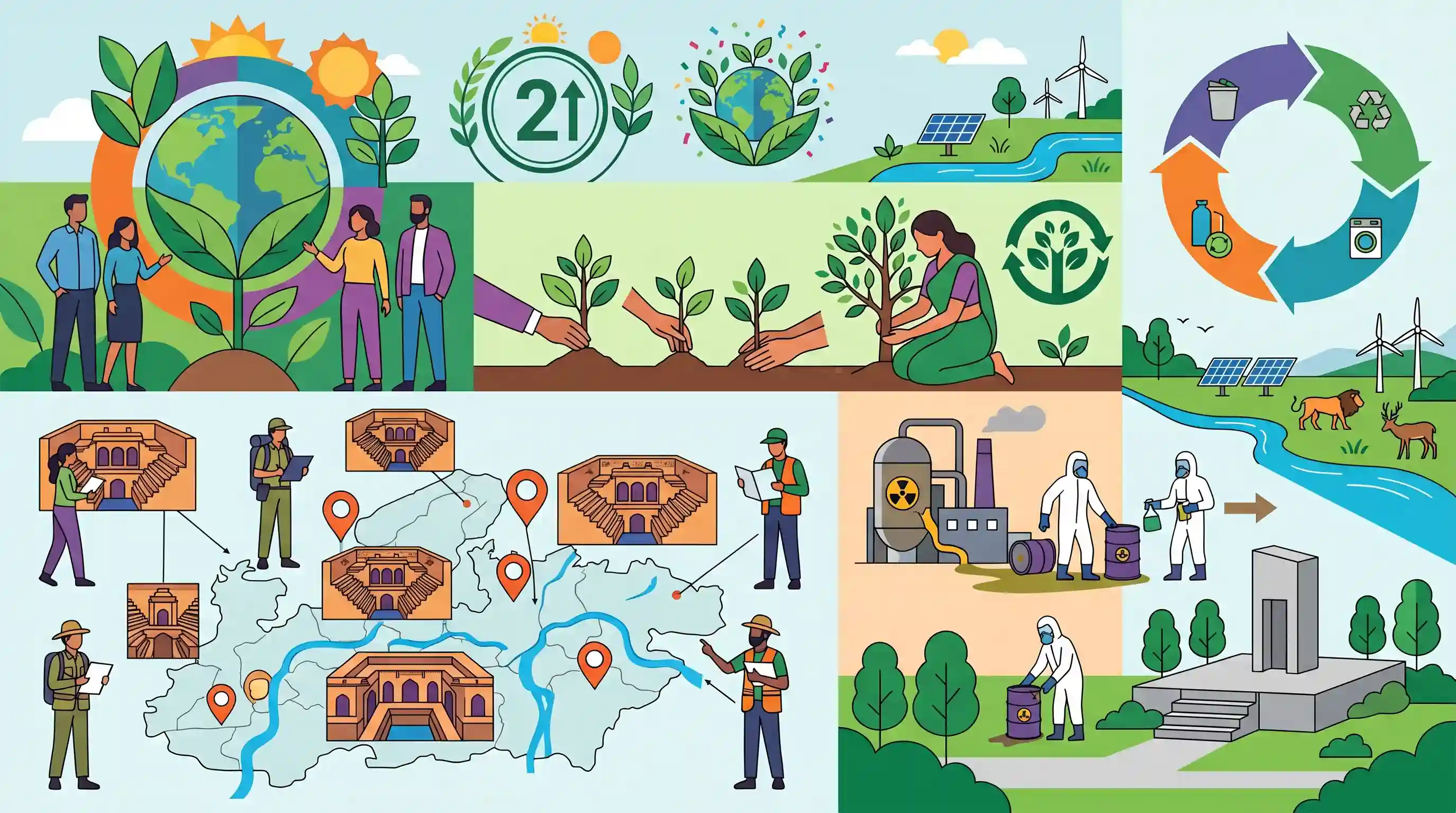
The Madhya Pradesh government celebrated World Environment Day 2026 by launching the 'Ek Ped Maa Ke Naam 2.0' plantation campaign. Key releases included modules on Circular Economy and extensive mapping of 500 historic stepwells (baoris) across 16 districts under the 'Jal Ganga Samvardhan Abhiyan' by EPCO and INTACH. Additionally, the Chief Minister announced updates on the toxic waste disposal and planned memorial at the Bhopal Union Carbide site.
Key Points
- On World Environment Day (June 5, 2026), Chief Minister Dr. Mohan Yadav launched the 'Ek Ped Maa Ke Naam 2.0' campaign at the Kushabhau Thakre International Convention Centre in Bhopal.
- The CM released five course modules on 'Circular Economy' and documentation cataloging 500 stepwells (baoris) across 16 districts of MP.
- The stepwell mapping was conducted under the 'Jal Ganga Samvardhan Abhiyan' jointly by EPCO and INTACH.
- A total of 11 state-level environment awards across 8 categories were presented to organizations and individuals for contribution to pollution control and sustainable development.
- An update was shared regarding the Union Carbide site in Bhopal: toxic waste has been disposed of as per Supreme Court directions, and the government plans to construct a memorial at the location.
- Governor Mangubhai Patel and Chief Secretary Anurag Jain participated in parallel plantation drives at Lokbhawan and Mantralaya, respectively.
Important Terms
Ek Ped Maa Ke Naam 2.0 Campaign

A nationwide tree-plantation initiative launched to encourage citizens to plant a sapling in tribute to their mothers, promoting public participation in afforestation, biodiversity conservation, and monitoring growth via digital portals.
UPSC context
GS Paper III (Environment): Tests public participation in afforestation, climate action, and community-led ecological restoration strategies.
Jal Ganga Samvardhan Abhiyan
A state-wide conservation campaign by the Madhya Pradesh government aimed at clean-up, restoration, and rejuvenation of traditional water bodies (including rivers, wells, ponds, and historic stepwells/baoris) through intensive community participation.
UPSC context
GS Paper I & III (Water Resources): Tests traditional water harvesting structures, decentralized resource management, and regional conservation policies.
EPCO (Environmental Planning & Coordination Organisation)
An autonomous environmental advisory think-tank established by the Government of Madhya Pradesh in 1981, tasked with assisting the state in policy formulation, EIA studies, wetland conservation, and raising environmental awareness.
UPSC context
GS Paper III (Environmental Governance): Tests state-level regulatory institutions, sustainable development, and environmental policy formulation.
INTACH (Indian National Trust for Art and Cultural Heritage)
A premier national non-profit organization founded in 1984, dedicated to conserving India's built, natural, and intangible heritage, and fostering community awareness about historical monuments and cultural legacy.
UPSC context
GS Paper I (Art & Culture): Tests heritage conservation, civil society's role, and structural restoration of historical architecture.
Union Carbide India Limited
The chemical company whose defunct pesticide plant in Bhopal was the site of the catastrophic 1984 gas tragedy, historically requiring extensive court-monitored toxic waste disposal and soil/groundwater remediation.
UPSC context
GS Paper III (Disaster Management): Tests industrial disaster response, hazardous waste protocols, and polluter-pays liability principles.
Prelims Trap
Toxic chemical waste from the defunct Bhopal Union Carbide plant was exported to Germany for safe disposal.
For over a decade, exporting the waste to Germany or other European nations was heavily litigated. However, the toxic waste was ultimately incinerated domestically at the TSDF facility in Pithampur, Madhya Pradesh.
Static Concepts Connected
What is the historical evolution of Stepwells (Baoris) in India and their ecological role?
- Architectural origin: Developed primarily in arid/semi-arid regions (Gujarat, Rajasthan, MP) during medieval times to collect and store seasonal monsoon rainwater.
- Ecological function: Served as subterranean aquifers that maintained local microclimates, recharged groundwater, and functioned as community gathering spaces.
- Prominent examples: Includes Rani ki Vav (UNESCO site, Gujarat), Chand Baori (Rajasthan), and the unique multi-tiered stepwells of MP's Malwa/Bundelkhand.
How did the 1984 Bhopal Gas Tragedy reshape India's environmental legislation?
- The Catalyst: The leak of highly toxic Methyl Isocyanate (MIC) gas exposed a severe regulatory vacuum in hazardous industrial operations.
- Legislative Overhaul: Directly prompted the enactment of the landmark Environment (Protection) Act, 1986, serving as umbrella legislation for environmental safety.
- Regulatory Offshoots: Led to the Hazardous Waste Rules, 1989, and the Public Liability Insurance Act, 1991, to provide immediate relief to victims of industrial accidents.
Cross-Topic Patterns
Traditional Hydrology + Climate Adaptation
Reviving historical stepwells bridges cultural heritage conservation with modern climate-resilience strategies, offering localized, decentralized solutions to urban water scarcity and groundwater depletion.
Industrial Disasters + Environmental Jurisprudence
The legislative legacy of Bhopal's industrial disaster underpins India's modern hazardous waste management rules, showing how historic remediation shapes current circular economy frameworks.

Traditional water-harvesting systems (Baoris/Surangams) mapped against modern rejuvenation schemes will likely feature in Prelims 2026.
Linked PYQs · 3
Linked PYQs · 3
- 2021MPPSC_PRELIMSGS1
In which year Bhopal Gas disaster occurred?
- 2008MPPSC_PRELIMSGS1
Gas released during Bhopal gas tragedy was:
- 2022MPPSC_PRELIMSGS1
Which of the following is a major source of irrigation in Madhya Pradesh?
