Madhya Pradesh Uniform Civil Code Final Draft Submission
Source:ummid ↗
Why It Matters
The implementation of UCC at the state level involves complex legal procedures since personal laws fall under the Concurrent List. It highlights constitutional mechanisms like Article 44 (DPSP), Article 201 (Presidential Assent), and Article 342 (Tribal notifications), alongside socio-legal debates on uniformity versus diversity.
Summary
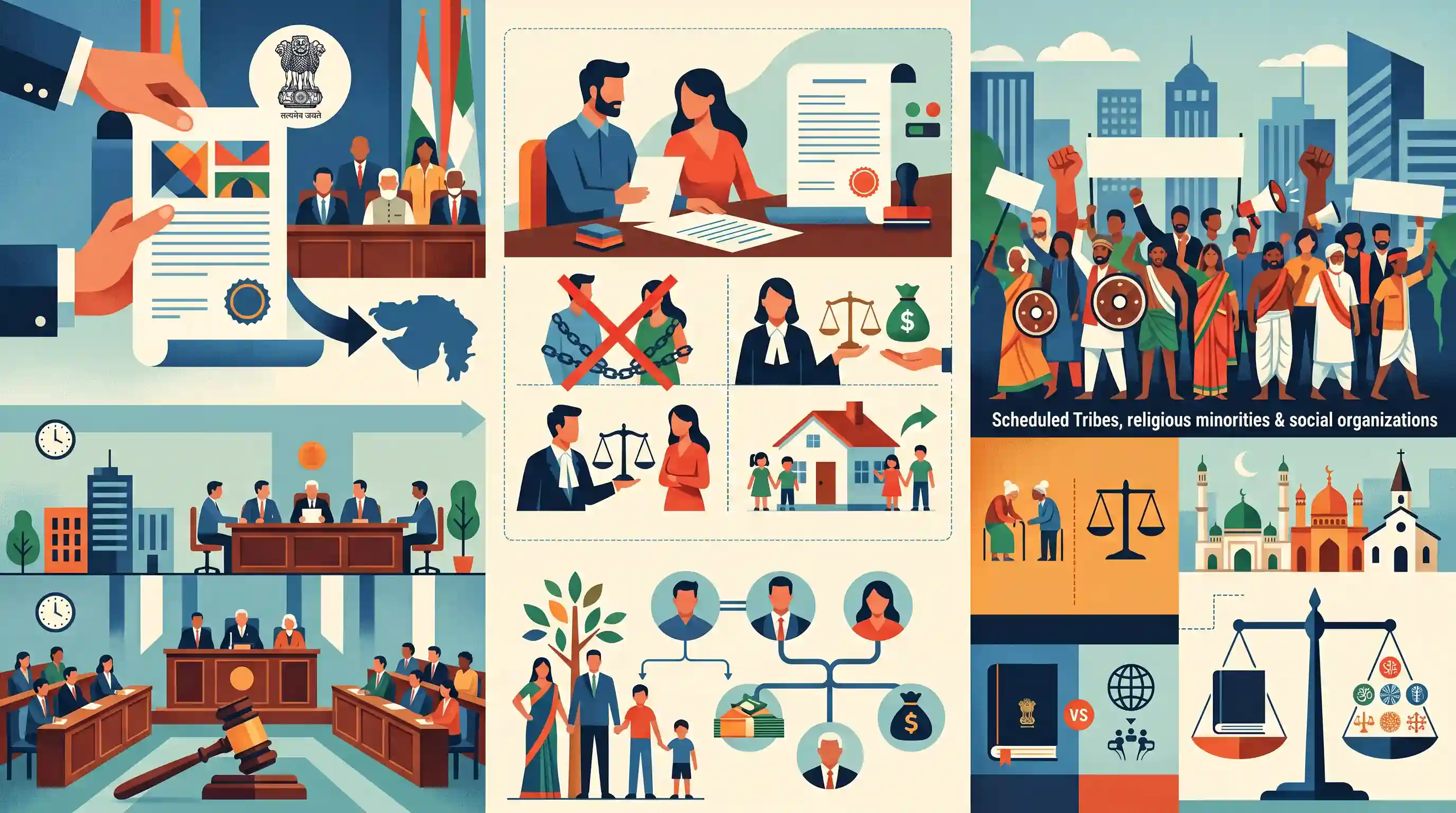
The High-Level Committee on the Uniform Civil Code (UCC) in Madhya Pradesh submitted its final draft to the state government on July 13, 2026. Modeled on Gujarat's draft, the MP UCC proposes mandatory registration of live-in relationships (criminalizing non-registration), maintenance rights for deserted live-in partners, and property shares for children born out of such unions. It also revises succession laws, making both parents a single unit to inherit a deceased son's property. The draft is scheduled to be cleared in a Cabinet meeting at Jagdishpur (Islam Nagar) on July 19, 2026, and tabled in the Assembly on July 20, 2026. However, various social organizations have formed a Joint Action Committee (JAC) in Bhopal to protest the bill, raising concerns over its impact on personal laws and customary practices of Scheduled Tribes (STs), SCs, and religious minorities.
Key Points
- On July 13, 2026, Madhya Pradesh's High-Level Committee on the Uniform Civil Code (UCC) submitted its final draft to the state government.
- The draft is structured in three parts: Recommendations, the Draft UCC Bill, and public opinion compiled from district/state consultations and web suggestions.
- Based on the Gujarat model, the MP UCC draft mandates registration of live-in relationships. Failing to register a live-in relationship is classified as a criminal offense.
- Under live-in relationship rules, a copy of the registration goes to the local police station and another to the parents. Desserted female partners can seek maintenance, and children born from such relationships are legally entitled to parental property.
- For succession laws, both parents (mother and father) are treated as a single unit to claim a share in the property of a deceased son. Under existing personal/succession laws, only the mother was eligible along with the wife and children.
- The draft bill is expected to be approved in a cabinet meeting in Jagdishpur (formerly Islam Nagar) on July 19, 2026, and tabled in the Assembly on July 20, 2026. Once passed, it will require presidential assent (Articles 200/201).
- Muslim social organizations in Bhopal have formed a Joint Action Committee (JAC) to oppose the draft, claiming it sidelines Scheduled Tribes (STs), Scheduled Castes (SCs), and other religious minorities like Christians.
- If enacted, Madhya Pradesh will become the fourth Indian state to implement the Uniform Civil Code, after Uttarakhand, Gujarat, and Assam.
Important Terms
Uniform Civil Code (UCC) Bill

A proposed law aimed at replacing faith-based personal laws with a uniform, common set of civil rules governing marriage, divorce, succession, and adoption for all citizens regardless of their religious affiliation.
UPSC context
GS Paper II (Polity & Constitution). Tests understanding of Article 44 (DPSP), federalism, and the intersection of religious freedom with gender equality.
Indian Constitution
The supreme legal document of India that defines the political structure, fundamental rights, and Directive Principles of State Policy, including Article 44, which guides the state to implement a Uniform Civil Code.
UPSC context
GS Paper II (Indian Constitution). Tests comprehensive understanding of constitutional values, federal structure, and the relationship between fundamental rights and directive principles.
High-Level Committee on UCC (Madhya Pradesh)
An expert panel, led by retired Supreme Court Justice Ranjana Prakash Desai, tasked with drafting the Uniform Civil Code for Madhya Pradesh by examining state-specific legal, social, and cultural frameworks.
UPSC context
GS Paper II (Governance/State Legislature). Tests knowledge of executive-led law-making processes, public consultation mechanisms, and committee recommendations in state policy formulation.
Joint Action Committee (JAC)
A pressure group formed by various minority, Christian, and tribal organizations in Madhya Pradesh to collectively protest and raise legal and cultural objections against the proposed Uniform Civil Code.
UPSC context
GS Paper II (Pressure Groups & Civil Society). Tests understanding of democratic protests, civil society advocacy, and the protection of minority and tribal customary rights.
Bharatiya Janata Party (BJP)
India's ruling national political party, which governs Madhya Pradesh, whose core ideological agenda includes implementing a Uniform Civil Code across India to achieve legal uniformity.
UPSC context
GS Paper II (Political Parties). Tests knowledge of major political parties, legislative goals, and how party manifestos shape state-level constitutional and legal reforms.
Rashtriya Swayamsevak Sangh (RSS)
A right-wing, Hindu nationalist volunteer organization that serves as the ideological parent body of the ruling BJP, consistently advocating for a Uniform Civil Code to replace religion-specific personal laws.
UPSC context
GS Paper I & II (Indian Society / Pressure Groups). Tests understanding of ideological movements, social organizations, and their influence on public policy and secularism.
Prelims Trap
Goa's Uniform Civil Code was the first civil code enacted by an Indian state legislature to fulfill Article 44.
Goa's code was not enacted by a state assembly under Article 44; it is a pre-Independence Portuguese Civil Code of 1867 preserved via a 1962 post-liberation parliamentary transit law.
Static Concepts Connected
How can a State UCC legally override central laws like the Hindu Marriage Act?
- Concurrent List Entry: Personal law subjects like marriage, divorce, and succession are placed in Entry 5 of the Concurrent List.
- Article 254(2) Assent: Under Article 254(2), a state law on a Concurrent subject that is repugnant to a central law can prevail if it receives Presidential assent.
- Governor's Reservation: The State Governor must reserve the passed Bill under Article 200/201 for the consideration and assent of the President of India.
What constitutional provisions protect tribal customary laws from uniform civil laws?
- Customary Protections: Scheduled Tribes defined under Article 366(25) read with Article 342 enjoy specific cultural protections that insulate their customary laws.
- Article 371 Exemptions: Articles 371A (Nagaland) and 371G (Mizoram) explicitly protect local customary law and civil justice systems from parliamentary acts.
- Fifth and Sixth Schedules: Fifth and Sixth Schedule areas are granted administrative autonomy to govern personal and land matters through local councils.
Cross-Topic Patterns
DPSP implementation vs. Federalism
Article 44 directs a uniform code "throughout the territory of India," but individual state enactments create a fragmented legal landscape, testing the boundaries of cooperative federalism.
Article 21 vs. Article 44 friction
State UCC clauses criminalizing unregistered live-in relationships create a direct constitutional friction between Article 44 (DPSP) and Article 21 (Right to Privacy and Autonomy).

State UCCs will likely trigger 2026 questions testing Article 254(2) repugnancy, Concurrent List Entry 5, and tribal customary exemptions.
Linked PYQs · 3
Linked PYQs · 3
- 2023MPPSC_PRELIMSGS1
The Directive Principles of State Policy are explained in Part IV of the Indian Constitution. This system has been taken from the Constitution of which country ?
- 2025MPPSC_PRELIMSGS1
In present times, Right to Property has been accepted in the Indian Constitution in which of the following forms?
- 2025MPPSC_PRELIMSGS1
Under which Article of the Indian Constitution does the President issue a public notification for the Scheduled Tribes for a specific state?
