Paper Leak Offenses: Fast Track Courts Set Up in Madhya Pradesh
Source:daily-pioneer ↗
Why It Matters
Exams and recruitment processes have seen severe setbacks due to widespread paper leaks across India. Setting up fast-track courts demonstrates a strong policy response to restore faith in public service commissions and educational institutions by ensuring speedy trials and timely justice.
Summary
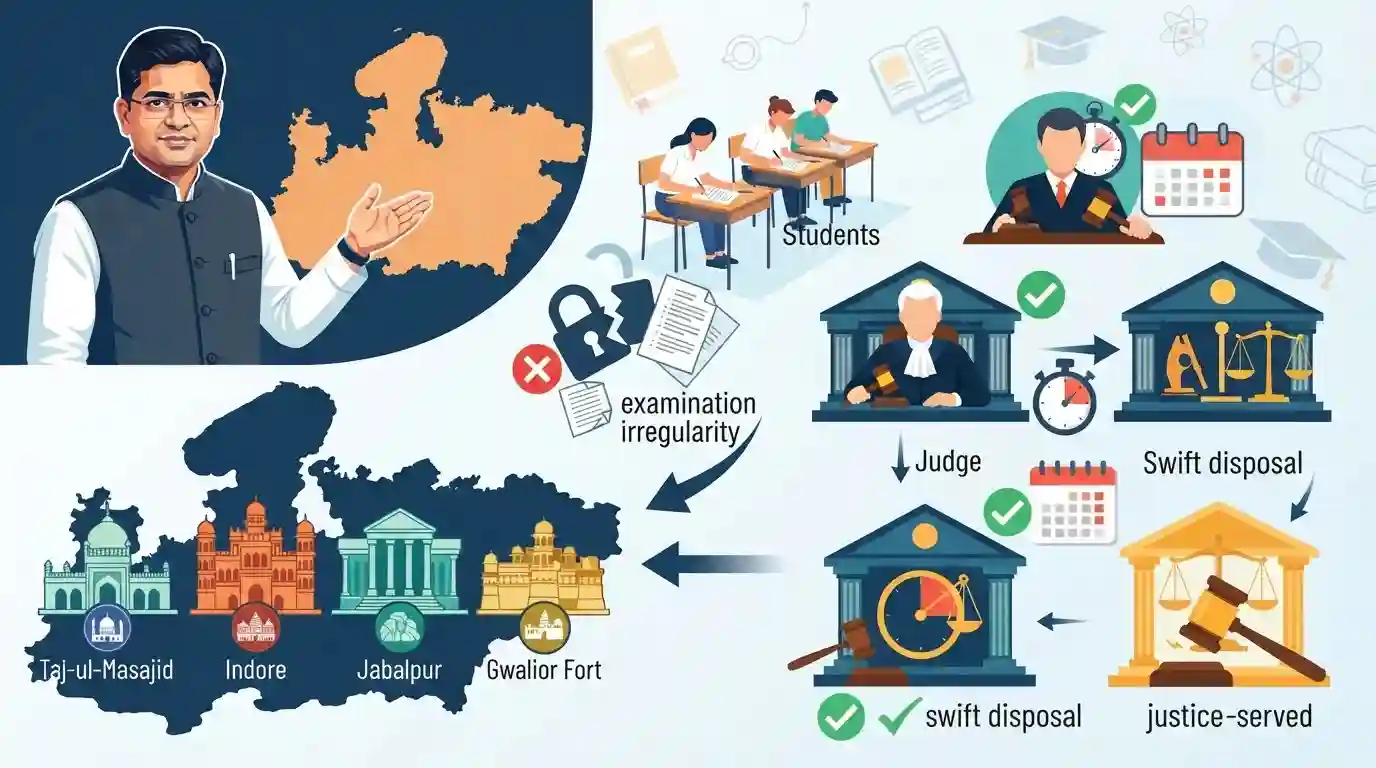
The Madhya Pradesh Government, led by Chief Minister Mohan Yadav, has decided to establish four fast-track courts in Bhopal, Indore, Jabalpur, and Gwalior to deal with cases of paper leaks and examination irregularities. MP will be the first Indian state to set up such dedicated judicial forums, aiming for the swift disposal of education-related offenses within three months.
Key Points
- The Madhya Pradesh state government has ordered the setting up of four fast-track courts across the state to handle cases related to paper leaks and examination irregularities.
- Chief Minister Mohan Yadav announced that these special judicial mechanisms will be established in Bhopal, Indore, Jabalpur, and Gwalior.
- Madhya Pradesh will become the first state in India to establish dedicated fast-track courts targeting examination malpractices.
- The fast-track courts will be mandated to hear and resolve cases within a three-month timeframe to ensure speedy justice.
Important Terms
Fast-Track Courts (FTCs)

Special courts designed to expedite trial processes and reduce case pendency. They target specified case categories for priority hearing to deliver quicker justice. In 2026, they were introduced to handle paper leak cases.
UPSC context
GS Paper II (Polity & Governance). Relevant for judicial reforms, tackling pendency, and upholding timely justice mechanisms.
Public Examinations (Prevention of Unfair Means) Act, 2024
A 2024 national legislation aimed at curbing widespread exam malpractices, paper leaks, and organized cheating. Under July 2026 amendments, it features increased prison terms (up to 10 years), massive fines, and fast-track courts.
UPSC context
GS Paper II (Governance). Examines transparency, accountability in recruitment, and structural reforms to Indian testing agencies.
Madhya Pradesh
A central Indian state whose High Court, in July 2026, became the first to designate four special fast-track courts (in Bhopal, Indore, Jabalpur, Gwalior) exclusively for exam paper leak cases.
UPSC context
GS Paper II (Governance/State Admin). Highlights pioneering state-level interventions aligning with central judicial directives.
Prelims Trap
Fast-Track Courts are established directly by the Union Judiciary under the Public Examinations (Prevention of Unfair Means) Act, 2024.
FTCs are established by State Governments in consultation with their respective High Courts, not directly by the Union under central statutes.
Static Concepts Connected
How are Fast-Track Courts (FTCs) set up and governed in India?
- State Jurisdictional Role: State Governments set up FTCs in consultation with their respective High Courts.
- Financial Commission Origin: The 11th Finance Commission in 2000 first recommended FTCs to reduce massive judicial pendency.
- Judicial Supervision: High Courts retain administrative control over these courts, including judges' appointments and postings.
What are the parameters of the Public Examinations Act, 2024?
- Target Institutions: Covers exams conducted by central authorities like UPSC, SSC, RRB, NTA, and IBPS.
- Legal Nature: All offenses under this Act are cognizable, non-bailable, and non-compoundable.
- Punitive Measures: Prescribes imprisonment from 3 to 10 years and fines up to ₹1 crore for organized malpractices.
Cross-Topic Patterns
Judicial pendency vs. administrative reforms
Ad-hoc judicial fast-tracking shifts judicial burdens without addressing deep-rooted structural vacancies and inadequate judge-to-population ratios in lower judiciaries.
Federalism in educational governance
While the Center regulates central exams via the 2024 Act, states create local judicial mechanisms, illustrating the concurrent responsibility of educational integrity.

UPSC 2026 may test the constitutional mechanism of establishing Fast-Track Courts versus Central Acts governing public examinations.
Linked PYQs · 3
Linked PYQs · 3
- 2012MPPSC_PRELIMSGS1
A Court of Session specified as Special Court to try the offences under the Scheduled Castes and Scheduled Tribes (Prevention of Atrocities) Act for the purpose of providing:
- 2020MPPSC_PRELIMSGS1
A Joint State Public Service Commission may be established for two or more States.
- 2023MPPSC_PRELIMSGS1
Through Which Amendment of the Constitution has the Right to Education became a Fundamental Right?
