Single Annual Crop Loan System for Farmers in Madhya Pradesh
Source:socialnews-xyz ↗
Why It Matters
Agricultural policies, irrigation statistics (such as the 55 lakh hectare milestone), and river-linking projects (like the PKC link) are high-priority topics frequently asked in the MPPSC State Service Prelims.
Summary
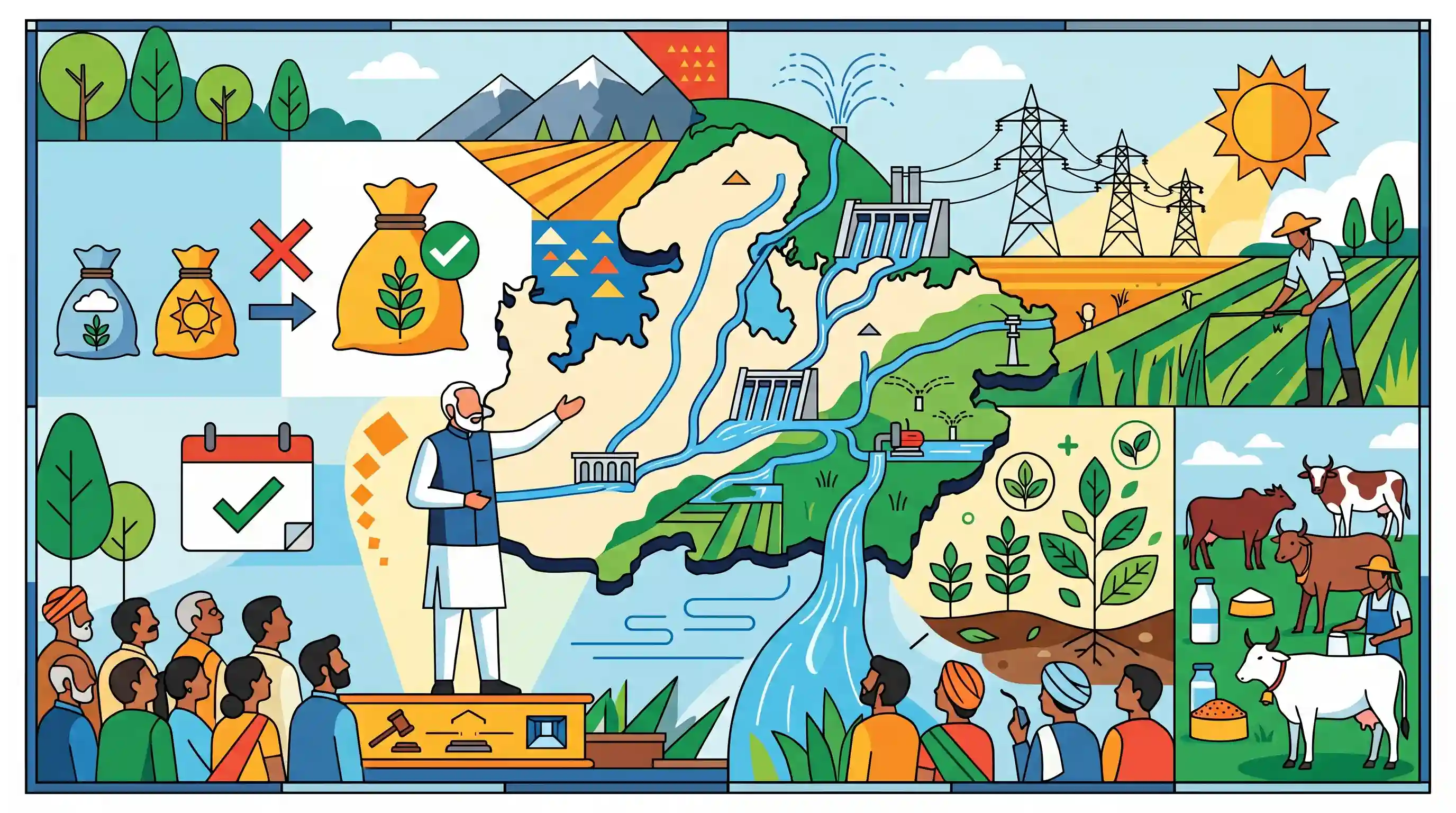
Madhya Pradesh Chief Minister Mohan Yadav announced the transition to a single annual crop loan system to replace the existing dual loan mechanism for Kharif and Rabi crops. Speaking at the 'Kisan Samriddhi Sankalp Sammelan' in Shajapur district, he also highlighted the expansion of MP's irrigation coverage to over 55 lakh hectares, progress on the Parvati-Kalisindh-Chambal (PKC) river-linking scheme, daytime agricultural electricity schemes, and targeted support for natural farming and cattle rearing.
Key Points
- Single Crop Loan: MP is set to introduce a single annual crop loan for farmers, consolidating separate Kharif and Rabi loans to enhance agricultural credit access.
- Irrigation Expansion: The state's total irrigated area has expanded to over 55 lakh hectares.
- River Linking & Water Projects: The Parvati-Kalisindh-Chambal (PKC) river-linking project will be expedited to expand irrigation, and Narmada river water will be brought to every village in Shajapur.
- Daytime Power Supply: The state government plans to provide electricity for irrigation during the daytime in a phased manner to reduce night-time hardships for farmers.
- Natural Farming & Animal Husbandry: Special incentives will be provided to encourage natural farming, alongside financial and technical support to cattle rearers for boosting milk production.
Important Terms
Parvati-Kalisindh-Chambal (PKC) river-linking project

An inter-state river-linking project integrated with the Eastern Rajasthan Canal Project (ERCP) to divert surplus monsoon water from the Chambal basin to water-deficit regions in Madhya Pradesh and Rajasthan, optimizing drinking and irrigation access.
UPSC context
Tested in GS Paper I (Geography - Water Resources) and GS Paper III (Irrigation, Interlinking of Rivers, and Agriculture).
Kisan Samriddhi Sankalp Sammelan
A farmer-centric convention organized by the Madhya Pradesh government to launch critical agricultural initiatives, distribute development funds, and promote rural welfare programs such as ecological campaigns.
UPSC context
Relevant for GS Paper II (Government Schemes & Interventions) and GS Paper III (Rural Development and Agricultural Welfare).
Single Annual Crop Loan
A credit facilitation scheme providing farmers with a unified, year-long agricultural loan instead of separate loans for Kharif and Rabi seasons, easing credit access and financial burdens.
UPSC context
Tested in GS Paper III (Agricultural Credit, Financial Inclusion, and Farmer Welfare Policies).
Natural Farming
A chemical-free, ecological farming practice relying on natural on-farm resources, bio-inputs, and natural processes to improve soil health, enhance biodiversity, and lower farmers' production costs.
UPSC context
Relevant for GS Paper III (Sustainable Agriculture, Soil Conservation, and Climate-Resilient Agricultural Practices).
Ken-Betwa Link Project
India's first river interlinking project under the National Perspective Plan, aimed at transferring surplus water from the Ken River in Madhya Pradesh to the drought-prone Betwa basin in Uttar Pradesh to irrigate Bundelkhand.
UPSC context
Tested in GS Paper I (Geography - Water Bodies) and GS Paper III (Irrigation, Environmental Impact Assessment, and Infrastructure).
Prelims Trap
The Modified PKC-ERCP (Ramjal Setu) project was approved at a 50% water dependability yield to maximize diverted volume.
Central Water Commission guidelines require a strict 75% dependability yield for interstate projects to ensure water security; a 50% yield is unacceptable for joint national schemes.
Static Concepts Connected
What is the 75% water dependability rule in Indian river-linking projects?
- Definition: It refers to the minimum volume of water flow available in a river basin for at least 75 out of 100 years.
- CWC Mandate: The Central Water Commission mandates this threshold for allocating water in major interstate river-linking projects to ensure legal viability.
- Conflict Resolution: Integrating the PKC link solved the ERCP dispute by upgrading Rajasthan's original 50% dependability proposal to the mandatory 75%.
How does the Kisan Credit Card (KCC) system define loan defaults under IRAC norms?
- NPA Trigger: KCC loans are classified as NPAs if unpaid for two crop seasons (short-duration crops) or one crop season (long-duration crops).
- Crop Duration: Short-duration crop cycles are under 12 months, whereas long-duration crop cycles exceed 12 months (like sugarcane).
- Monitoring Simplification: Single annual credit limits simplify monitoring by aligning the loan tenure with the standardized 12-month short-duration cycle.
Cross-Topic Patterns
Federal Hydrology vs Water Disputes
Standardising technical parameters like 75% dependability helps resolve long-standing riparian conflicts, converting political disputes into collaborative cooperative federalism projects.
KCC Reforms vs NPA Management
Consolidating seasonal credit into single annual loans simplifies banking operations but risks hiding structural crop-cycle failures if not tightly mapped to RBI's IRAC norms.

Interstate river links (PKC-ERCP) and the hydrology concept of 75% dependability yield will likely feature in GS-1/GS-3 2026.
Linked PYQs · 3
Linked PYQs · 3
- 2020MPPSC_PRELIMSGS1
Chambal Canal Irrigation Project is related with
- 2022MPPSC_PRELIMSGS1
Which of the following is a major source of irrigation in Madhya Pradesh?
- 2024MPPSC_PRELIMSGS1
UNNATI (Agri-GISl project of Madhya Pradesh Government is for :
