Mission Buniyaad Introduces AI Learning in MP Schools
Source:timesofindia ↗
Why It Matters
State-level schemes like Mission Buniyaad and the Kavach Scheme are high-probability topics for MPPSC Prelims questions focusing on state governance, welfare policies, and digital initiatives. The commemoration of 150 years of Vande Mataram also provides a strong cultural and historical linkage relevant to the exam.
Summary
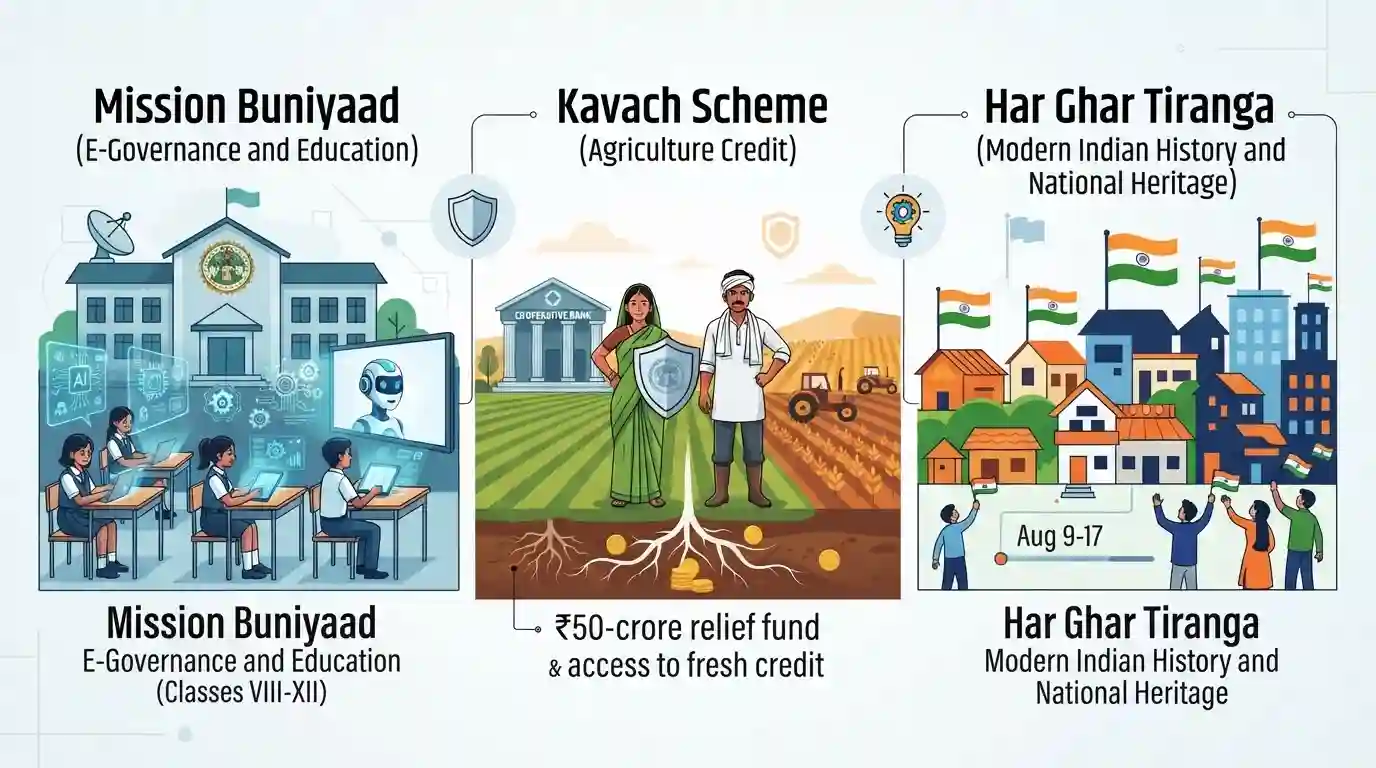
The Madhya Pradesh cabinet has approved multiple significant initiatives spanning education, agriculture, and national heritage. Under 'Mission Buniyaad', AI-based learning will be introduced in 500 government schools to boost technological literacy among students from Classes VIII to XII. For the agricultural sector, the 'Kavach Scheme' was sanctioned to provide a ₹50-crore relief fund for farmers unable to secure fresh credit due to ongoing probes into their cooperative bank loan accounts. Additionally, the state will observe the 'Har Ghar Tiranga' campaign from August 9 to 17 to celebrate 150 years of the national song, Vande Mataram.
Key Points
- The Madhya Pradesh government will implement an Artificial Intelligence (AI) learning programme in 500 government schools across eight districts under 'Mission Buniyaad' to develop students' digital skills.
- The cabinet approved the 'Kavach Scheme' to provide relief to around 5,000 farmers whose loan accounts in cooperative banks are under investigation, backed by a ₹50-crore fund.
- The state will organize the 'Har Ghar Tiranga' campaign from August 9 to 17, uniquely dedicating it this year to commemorate 150 years of the national song, Vande Mataram.
Important Terms
Mission Buniyaad

An educational initiative by the Madhya Pradesh government introducing artificial intelligence (AI) and emerging technology modules in 500 government schools for students in classes VIII to XII.
UPSC context
Relevant for GS Paper 2 (Education) and GS Paper 3 (Technology), highlighting state-level integration of AI into foundational schooling.
Kavach Scheme
A Madhya Pradesh government scheme creating a ₹50-crore fund to restore formal credit access and welfare eligibility for farmers whose cooperative loan accounts were frozen due to pending administrative investigations.
UPSC context
Important for GS Paper 3 (Agricultural Credit) and GS Paper 2 (Government Schemes), illustrating mechanisms to shield farmers from systemic credit blockages.
Har Ghar Tiranga
A mass campaign encouraging citizens to hoist the Indian tricolor at home. In 2026, Madhya Pradesh integrated this observance with nationwide celebrations marking the 150th anniversary of the national song, Vande Mataram.
UPSC context
Links GS Paper 1 (Modern Indian History) and GS Paper 2 (Governance), emphasizing cultural nationalism and civic participation initiatives.
Apex Bank
The Madhya Pradesh Rajya Sahakari Bank, which serves as the state's highest cooperative banking authority. It channels agricultural credit and NABARD funds through district cooperative banks to rural farmers.
UPSC context
Relevant for GS Paper 3 (Indian Economy), specifically for understanding the tier-based cooperative banking structure and rural credit distribution.
District Central Cooperative Banks
Mid-tier financial institutions in the cooperative banking structure operating at the district level. They act as intermediaries between the state Apex Bank and Primary Agricultural Credit Societies, facilitating rural loans.
UPSC context
Crucial for GS Paper 3 (Agriculture), as they are the primary engines for rural credit delivery and financial inclusion at the grassroots level.
Prelims Trap
"The Prevention of Insults to National Honour Act, 1971 penalizes disrespect to the National Flag, National Anthem, and National Song."
The 1971 Act currently protects the National Flag, Constitution, and National Anthem. It does not explicitly cover the National Song, making this a classic UPSC legal-status trap.
Static Concepts Connected
What is the historical significance of Vande Mataram and the novel Anandamath?
- Origins: Composed by Bankim Chandra Chattopadhyay around 1876, it was later incorporated into his 1882 Bengali novel, Anandamath.
- Historical Backdrop: The novel is famously set against the backdrop of the Sannyasi Rebellion of the late 18th century in Bengal.
- Political Debut: It was first sung in a political context by Rabindranath Tagore at the 1896 Calcutta session of the Indian National Congress.
What are the provisions of the Prevention of Insults to National Honour Act, 1971?
- Protected Entities: It explicitly penalizes disrespect directed at the National Flag, the Constitution of India, and the National Anthem.
- National Song Status: Adopted on January 24, 1950, the National Song enjoys equal status with the Anthem but currently lacks this specific statutory penal protection.
Cross-Topic Patterns
History meets Statutory Law
UPSC frequently links historical symbols to modern laws. The 150th anniversary of Vande Mataram makes the distinction between the National Anthem's and Song's legal protections highly testable in Polity.
Agri-credit and Cooperative bottlenecks
MP's Kavach scheme highlights a critical GS3 issue: institutional credit disruption. Probes into cooperative banks freeze farmer accounts, pushing them toward informal, high-interest lenders.
AI integration in basic education
State schemes like MP's Mission Buniyaad reflect the NEP 2020 mandate of integrating AI literacy early, offering excellent localized case studies for Mains GS2 (Education) and GS3 (Technology).

Expect a 2026 prelims question mixing Vande Mataram's historical origins (Anandamath, 1896 INC) with its legal status vs National Anthem.
Linked PYQs · 3
Linked PYQs · 3
- 2024MPPSC_PRELIMSGS1
UNNATI (Agri-GISl project of Madhya Pradesh Government is for :
- 2024MPPSC_PRELIMSGS1
What is the name of the historical novel Durgeshnandini in Bengali language?
- 2025MPPSC_PRELIMSGS1
The objective of "Mukhyamantri Ladli Behna Yojana" implemented in entire Madhya Pradesh, in addition to economic self-reliance is:
