Madhya Pradesh to Draft Uniform Civil Code Following Public Feedback
Source:theshillongtimes ↗
Why It Matters
The formulation of a Uniform Civil Code (UCC) at the state level (following Uttarakhand's precedent) represents a major constitutional, legal, and socio-political shift in India. Understanding state-level execution, the role of DPSPs (Article 44), and grassroots engagement through Gram Sabhas is highly relevant for State Services and UPSC civil services exams.
Summary
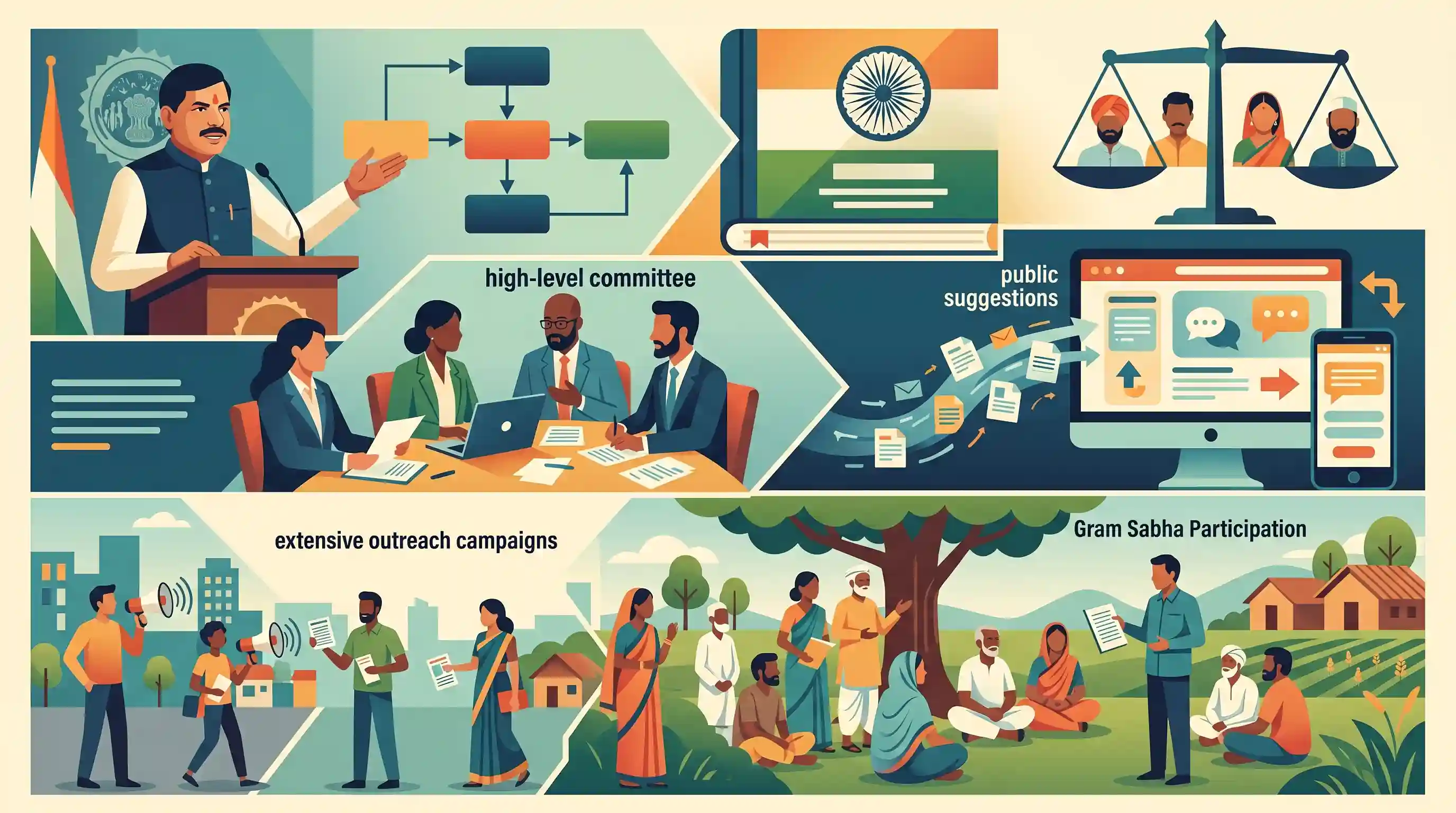
Madhya Pradesh Chief Minister Mohan Yadav has announced that the state's proposed Uniform Civil Code (UCC) policy will be finalized based on comprehensive public consultation. The government has set up a high-level committee to examine the policy, and a dedicated portal has been launched for public suggestions. District administrations have been directed to organize extensive outreach campaigns, including special Gram Sabha meetings, to ensure rural participation.
Key Points
- Madhya Pradesh Chief Minister Mohan Yadav announced that the state's proposed Uniform Civil Code (UCC) will be drafted using public suggestions and comprehensive social feedback.
- A high-level committee has been established to examine the administrative, social, and legal dimensions of implementing a UCC in the state.
- Outreach campaigns are planned across urban and rural parts of MP, including the holding of special Gram Sabha meetings to discuss the policy framework.
- Citizens can submit their recommendations and opinions on the dedicated online portal through an OTP-verified system until June 22, 2026.
- The UCC seeks to provide a uniform legal framework governing matters of marriage, divorce, alimony/maintenance, inheritance, and family laws.
Important Terms
Uniform Civil Code (UCC)

A proposed common set of civil laws governing personal matters like marriage, divorce, inheritance, and adoption for all citizens, regardless of their religion.
UPSC context
GS Paper II (Polity & Governance). Tests understanding of Article 44, gender justice, and federal debates over personal law reforms.
Directive Principles of State Policy (DPSP)
Non-justiciable guidelines enshrined in Part IV (Articles 36-51) of the Indian Constitution that direct the State to establish social and economic democracy.
UPSC context
GS Paper II (Polity). Tests knowledge of constitutional directives, their comparison with Fundamental Rights, and implementation challenges.
Gram Sabha
A constitutional village assembly comprising all registered voters within a Panchayat area, serving as the foundation of direct democracy and local governance.
UPSC context
GS Paper II (Local Governance). Tests knowledge of the 73rd Constitutional Amendment, decentralization, and grassroots community participation.
Personal Laws
Laws governing private and family matters, such as marriage, divorce, inheritance, and succession, based on the religious texts or customs of different communities.
UPSC context
GS Paper II (Polity & Social Justice). Tests understanding of cultural diversity, fundamental rights versus state-led social reforms.
Prelims Trap
Because Article 44 seeks a UCC for the entire nation, only Parliament has the legislative competence to enact uniform civil laws.
Personal laws fall under Entry 5 of the Concurrent List (List III), allowing both Parliament and State Legislatures to enact laws on marriage, divorce, and inheritance.
Static Concepts Connected
Which constitutional provisions enable states to legislate on personal laws like the Uniform Civil Code?
- Concurrent List Entry 5: Governs marriage, divorce, and inheritance, granting legislative competence to both Parliament and State Assemblies to enact family-related laws.
- Article 254(2) Clause: Allows state-level personal law amendments to override conflicting central laws within that state, provided they receive presidential assent.
- Article 12 Definition: Defines 'State' to include provincial legislatures, validating their individual efforts to fulfill the Directive Principle under Article 44.
How did the status of the Right to Property evolve, and how does Article 300A operate?
- 44th Amendment Shift: Removed the Right to Property as a Fundamental Right under Part III in 1978, shifting it to Part XII.
- Article 300A Scope: Protects citizens from arbitrary state deprivation of property, requiring explicit statutory authority for any such state action.
- Human Right Status: Supreme Court jurisprudence defines the right to property as a constitutional and human right, ensuring gender-equal inheritance is legally protected.
Cross-Topic Patterns
State UCCs + Schedule V & VI autonomy
State-level UCCs typically exclude Scheduled Tribes to avoid clashing with customary protections under Articles 244 and 371, balancing civil uniformity with indigenous constitutional autonomy.
Gram Sabhas + Grassroots Deliberation
Using Gram Sabhas for UCC feedback leverages Part IX local governance bodies for major social-legal reform, demonstrating how rural institutions act as conduits for deliberative democracy.

State-level UCCs, Entry 5 of the Concurrent List, and the constitutional limits of tribal exemptions will likely be tested in Prelims 2026.
Linked PYQs · 4
Linked PYQs · 4
- 2023MPPSC_PRELIMSGS1
The Directive Principles of State Policy are explained in Part IV of the Indian Constitution. This system has been taken from the Constitution of which country ?
- 2022MPPSC_PRELIMSGS1
What is the minimum population required for the declaration of a Gram Panchayat in Madhya Pradesh?
- 2022MPPSC_PRELIMSGS1
Who among the following shall preside the meeting of Council of Ministers in Madhya Pradesh in the absence of the Chief Minister?
- 2023MPPSC_PRELIMSGS1
Who decides whether a bill is a money bill or not in the State ?
