Madhya Pradesh Police forms SIT to probe suspended Katni SP
Source:theprint ↗
Why It Matters
The case is a practical example of the intersections between civil service ethics, legal procedure, and political interference. It highlights systemic vulnerabilities such as default bail resulting from administrative delays in filing charge sheets, and demonstrates the state\'s investigative recourse (SITs and EOW) in addressing public official corruption.
Summary
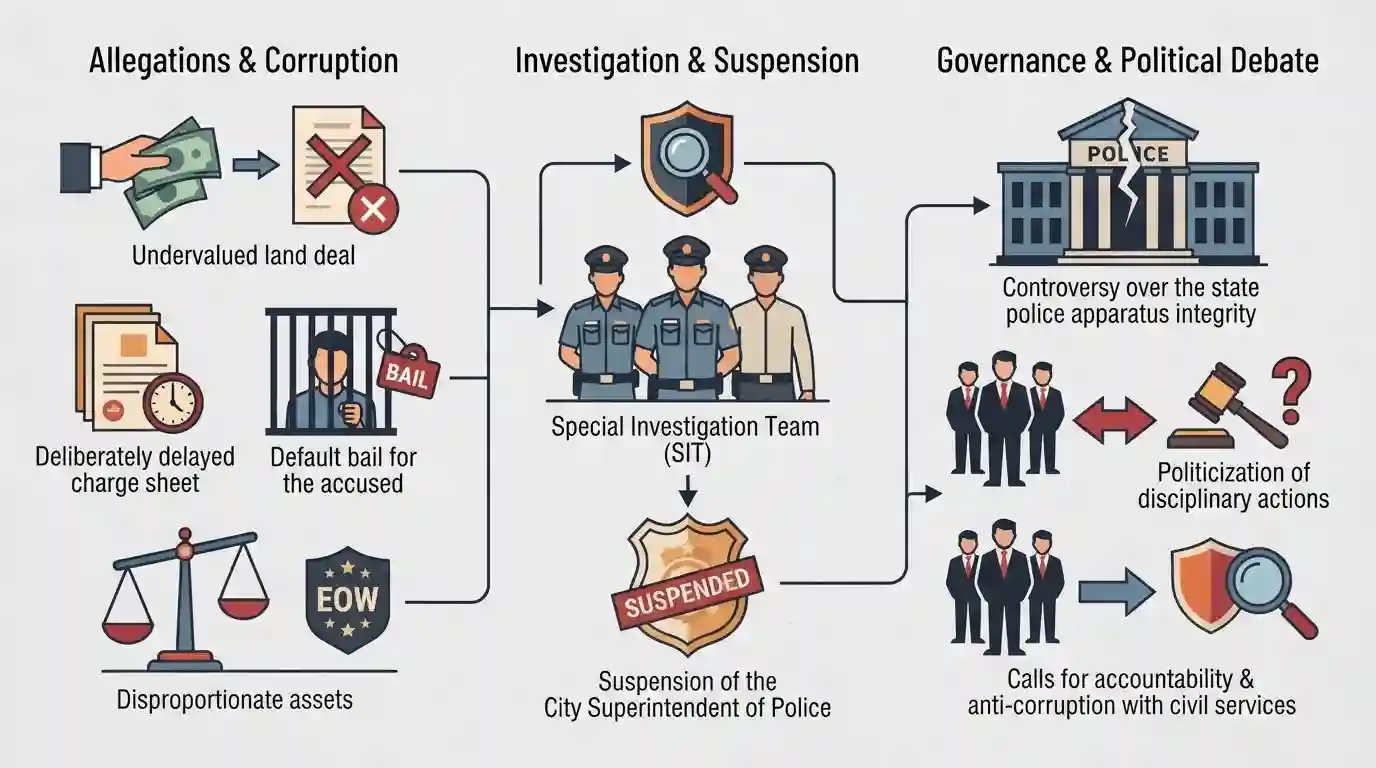
A Special Investigation Team (SIT) has been formed by the Madhya Pradesh Police to investigate suspended Katni City Superintendent of Police, Neha Pachisia. The 2012-batch MPPSC officer faces severe allegations of corruption, including brokering an undervalued land deal with a murder accused and deliberately delaying the filing of a charge sheet to allow the accused to secure default bail under the CrPC. The Economic Offences Wing (EOW) has also lodged a disproportionate assets case. The controversy has ignited a political debate over the integrity of the state police apparatus and the potential politicization of disciplinary actions against civil servants.
Key Points
- Madhya Pradesh Police constituted a 5-member SIT led by Rewa IG Vivek Kumar Bhal to probe corruption and abuse of power allegations against suspended Katni CSP Neha Pachisia.
- Pachisia, a 2012-batch MPPSC officer, allegedly facilitated a benami land deal substantially below the state guideline valuation involving a murder accused.
- The accused secured default bail because the local police under Pachisia\'s supervision failed to file a charge sheet within the mandatory 90-day period.
- The state Economic Offences Wing (EOW) separately registered a disproportionate assets case following a raid on her premises.
- The incident sparked a political row, with Congress leaders alleging she was targeted for previously acting against RSS workers, while the BJP defended the administration\'s anti-corruption stance.
Important Terms
Special Investigation Team (SIT)

A specialized task force of law enforcement officers created to investigate complex or high-profile crimes when existing agencies are inadequate or biased. In India, it can be appointed by the Supreme Court, central government, or state governments.
UPSC context
MPPSC Paper II (Governance): Illustrates ad-hoc accountability and anti-corruption mechanisms outside regular police hierarchy.
Economic Offences Wing (EOW)
A specialized agency in Madhya Pradesh (and other states) tasked with investigating major economic crimes, financial frauds, disproportionate assets, and corruption cases, particularly those involving public servants.
UPSC context
MPPSC Paper II (Public Administration): Relevant for topics on state anti-corruption apparatus and maintaining civil service integrity.
Default Bail
A statutory right under Section 167(2) of the CrPC allowing an accused to be released on bail if investigating agencies fail to file a charge sheet within the stipulated 60 or 90 days.
UPSC context
MPPSC Paper II (Indian Constitution): Tests understanding of fundamental rights (Article 21), criminal justice procedures, and safeguards against indefinite detention.
Madhya Pradesh Public Service Commission (MPPSC)
A constitutional body established under Article 315, responsible for conducting civil service examinations and advising the state government on recruitment, promotions, and disciplinary matters for state administrative services.
UPSC context
MPPSC Paper II (Constitution): Crucial for state administrative framework, constitutional bodies, and civil service recruitment processes.
Prelims Trap
"Default bail is granted at the discretion of the magistrate."
Default bail is an indefeasible statutory right under CrPC/BNSS. If the charge sheet isn't filed within 60/90 days, bail MUST be granted; it is not discretionary.
Static Concepts Connected
What are the provisions for 'Default Bail' in the criminal justice system?
- Statutory Right: It is an indefeasible statutory right granted to an accused if the investigating agency fails to complete its probe in time.
- Time Limits: The charge sheet must be filed within 60 or 90 days, depending on the severity of the offence and the prescribed punishment.
- Legislative Shift: Previously governed by Section 167(2) of the CrPC, it now falls under the corresponding provisions of the Bharatiya Nagarik Suraksha Samhita (BNSS).
How are disciplinary actions against MP civil servants governed?
- Governing Rules: Suspensions and departmental inquiries are procedurally governed by the Madhya Pradesh Civil Services (Classification, Control and Appeal) Rules, 1966.
- EOW Jurisdiction: The state Economic Offences Wing (EOW) acts as a specialized branch to probe white-collar crimes and disproportionate assets involving these public servants.
Cross-Topic Patterns
Ethics vs. Political Neutrality
The political debate over the officer's suspension links directly to Mains Paper IV themes of non-partisanship, accountability, and the politicization of civil services.
SITs & Criminal Justice Reforms
Connects police procedural delays (resulting in default bail) to the broader need for structural police reforms and the role of specialized oversight mechanisms like SITs.

Questions on the statutory nature of 'Default Bail' (BNSS) or an Ethics case study on political pressure & police accountability are likely.
Linked PYQs · 2
Linked PYQs · 2
- 2017MPPSC_PRELIMSGS1
In how many days will the investigating officer submit his report for offences committed under the Scheduled Castes and Scheduled Tribes (Prevention of Atrocities) Act, 1989?
- 2021MPPSC_PRELIMSGS1
The Madhya Pradesh Public Service Commission shall consist of maximum
