Madhya Pradesh Code on Empowering Workspaces and Labour Reforms
Source:times-of-india ↗
Why It Matters
MPPSC Prelims frequently tests candidates on new state-level legislation, schemes, and governance reforms. The 'Madhya Pradesh Code on Empowering Workspaces' represents a major policy shift toward improving the business environment and modernizing labour relations, making it highly probable for questions regarding state governance initiatives and labour rights.
Summary
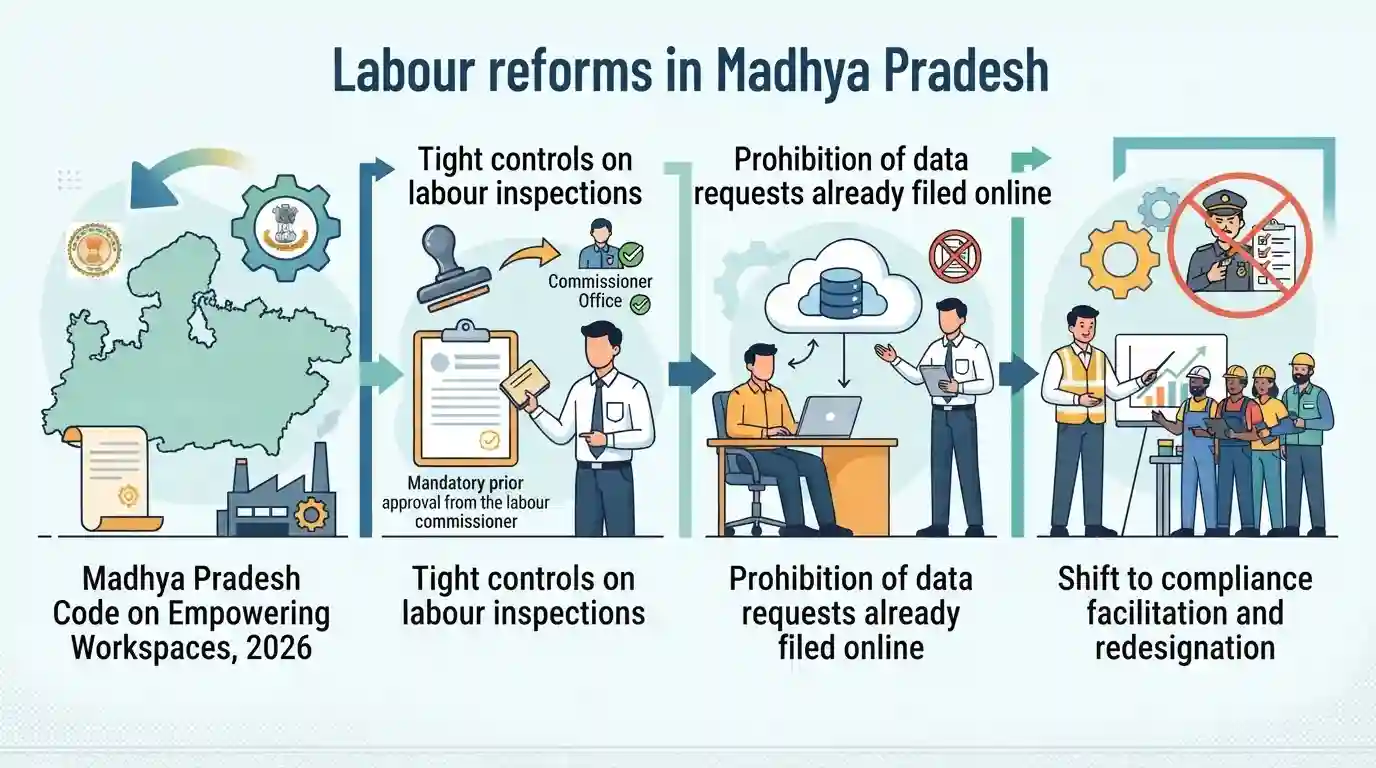
Madhya Pradesh has rolled out the "Madhya Pradesh Code on Empowering Workspaces, 2026," significantly reforming its labour inspection framework to enhance the ease of doing business. The new code places tight controls on labour inspections, mandating prior approval from the labour commissioner and forbidding requests for data already filed online. In a shift from punitive enforcement to compliance facilitation, inspectors have been redesignated as "inspector-cum-facilitators." The code applies universally to all state establishments under the Code on Wages, 2019, ensuring standardized and transparent governance.
Key Points
- The Madhya Pradesh government introduced the 'Madhya Pradesh Code on Empowering Workspaces, 2026' to promote ease of doing business by curbing the 'inspector raj'.
- Labour inspections now require prior permission from the labour commissioner, preventing arbitrary visits.
- Labour officials are rebranded as 'inspector-cum-facilitators' to assist employers with compliance rather than focusing solely on enforcement.
- The code prohibits inspectors from demanding records or information that establishments have already submitted online.
- The new rules apply to all establishments in the state as defined by the central Code on Wages, 2019, irrespective of wage ceilings or sector types.
Important Terms
Madhya Pradesh Code on Empowering Workspaces, 2026

A 2026 state-level regulatory reform placing tighter controls on labour inspections. It mandates prior commissioner approval, forbids redundant data requests, and shifts the regulatory focus from punitive enforcement to compliance facilitation.
UPSC context
Important for MPPSC GS Paper 2 (Governance) and GS 3 (Economy), demonstrating MP's initiatives for Ease of Doing Business.
Code on Wages, 2019
A central legislation consolidating four pre-existing wage laws. It standardizes definitions, establishes a national floor wage, and ensures universal minimum wage protections across organized and unorganized sectors.
UPSC context
Vital for MPPSC GS Paper 3 (Indian Economy/Labour Reforms), testing knowledge of national legislative frameworks guiding state rules.
Inspector-cum-facilitator
A redefined administrative role introduced under the new Labour Codes, replacing traditional punitive inspectors. These officers now actively advise employers on compliance and provide mandatory correction windows before initiating prosecution.
UPSC context
High relevance for MPPSC GS Paper 2 (Public Administration), illustrating modern regulatory shifts away from the \"inspector raj.\"
Ease of Doing Business (EoDB)
A regulatory environment metric reflecting the simplicity of setting up and operating businesses. MP's recent labour inspection code directly targets EoDB by reducing bureaucratic hurdles and arbitrary oversight.
UPSC context
Central to MPPSC GS Paper 3 (Economy), testing understanding of the state's industrial policies and investment-attraction strategies.
Prelims Trap
The code only applies to large industries exceeding a specific wage ceiling.
The 2026 Code applies universally to all state establishments covered under the central Code on Wages, 2019, irrespective of wage ceilings or specific industry sectors.
Static Concepts Connected
Under which Constitutional list does "Labour" fall in India?
- Concurrent List: Labour welfare is placed in the Concurrent List (Entries 22, 23, and 24) of the 7th Schedule of the Indian Constitution.
- Shared Jurisdiction: Both Parliament and State Legislatures can enact laws, allowing Madhya Pradesh to create state-specific administrative codes aligned with overarching Central frameworks.
What are the four Central Labour Codes aimed at simplifying regulations?
- Code on Wages: Subsumed older acts (like Minimum Wages Act); it serves as the definitional basis for the new MP 2026 workspace code.
- Industrial Relations Code: Consolidates laws relating to trade unions, conditions of employment, and settlement of industrial disputes.
- Social Security Code: Aims to extend the social security net (EPF, ESI, maternity benefits) to all workers, including the unorganized sector.
- OSH & WC Code: Regulates workplace safety, health standards, and working conditions across factories and establishments.
Cross-Topic Patterns
EoDB + MP Industrial Promotion
This labour reform directly bolsters MP's Industrial Policy aims, attracting private investment by replacing punitive 'inspector raj' with business-friendly compliance facilitation.
Digital Governance + Labour Reforms
Prohibiting physical demands for online-filed data aligns with the digital-first governance push seen in national platforms like Shram Suvidha and state portals like SAMAGRA.

Expect a Prelims objective on the 'inspector-cum-facilitator' redesignation or a Mains GS-2 3-marker on the MP Workspace Code 2026.
Linked PYQs · 2
Linked PYQs · 2
- 2024MPPSC_PRELIMSGS1
UNNATI (Agri-GISl project of Madhya Pradesh Government is for :
- 2022MPPSC_PRELIMSGS1
What amount will be given to eligible women under "Ladli Bahna Yojana" of the Madhya Pradesh Government?
