FCI Clarification on Madhya Pradesh Rice Diversion Claims
Source:rediff ↗
Why It Matters
This case highlights the strict monitoring framework governing food grain allocation for biofuels in India, the active role of statutory institutions like FCI, state civil supply corporations, and apex bodies like NABARD in enforcing regulatory compliance, and clarifies statistical discrepancies in public distribution reporting.
Summary
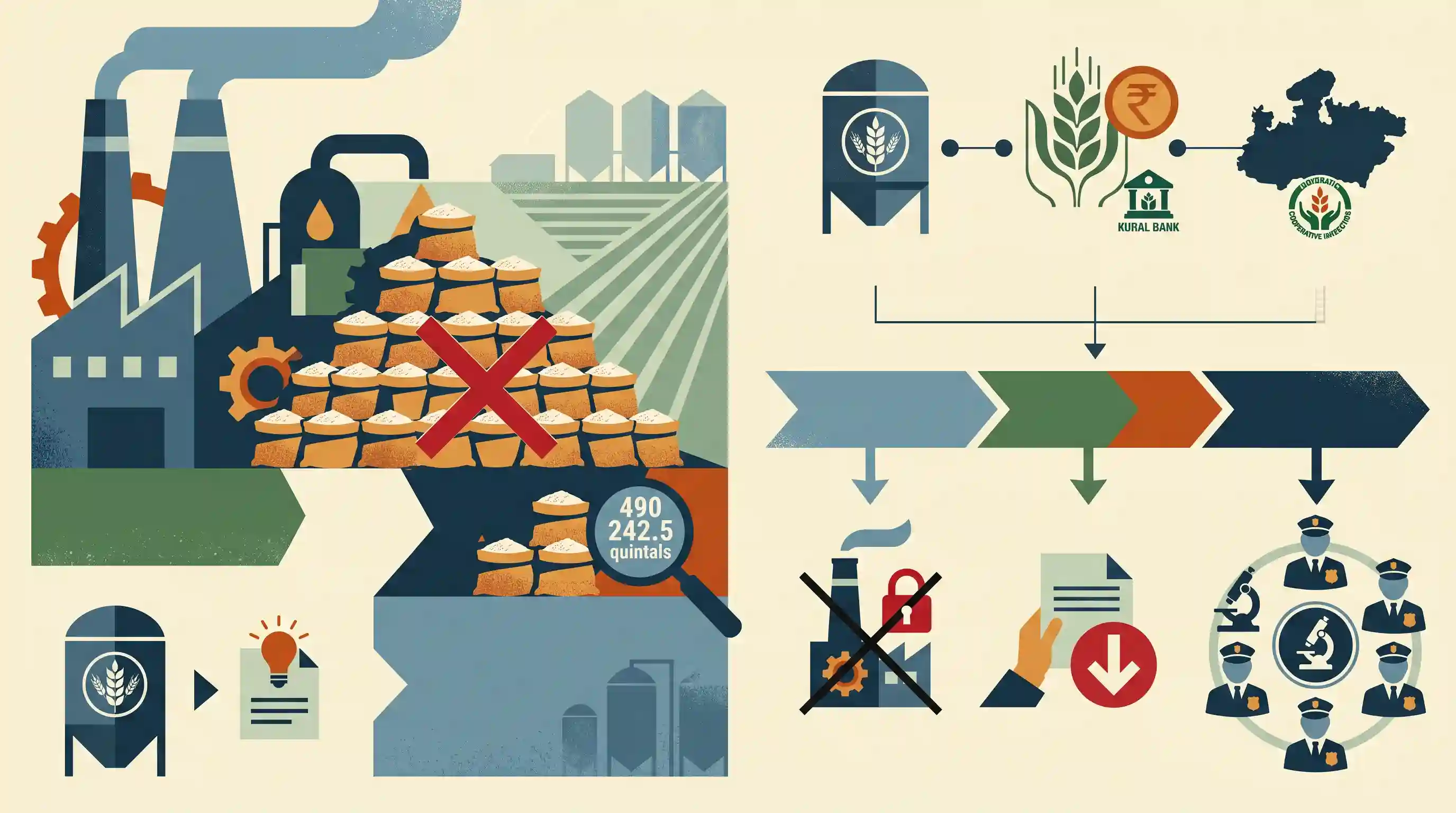
The Food Corporation of India (FCI) clarified that the ongoing investigation into the alleged diversion of rice for ethanol production in Madhya Pradesh pertains only to 242.50 quintals (490 bags) worth Rs 5.63 lakh, and not the 5 lakh tonnes (worth Rs 1,160 crore) claimed in media reports. The Rs 1,160 crore figure represents the legitimate supply of 5.39 lakh tonnes of rice issued to distilleries in the state against full payment since the 2024-25 Ethanol Supply Year. Multiple central and state agencies (including NABARD, DFPD, MPSCSC, and FCI) have taken swift penal and regulatory actions, including withholding interest subventions, blacklisting the offending mill, and establishing a Special Investigation Team (SIT).
Key Points
- The Food Corporation of India (FCI) clarified that the alleged rice diversion in Madhya Pradesh for ethanol production involves only 242.50 quintals (490 bags) of rice worth approximately Rs 5.63 lakh, refuting media reports of a 5 lakh tonnes (worth Rs 1,160 crore) scam.
- The Rs 1,160 crore figure represents the value of rice legitimately issued to MP distilleries against payments during Ethanol Supply Years (ESY) 2024-25 and 2025-26.
- During ESY 2024-25, 2.98 lakh tonnes of FCI rice was issued to MP distilleries at Rs 22.50/kg, and in ESY 2025-26 (till June 30, 2026), 2.41 lakh tonnes was issued at Rs 23.20/kg.
- Irregularities were flagged in June 2026 by government agencies, leading to a joint inspection by the DFPD and FCI on June 11, 2026.
- Administrative actions taken include registering an FIR, withholding the distillery's security deposit, stoppage of future rice allocation by FCI, and blacklisting of the rice mill along with a penalty of Rs 44.12 lakh by the MP State Civil Supplies Corporation.
- DFPD directed NABARD to withhold interest subvention to the concerned distillery, and the MP state government constituted a Special Investigation Team (SIT) to investigate further.
Important Terms
Food Corporation of India (FCI)

A statutory body established under the Food Corporations Act, 1964. It oversees the procurement, storage, distribution, and maintenance of buffer stocks of foodgrains to ensure food security across India.
UPSC context
GS Paper 3: Food Security & PDS. Tests understanding of agricultural pricing, buffer stock management, and public distribution system reforms.
National Bank for Agriculture and Rural Development (NABARD)
The apex development financial institution in India, established in 1982 under the NABARD Act, 1981. It regulates and provides credit for the promotion and development of agriculture and rural industries.
UPSC context
GS Paper 3: Indian Economy & Agriculture. Tests concepts of rural credit, agricultural financing infrastructure, and microfinance schemes.
Ethanol Blending Programme (EBP)
A government initiative implemented by the Ministry of Petroleum and Natural Gas to blend ethanol with petrol. It aims to reduce crude oil imports, lower emissions, and boost farmers' incomes.
UPSC context
GS Paper 3: Infrastructure, Energy & Environment. Tests bio-fuel policies, carbon emission mitigation strategies, and agricultural diversification.
Department of Food and Public Distribution (DFPD)
A department under the Ministry of Consumer Affairs, Food and Public Distribution. It is the nodal agency for formulating national policies on foodgrain procurement, storage, and PDS.
UPSC context
GS Paper 2 & 3: Governance & Food Security. Tests administrative mechanisms for welfare, PDS implementation, and food subsidy management.
Ethanol Supply Year (ESY)
The designated annual cycle for allocating and supplying ethanol to Oil Marketing Companies. It was officially redefined to run from November 1 to October 31 of the following year.
UPSC context
GS Paper 3: Economic Development & Energy. Tests policy-level execution timelines of biofuel programs and sugarcane/agricultural crop cycles.
Prelims Trap
The NBCC, which approves surplus foodgrain diversion for ethanol, is chaired by the Minister of Consumer Affairs, Food and Public Distribution.
The NBCC is chaired by the Union Minister of Petroleum and Natural Gas, not the Minister of Consumer Affairs, despite managing foodgrain diversion.
Static Concepts Connected
What is the role of the National Biofuel Coordination Committee (NBCC)?
- Chairmanship: Chaired by the Union Minister of Petroleum and Natural Gas.
- Feedstock Decisions: Authorized to approve the conversion of surplus or damaged foodgrains into ethanol.
- Policy Coordination: Provides high-level direction, monitoring, and inter-ministerial coordination for India's biofuel programmes.
What is the statutory mandate of Food Corporation of India?
- Origin: Established under the Food Corporations Act, 1964, to handle national foodgrain procurement.
- Price Support: Secures farmers' interests through MSP-based procurement of wheat and paddy.
- PDS Operations: Maintains operational buffer stocks and distributes foodgrains nationwide to ensure food security.
Cross-Topic Patterns
Food Security vs. Green Transition
Diverting PDS-bound surplus grains like rice for biofuel targets creates regulatory conflicts between national food security commitments and carbon mitigation goals.
Multi-tiered Agri-Surveillance
The cooperation between FCI, state corporations, and NABARD illustrates how multi-agency governance is critical to preventing leakages during decentralised procurement.

Dual targets of national food security and E20 ethanol blending by 2025-26 will likely feature as a GS-3 resource-conflict question.
Linked PYQs · 3
Linked PYQs · 3
- 2023MPPSC_PRELIMSGS1
When was the NABARD established?
- 2015MPPSC_PRELIMSGS1
'NABARD' stands for
- 2023MPPSC_PRELIMSGS1
The Food Preservation Commission is a statutory body established under which of the following Acts?
