Economic Offences Wing Probes Kuno Cheetah Project Tendering
Source:etvbharat ↗
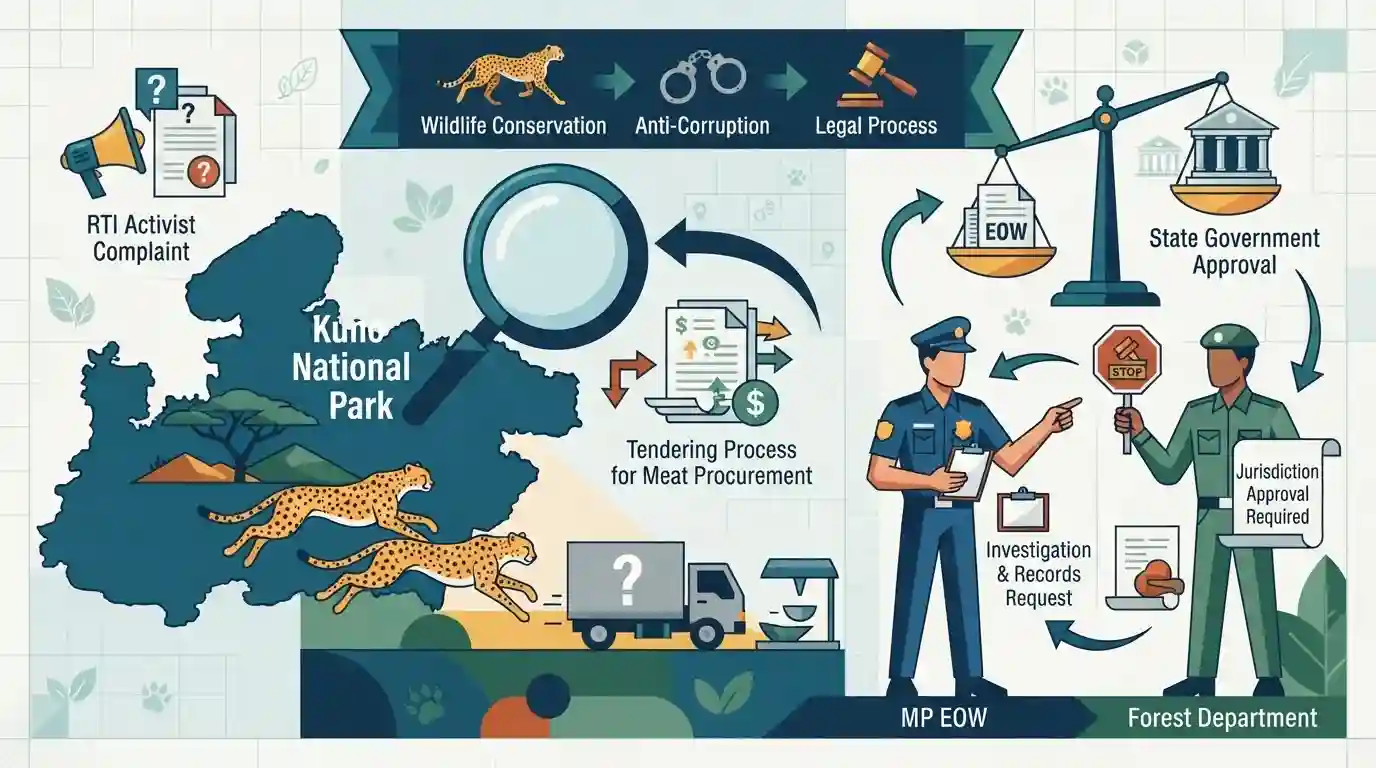
Why It Matters
This issue highlights the challenges of administrative transparency and financial accountability in high-profile wildlife conservation initiatives like Project Cheetah, as well as the jurisdictional interplay between state departments and anti-corruption agencies.
Summary
The Madhya Pradesh Police's Economic Offences Wing (EOW) has launched an investigation into alleged financial irregularities within the Kuno Cheetah Project. The probe centers on the tendering process for procuring meat to feed the translocated African cheetahs. Triggered by a complaint from an RTI activist, the EOW is seeking records from the Forest Department, which claims the investigating agency lacks jurisdiction without prior state government approval.
Key Points
- The Madhya Pradesh Economic Offences Wing (EOW) is probing a suspected tendering scam related to the supply of meat for cheetahs at Kuno National Park.
- A complaint by RTI activist Ajay Dubey alleged that a cartel manipulated the procurement of goats and calves, causing significant financial loss.
- The EOW has sought documents from the Chief Wildlife Warden regarding meat supply orders and a specific supplier, R B Singh.
- The Forest Department countered the probe, citing rules that the EOW requires prior state government permission to investigate its officials.
- Project Cheetah, under which African cheetahs were translocated to Kuno National Park, was launched in September 2022.
Important Terms
Project Cheetah

An Indian government wildlife conservation initiative launched in 2022 to reintroduce African cheetahs to India, seven decades after the Asiatic cheetah went locally extinct. It involves translocating cheetahs to habitats like Kuno National Park to restore grassland ecosystems.
UPSC context
Crucial for GS Paper 3 (Environment & Ecology) to evaluate wildlife conservation strategies, intercontinental species translocation, and ecological restoration challenges.
Right to Information (RTI) Act
A landmark 2005 Indian legislation granting citizens the legal right to access information held by public authorities. It aims to empower citizens, ensure government transparency, and curb corruption by enforcing accountability in public administration.
UPSC context
Highly important for GS Paper 2 (Governance) and GS Paper 4 (Ethics) regarding transparency, citizen empowerment, and administrative accountability.
Economic Offences Wing (EOW)
A specialized investigation branch within Indian state police forces (such as Madhya Pradesh) tasked with probing complex financial crimes, including bank frauds, government fund misappropriation, scams, and money laundering.
UPSC context
Relevant for GS Paper 2 and 3 concerning anti-corruption mechanisms, internal security, and law enforcement agencies tackling economic crimes.
Kuno National Park
A national park in the Sheopur district of Madhya Pradesh, characterized by dry deciduous forests and expansive grasslands. It is the primary site for India's Project Cheetah and was historically proposed for Asiatic lion reintroduction.
UPSC context
Key for GS Paper 3 (Environment) and Prelims map-based questions, focusing on biodiversity corridors, habitat suitability, and species reintroduction.
Prelims Trap
Agencies like EOW or CBI can initiate corruption probes against public servants without any prior government approval.
Under Section 17A of the Prevention of Corruption Act (amended 2018), investigating agencies must obtain prior approval from the competent authority to probe decisions made by public servants in official capacities.
Static Concepts Connected
What is the prior approval safeguard under the Prevention of Corruption Act?
- Section 17A: Requires police/agencies to obtain prior approval before investigating public servants for alleged corruption related to official duties.
- Red-handed exception: Approval is not needed if the public servant is arrested on the spot (caught red-handed) accepting an undue advantage.
- Competent Authority: The authority competent to remove the public servant from office is responsible for granting or denying the investigation approval.
Who governs and monitors Project Cheetah in India?
- Nodal Agency: The National Tiger Conservation Authority (NTCA), a statutory body under MoEFCC, serves as the nodal implementing agency for the project.
- Technical Support: The Wildlife Institute of India (WII) provides technical, scientific, and monitoring expertise for the translocation.
- Habitat match: Kuno National Park was selected specifically for its dry deciduous forests and open savannah-like grasslands, which suit cheetahs.
Cross-Topic Patterns
Conservation Admin & Anti-Corruption Laws
Major wildlife projects involving huge funds often trigger governance scrutiny. Expect UPSC to link environmental project implementation with statutory oversight mechanisms under the RTI Act and Prevention of Corruption Act.
Apex Predators & Grassland Ecology
Cheetah introductions test the carrying capacity of Kuno's dry deciduous grasslands. UPSC frequently examines the habitat requirements and co-predator dynamics of introduced apex species within specific Indian ecosystems.

A 2026 prelims question could pair NTCA's statutory mandate with Kuno's habitat, testing if aspirants know NTCA manages non-tiger species.
Linked PYQs · 2
Linked PYQs · 2
- 2022MPPSC_PRELIMSGS1
Which of the following National Parks is the first in India to officially introduce a mascot named "Bhoorsingh the Barasingha"?
- 2021MPPSC_PRELIMSGS1
Who among the following can impose the penalty under Section 20 of Right to Information Act?
