Madhya Pradesh Pollution Control Board merges Dhar regional office
Source:timesofindia ↗
Why It Matters
This development directly connects to legacy environmental hazards (Bhopal Gas Disaster), local protests in the Pithampur industrial area, and administrative reorganizations of statutory boards (MPPCB). MPPSC frequently tests the statutory origin of state boards, geographic locations of industrial areas like Dhar/Pithampur, and historical environmental disasters.
Summary
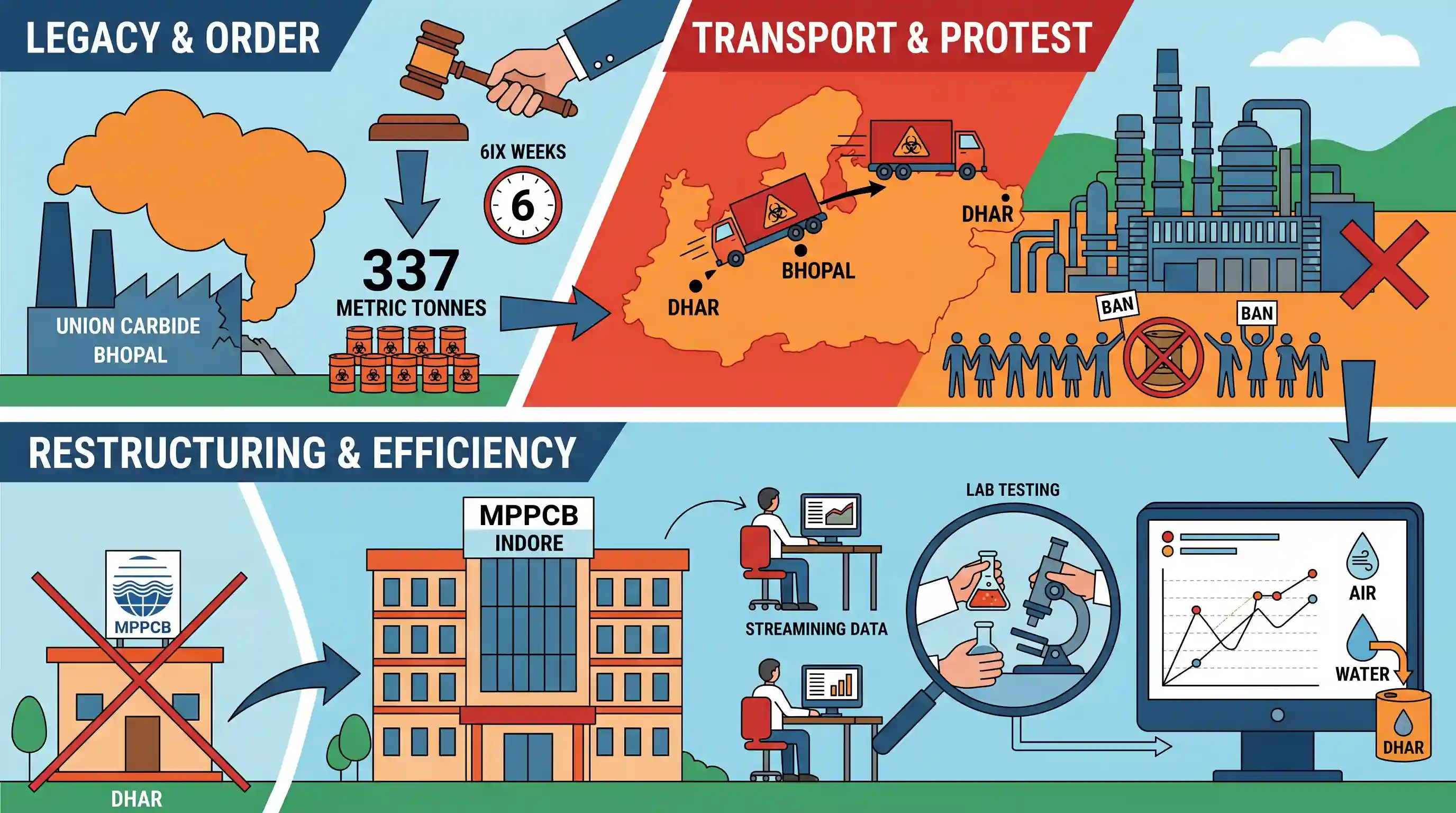
In January 2025, the Madhya Pradesh Pollution Control Board (MPPCB) merged its Dhar regional office into the Indore office for administrative efficiency. This decision followed public protests against the disposal of 337 metric tonnes of legacy hazardous waste from the defunct Bhopal Union Carbide pesticide plant at the Pithampur (Dhar) treatment facility. Following a Madhya Pradesh High Court order giving the state government six weeks to safely dispose of the waste, the merger aims to streamline environmental monitoring and lab testing, which is primarily anchored in Indore.
Key Points
- The Madhya Pradesh Pollution Control Board (MPPCB) merged its Dhar regional office with the Indore regional office, placing the combined jurisdiction under Indore's Regional Officer SN Dwivedi.
- The administrative consolidation was triggered by intense public protests in Pithampur (Dhar district) on January 3, 2025, following the transport of 337 Metric Tonnes (MT) of legacy toxic waste from the defunct Union Carbide factory in Bhopal.
- On January 6, 2025, the Madhya Pradesh High Court mandated the state government to completely and safely dispose of the Union Carbide toxic waste within six weeks.
- To address immediate environmental safety, a four-member MPPCB team was tasked with monitoring the air and water quality around Pithampur's waste disposal facility.
- Due to a lack of advanced testing laboratories in Dhar, environmental samples had to be processed in Indore, showcasing the administrative and infrastructural gap that prompted the merger.
- The MPPCB is a statutory body established on September 23, 1974 under the Water (Prevention and Control of Pollution) Act, 1974, and is also responsible for enforcing the Air Act, 1981.
Important Terms
Water (Prevention and Control of Pollution) Act, 1974

A foundational legislation enacted to prevent and control water pollution, restore the wholesomeness of water bodies, and establish central and state pollution control boards.
UPSC context
GS Paper III (Environment); tests statutory environmental frameworks, pollution standards, and regulatory powers of state bodies.
Air (Prevention and Control of Pollution) Act, 1981
A key Indian environmental legislation enacted to prevent, control, and abate air pollution, which expanded the authority of pollution control boards to monitor ambient air quality.
UPSC context
GS Paper III (Environment); tests legislative frameworks for air pollution, emission standards, and statutory enforcement.
Madhya Pradesh Pollution Control Board (MPPCB)
A statutory body established under the Water Act, 1974, responsible for monitoring environmental quality, enforcing compliance, and issuing industrial consents within Madhya Pradesh.
UPSC context
GS Paper II (Statutory Bodies) & GS III (Environment); tests state-level regulatory enforcement and industrial waste management.
Madhya Pradesh High Court
The highest judicial authority in Madhya Pradesh, established in 1956 with its principal seat in Jabalpur and permanent benches in Gwalior and Indore.
UPSC context
GS Paper II (Judiciary); tests high court jurisdiction, judicial review, and environmental intervention orders.
Union Carbide India Limited (UCIL)
A chemical company and subsidiary of Union Carbide Corporation whose Bhopal pesticide plant was the site of the catastrophic 1984 methyl isocyanate gas leak.
UPSC context
GS Paper III (Disaster Management); tests industrial hazard mitigation, corporate environmental liability, and toxic waste management.
Prelims Trap
State Pollution Control Boards (SPCBs) were originally established under the Environment (Protection) Act, 1986 to consolidate environmental clearances.
SPCBs are statutory bodies created specifically under the Water Act, 1974. They were only later given responsibilities under the Air Act and EPA.
Static Concepts Connected
What are the statutory powers of SPCBs under the Water Act, 1974?
- Origin: Constituted under Section 4 of the Water Act, 1974, and later designated to enforce the Air Act, 1981.
- Consent Authority: Grants or refuses 'Consent to Establish' (CTE) and 'Consent to Operate' (CTO) for industrial discharge.
- Enforcement Power: Section 33A empowers SPCBs to issue direct orders for industrial closure or cutting off essential services like electricity.
How is hazardous chemical waste scientifically managed under Indian regulations?
- Incineration: Employs double-chamber rotary kilns (850°C to 1150°C) with advanced scrubbers to neutralize acidic flue gases.
- Secured Landfills: Isolates non-incinerable waste using multi-layered geosynthetic liners and clay barriers to halt toxic leachate.
- Regulatory Framework: Governed by the Hazardous and Other Wastes (Management and Transboundary Movement) Rules, 2016 under EPA 1986.
Cross-Topic Patterns
Judicial Mandates vs Executive Infrastructure
Strict judicial timelines for clearing legacy toxic waste expose local lab deficits, forcing administrative mergers of state pollution regulators.
Environmental Justice in Industrial Hubs
Transporting Bhopal's legacy chemical waste to Pithampur highlights the environmental justice challenges and NIMBY protests in specialized manufacturing zones.

The statutory powers of SPCBs under the Water Act 1974 vs. 1986 Rules for hazardous waste disposal will likely be tested in Prelims 2026.
Linked PYQs · 4
Linked PYQs · 4
- 2024MPPSC_PRELIMSGS1
When did the Government of India pass the Water (Prevention and Control of Pollution) Act?
- 2008MPPSC_PRELIMSGS1
Gas released during Bhopal gas tragedy was:
- 2021MPPSC_PRELIMSGS1
In which year Bhopal Gas disaster occurred?
- 2019MPPSC_PRELIMSGS1
Direction: Consider the following statements. I. Mandu is in Dhar district. II. Hindola Mahal is in Mandu. Select the correct answer on the basis of above statements.
