Madhya Pradesh Launches Naman Mission for Narmada River Conservation
Source:indianmasterminds ↗
Why It Matters
The Narmada River is the lifeline of Madhya Pradesh. Understanding its conservation missions, administrative structures (like Naman Mission), geographic milestones (Amarkantak), and cultural tourism initiatives (Omkareshwar, Maheshwar) is highly crucial for the MPPSC State Service Prelims GS Paper 1.
Summary
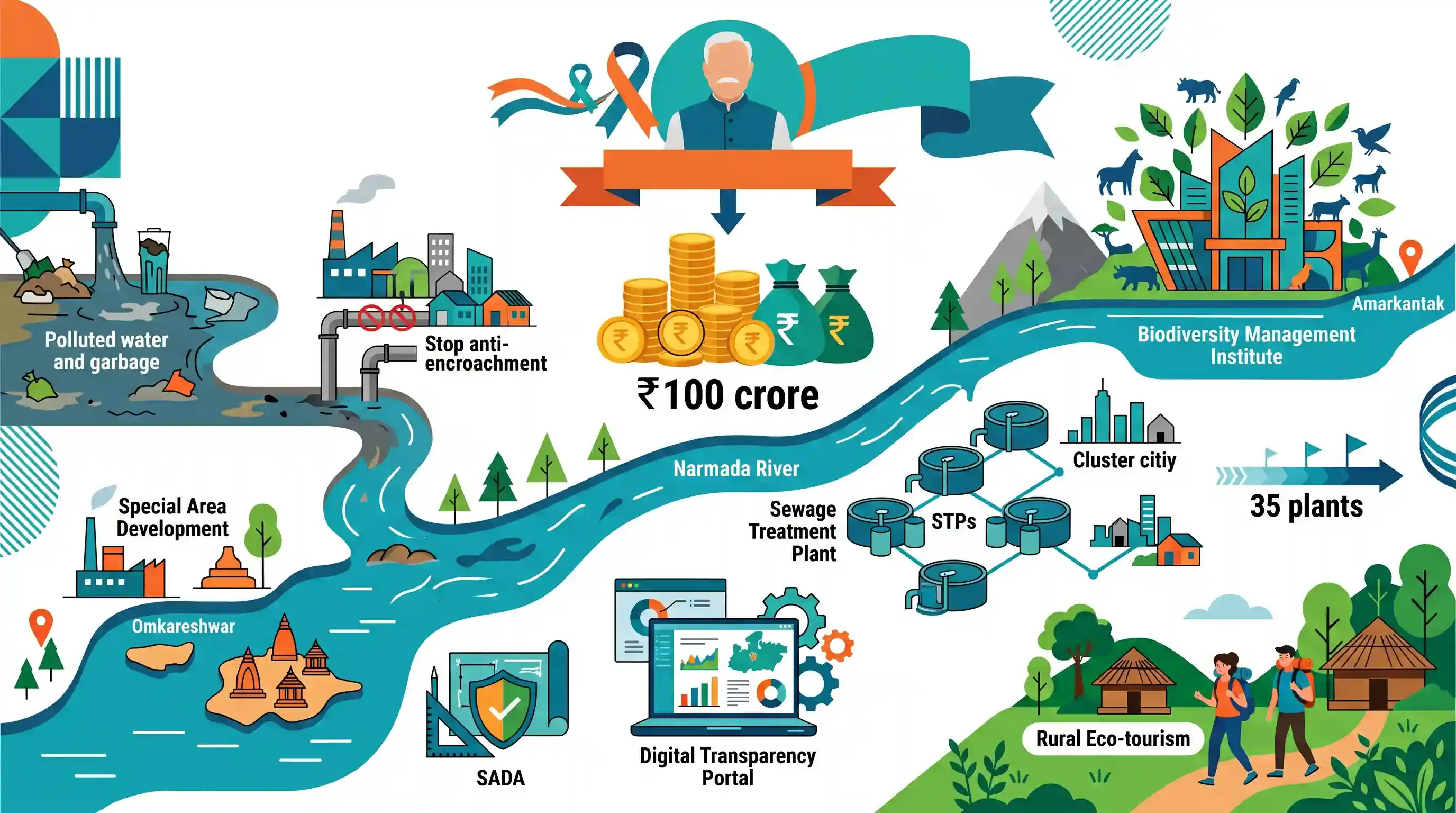
Madhya Pradesh Chief Minister Dr. Mohan Yadav launched the ‘Naman Mission’, a major river conservation and ecological revival roadmap for the Narmada River. Financed with an annual grant of ₹100 crore, the mission seeks to eliminate pollution and encroachments along the Narmada basin. Key initiatives under the roadmap include establishing a Biodiversity Management Institute in Amarkantak, building 35 Sewage Treatment Plants in 21 cities by December 2027, launching the 'Narmada Kosh Portal' for digital transparency, setting up a Special Area Development Authority (SADA) for Omkareshwar, and promoting rural eco-tourism through homestays.
Key Points
- Chief Minister Dr. Mohan Yadav launched the 'Naman Mission' to ensure a clean, uninterrupted, and encroachment-free flow of the Narmada River.
- A dedicated annual state grant of ₹100 crore is allocated for the mission, integrating departments like water resources, forest, tourism, and tribal welfare.
- Administrative structure of the Naman Mission: CM acts as Chairperson of the General Assembly, the Panchayat Minister as Vice Chairperson, and the Chief Secretary as Mission Secretary.
- A Biodiversity Management Institute will be set up in Amarkantak (the origin of the Narmada River) along with planting 2.70 lakh saplings across 415 hectares.
- The Urban Development Department will construct 35 sewage treatment plants (STPs) in 21 cities along the river by December 2027 and develop the 'Narmada Kosh Portal' for digital tracking.
- A Special Area Development Authority (SADA) will be set up for Omkareshwar, alongside initiatives to make the Narmada Parikrama route encroachment-free and expand local homestays in Maheshwar and tribal villages.
Important Terms
Naman Mission

A comprehensive river conservation and ecological revival roadmap launched by the Madhya Pradesh government to ensure the clean and uninterrupted flow of the Narmada River, backed by a ₹100 crore annual grant.
UPSC context
GS III: River Conservation and Environmental Pollution. Tests knowledge of state-level river basin management and ecological restoration policies.
Janjatiya Gram Utkarsh Abhiyan
A major central government initiative (Dharti Aaba Janjatiya Gram Utkarsh Abhiyan) to saturate infrastructural gaps, improve socio-economic conditions, and promote welfare in tribal-majority villages across India.
UPSC context
GS II: Welfare Schemes for Vulnerable Sections. Tests awareness of tribal development initiatives and multi-sectoral convergence strategies.
Special Area Development Authority (SADA)
A statutory urban planning and development body established by state governments to manage infrastructure-led growth, economic development, and counter-magnet urbanization in specific subregions.
UPSC context
GS I & II: Urbanization, Regional Planning, Government Bodies. Tests understanding of regional development strategies and urban planning institutions.
Deendayal Rasoi
A subsidized meal scheme run by the Madhya Pradesh government to provide nutritious, affordable food at ₹10 per plate to the poor, daily wage workers, and laborers.
UPSC context
GS II: Issues relating to Poverty and Hunger. Tests knowledge of food security, safety nets, and state-level welfare programs.
Narmada Samagra
A prominent non-profit organization in Madhya Pradesh dedicated to the conservation, environmental protection, and holistic, sustainable development of the Narmada River basin.
UPSC context
GS III: Environmental Conservation, Role of NGOs. Tests understanding of civil society participation in environmental preservation.
Narmada Kosh Portal
A digital portal launched by Madhya Pradesh's Urban Development Department under the Naman Mission to ensure transparency, digital monitoring, and coordination of river conservation funds.
UPSC context
GS II: E-governance and Transparency. Tests understanding of digital tools used for environmental governance and public accountability.
Prelims Trap
Omkareshwar is situated at the confluence of the Narmada and the major south Indian peninsular river Kaveri.
Omkareshwar lies at the confluence of the Narmada and a minor local tributary also named 'Kaveri' in MP, which is entirely distinct from the major southern peninsular Kaveri River.
Static Concepts Connected
What are the key geographical and hydrological features of the Narmada River?
- Origin and Course: Rises from the Amarkantak Plateau in Madhya Pradesh and flows westward in a rift valley between the Vindhya and Satpura ranges.
- Tributary System: Major tributaries include the Orsang, Tawa, Sher, Shakkar, and Kolar, flowing through MP, Gujarat, and Maharashtra.
- Estuary Formation: Unlike major east-flowing peninsular rivers, it does not form a delta due to its steep gradient and hard rocky bed, emptying via an estuary into the Gulf of Khambhat.
What is the historical significance of Maheshwar and the Holkar Dynasty?
- Ancient Mahishmati: Historically identified as Mahishmati, which served as the southern capital of the ancient Avanti Mahajanapada.
- Holkar Capital: Queen Ahilyabai Holkar shifted her capital here from Indore in 1767, constructing its iconic riverfront ghats and temples.
- Maheshwari Sarees: Queen Ahilyabai patronized local weavers, laying the foundation for the famous handloom Maheshwari saree tradition.
Cross-Topic Patterns
River Basins + UNESCO Biosphere Reserves
The intersection of river sources with Biosphere Reserves (like Amarkantak) highlights how crucial river catchment protection is tied directly to global biodiversity conservation frameworks.
Sacred Geography + GI Handicrafts
Linking the conservation of historical ghats to traditional handloom sectors (Maheshwari Sarees) illustrates how physical geography, sacred tourism, and rural livelihoods are integrated.

UPSC may target the geographic origin of Narmada, Sone, and Johilla rivers alongside the Achanakmar-Amarkantak Biosphere Reserve.
Linked PYQs · 4
Linked PYQs · 4
- 2010MPPSC_PRELIMSGS1
Narmada river rises from its source from
- 2021MPPSC_PRELIMSGS1
'Mandhata' was the ancient name of the which pilgrimage centre ?
- 2021MPPSC_PRELIMSGS1
In which city of Madhya Pradesh, Indira Gandhi Tribal University is located?
- 2009MPPSC_PRELIMSGS1
Amarkantak is situated in:
