Farmers Stir Eased as Madhya Pradesh Enhances Moong Procurement at MSP
Source:new-indian-express ↗
Why It Matters
This case highlights the fiscal and operational friction between central welfare limits (PM-AASHA's 25% procurement cap) and state-level agricultural interventions. It also underscores the grassroot challenges of digitizing input delivery systems like fertilizers, showing the necessity of policy flexibility and localized adaptations.
Summary
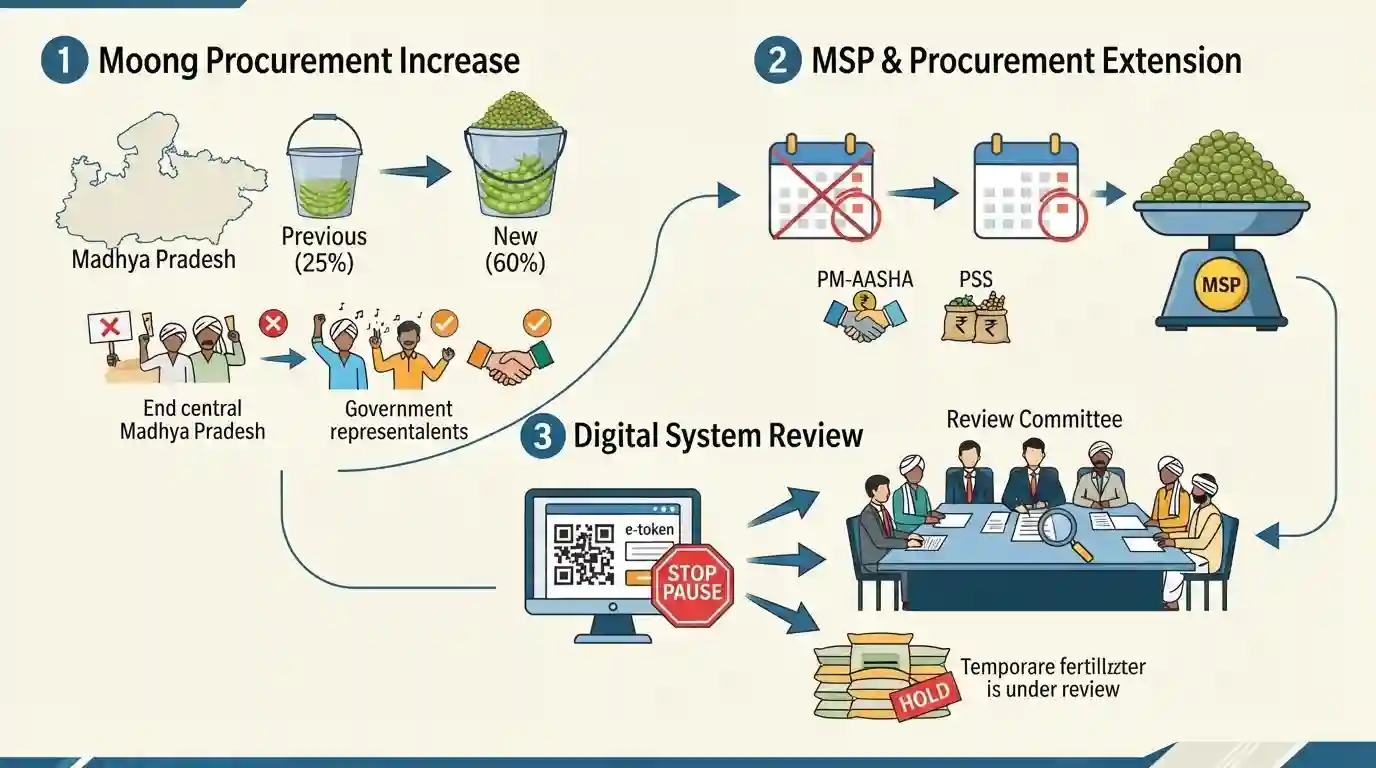
The Madhya Pradesh government, led by CM Mohan Yadav, has decided to increase Moong (green gram) procurement at the Minimum Support Price (MSP) from 25% to 60% of produce to end protests by central MP farmers. The government has also extended procurement timelines and temporarily suspended the digital e-token based fertilizer distribution system pending review by a high-level committee under the Agriculture Production Commissioner (APC).
Key Points
- Moong farmers from central Madhya Pradesh's Narmada Valley districts launched the 'Kisan Kranti Yatra' in Bhopal, demanding 100% procurement at an MSP of Rs 8,780/quintal and the discontinuation of the e-token based fertilizer distribution system.
- In response, the MP government raised its Moong procurement limit from the standard 25% to 60% of each eligible farmer's produce, translating to approximately 3 quintals per acre in districts like Harda, Sehore, and Narmadapuram.
- Under the central PM-AASHA's Price Support Scheme (PSS) guidelines, central agencies can only procure up to 25% of a state's total production; any procurement above this limit must be funded using the state government's own resources.
- For the summer season 2025–26, the central government approved 4,54,580 metric tonnes of summer moong procurement for Madhya Pradesh under PSS, which is the highest in India, accounting for 87% of the total approved moong procurement across all states.
- The state suspended the newly introduced e-token based fertilizer distribution system with immediate effect and constituted a high-level committee under the Agriculture Production Commissioner (APC) to address farmers' grievances and suggest improvements.
- Procurement slot bookings have been extended by 10 days to August 10, 2026, and the final date of procurement was extended from August 10 to August 20, 2026.
Important Terms
Pradhan Mantri Annadata Aay Sanraksan Abhiyan (PM-AASHA)

An umbrella scheme launched in 2018 to ensure farmers receive remunerative prices. It comprises the Price Support Scheme, Price Deficiency Payment Scheme, and Private Procurement & Stockist Scheme to mitigate agricultural price volatility.
UPSC context
GS 3 (Agriculture). Tests knowledge of government interventions, farm subsidies, and farmer income protection mechanisms.
Price Support Scheme (PSS)
A core component of PM-AASHA under which central agencies like NAFED physically procure pulses, oilseeds, and copra when open-market wholesale prices plummet below the government-declared Minimum Support Price (MSP).
UPSC context
GS 3 (Agriculture). Crucial for questions on procurement mechanisms, NAFED's role, and the practical implementation of MSP.
Minimum Support Price (MSP)
A guaranteed floor price set by the government for 23 mandated crops before sowing. Recommended by the Commission for Agricultural Costs and Prices (CACP), it protects farmers from distress sales during market gluts.
UPSC context
GS 3 (Economy/Agriculture). Highly tested in Prelims and Mains regarding crop pricing, CACP calculation metrics, and food security.
Samyukt Kisan Morcha (SKM)
An umbrella coalition of over 400 Indian farmers' unions formed in 2020. It initially spearheaded protests to repeal three farm laws and currently advocates for a legally enforceable Minimum Support Price (MSP).
UPSC context
GS 2 & 3 (Polity/Agriculture). Relevant for understanding pressure groups, civil society movements, and agrarian policy debates.
Prelims Trap
"Under PM-AASHA, the Central Government mandates 100% physical procurement of pulses and oilseeds at MSP."
The Centre caps physical procurement of pulses and oilseeds at 25% of total production under the Price Support Scheme (PSS). States must self-fund any procurement beyond this ceiling.
Static Concepts Connected
What are the three core components of the PM-AASHA scheme?
- Price Support Scheme (PSS): Physical procurement of pulses, oilseeds, and copra by central nodal agencies, capped at 25% of the state's production.
- Price Deficiency Payment (PDPS): Direct compensation to registered farmers for the difference between MSP and the market price, involving no physical procurement.
- Private Procurement Scheme (PPSS): A pilot scheme allowing the participation of private players in the procurement operations for oilseeds.
Why is Moong cultivation ecologically beneficial in Indian crop rotations?
- Nitrogen Fixation: It is a leguminous crop that fixes atmospheric nitrogen via root-nodule Rhizobium, naturally improving soil fertility and reducing urea dependency.
- Short Duration: Maturing in just 50-60 days, it fits perfectly into the brief Zaid (summer) window between the Rabi wheat harvest and Kharif paddy sowing.
- Water Efficiency: It requires significantly less irrigation compared to water-intensive cereal crops, making it a climate-resilient choice for water-stressed regions.
Cross-Topic Patterns
Fiscal federalism & agrarian populism
State-led hikes in agricultural procurement (like MP funding the gap between 25% and 60%) directly strain state finances, highlighting the tension between agrarian populism and strict fiscal deficit targets (FRBM Act).
Friction in grassroots digital agriculture
The suspension of MP's e-token fertilizer system echoes recurring challenges with digital literacy and infrastructural bottlenecks when implementing agritech and DBT solutions at the grassroots level.

Expect a 2026 multi-statement question combining PM-AASHA's 25% procurement cap, PDPS mechanisms, and India's pulse crop seasons (Zaid).
Linked PYQs · 1
Linked PYQs · 1
- 2024MPPSC_PRELIMSGS1
UNNATI (Agri-GISl project of Madhya Pradesh Government is for :
