Jan Vishwas Abhiyan Mandates Ministers To Spend Fridays In Field
Source:punjabkesari ↗
Why It Matters
It serves as a prominent example of proactive grassroots governance, administrative accountability, and grievance redressal mechanisms, which are highly relevant for MPPSC GS2 Governance and state-specific policy questions.
Summary
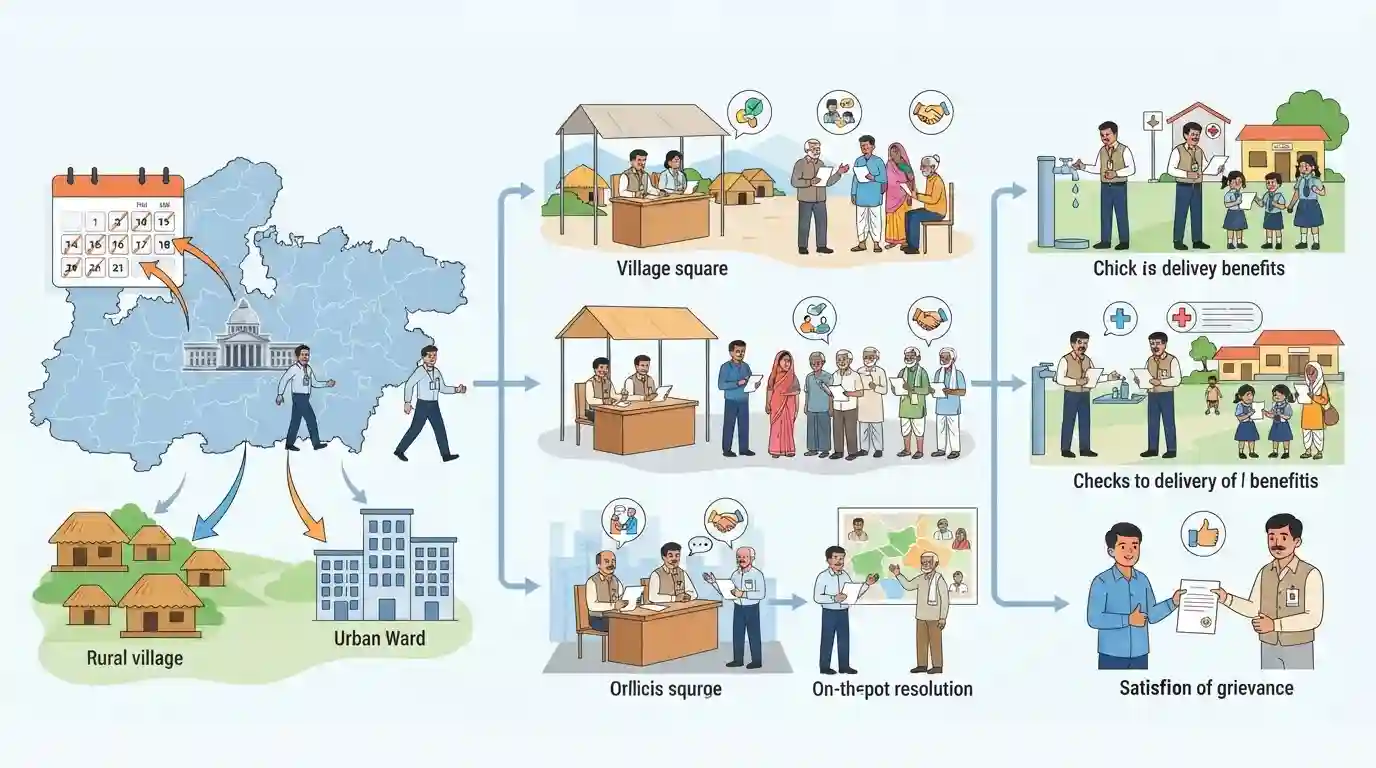
Madhya Pradesh Chief Minister Mohan Yadav announced the 'Jan Vishwas Abhiyan', an initiative aimed at improving accountability and governance by mandating ministers and officials to spend every Friday in villages and urban wards. The campaign focuses on resolving public grievances on the spot, reviewing welfare schemes, and ensuring their effective grassroots implementation.
Key Points
- The 'Jan Vishwas Abhiyan' requires Madhya Pradesh ministers, MLAs, and district officials to spend every Friday interacting with citizens in villages and urban wards.
- The initiative aims to strengthen public trust, review welfare scheme implementation, and ensure time-bound resolution of public grievances.
- Strict action will be taken against officials for corruption, negligence, or irregularities discovered during the field visits.
- The campaign will operate without any additional budget, promoting responsive and decentralized governance at the grassroots level.
Important Terms
Jan Vishwas Abhiyan

A public outreach campaign by the Madhya Pradesh government mandating ministers and officials to visit villages/wards every Friday to resolve public grievances on-the-spot and review welfare schemes.
UPSC context
GS Paper-2: Governance; tests knowledge of innovative state-level accountability mechanisms and public outreach initiatives.
Citizen-Centric Governance
An administrative approach prioritizing the needs, rights, and satisfaction of citizens, shifting from top-down bureaucratic convenience to transparent, responsive, and participatory service delivery.
UPSC context
GS Paper-2: Governance & Ethics; tests administrative reforms and principles from the 2nd ARC’s 12th Report.
Public Grievance Redressal Mechanism
An institutional framework designed to receive, process, and resolve citizens' complaints regarding deficient public services, corruption, or administrative lapses in a time-bound manner.
UPSC context
GS Paper-2: Governance; tests structural efficiency of service delivery and administrative accountability systems.
Decentralised Governance
The transfer of authority, planning, and decision-making power from central and state offices to local government units, promoting grassroots participation and responsive administration.
UPSC context
GS Paper-2: Polity & Governance; tests devolution of power and decentralisation at the grassroots level.
Sevottam Model
An assessment-improvement framework for public service delivery consisting of three modules: Citizen’s Charters, Public Grievance Redressal, and Service Delivery Capability.
UPSC context
GS Paper-2 & GS-4: Ethics; tests standards of public service excellence and citizen empowerment models.
Prelims Trap
The Jan Vishwas Abhiyan is a legislative bill passed by Madhya Pradesh to decriminalize minor technical and procedural defaults.
The 'Abhiyan' is an administrative field-outreach campaign. Do not confuse it with the state's parallel legislative efforts to pass 'Jan Vishwas' bills aimed at business compliance decriminalization.
Static Concepts Connected
What are the core pillars and mechanisms of Public Service Delivery Guarantee Acts in India?
- Legal Entitlement: Guarantees citizens the right to time-bound delivery of notified services, transforming discretionary administration into a statutory right.
- Penalty Provisions: Imposes direct monetary penalties on designated officers for delayed or denied services, which are often paid directly to the aggrieved citizen as compensation.
- Pioneer State: Madhya Pradesh’s Lok Seva Guarantee Act (2010) was the first such legislation in India, winning the UN Public Service Award in 2012.
Cross-Topic Patterns
Physical outreach vs. Digital Portals
While platforms like CPGRAMS digitize grievance filing, physical programs like Jan Vishwas Abhiyan bridge the digital divide for rural populations needing immediate administrative redressal.
Decriminalization and Ease of Doing Business
State-level Jan Vishwas bills complement Union reforms, showcasing cooperative federalism in easing regulatory compliance and removing imprisonment for minor administrative defaults.

Mains 2026 may evaluate administrative accountability drives (like field visits) against digital grievance systems for inclusive governance.
Linked PYQs · 3
Linked PYQs · 3
- 2022MPPSC_PRELIMSGS1
What is the minimum population required for the declaration of a Gram Panchayat in Madhya Pradesh?
- 2025MPPSC_PRELIMSGS1
The objective of "Mukhyamantri Ladli Behna Yojana" implemented in entire Madhya Pradesh, in addition to economic self-reliance is:
- 2024MPPSC_PRELIMSGS1
The list of powers, authority and responsibilities which may be entrusted to the Panchayats is given in the :
