Balaghat tribal deaths highlight public health issues in MP
Source:dailypioneer ↗
Why It Matters
The socio-economic and health status of PVTGs (like the Baiga tribe) is a crucial topic for MPPSC Prelims. Issues surrounding public health, malnutrition, tribal welfare budgets, and the implementation of schemes like the Jal Jeevan Mission form essential governance and social justice components.
Summary
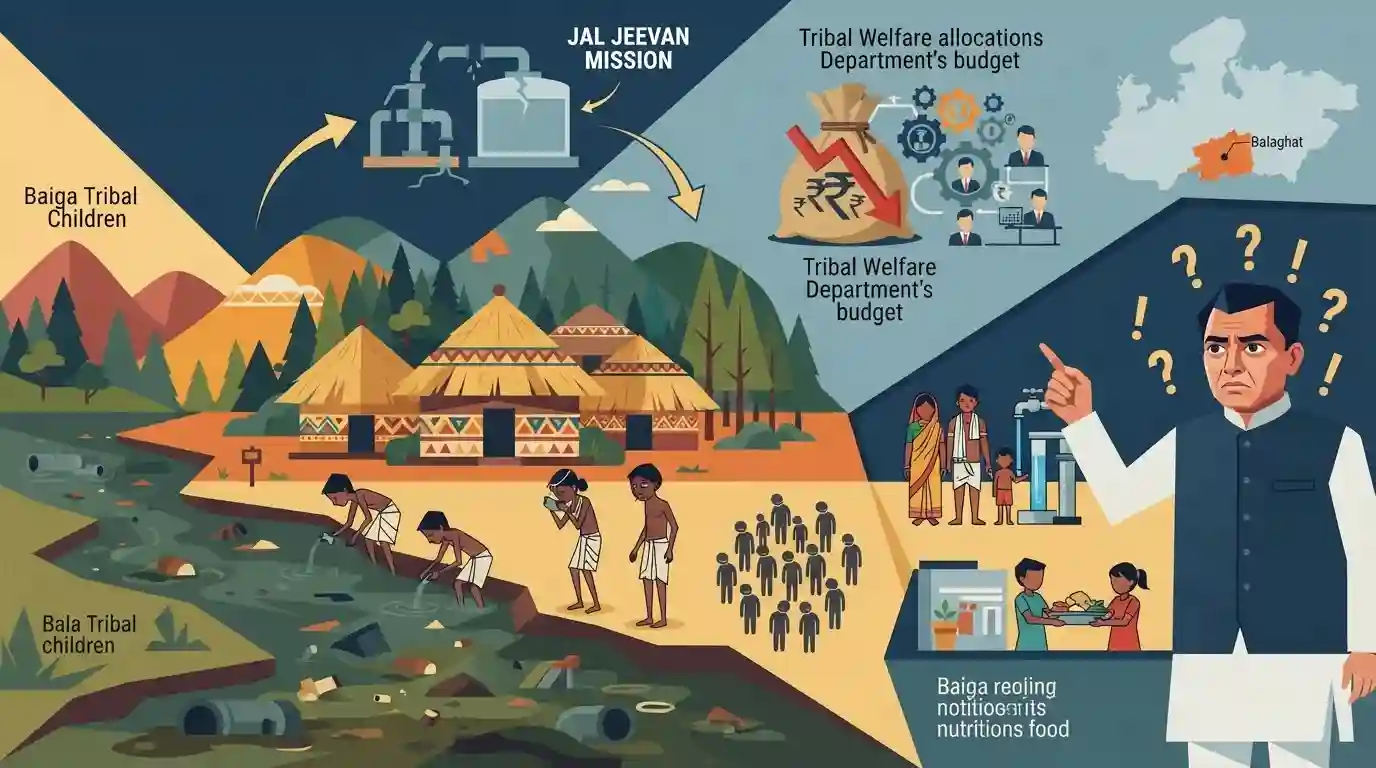
Madhya Pradesh Leader of Opposition Umang Singhar has claimed that 19 children, predominantly from the vulnerable Baiga tribe, died due to contaminated water and malnutrition in Balaghat district. The incident, spanning villages such as Kundekasa, Bondari, and Korka, highlights severe lapses in basic amenities. Singhar criticized the state government for the failure of the Jal Jeevan Mission, which forced tribals to rely on polluted streams for drinking water, and questioned the effectiveness of the Rs 37,000 crore budget allocated to the Tribal Welfare Department.
Key Points
- Leader of Opposition Umang Singhar alleged that 19 children died due to contaminated water and malnutrition in Balaghat district, Madhya Pradesh.
- The deaths predominantly affected the Baiga tribe, a Particularly Vulnerable Tribal Group (PVTG), in villages like Kundekasa, Bondari, and Korka.
- Singhar highlighted the failure of the Jal Jeevan Mission, forcing residents to drink contaminated water from local streams.
- He also questioned the utilization of the Rs 37,000 crore budget allocated to the state's tribal welfare department.
Important Terms
Jal Jeevan Mission

A flagship Central scheme launched in 2019 to provide safe and adequate drinking water via functional household tap connections to all rural households, emphasizing water security, community participation, and health.
UPSC context
GS Paper 2. Tests knowledge of rural infrastructure, health outcomes tied to water quality, and government schemes for basic amenities.
Tribal Welfare Department
A state-level administrative body responsible for implementing developmental policies, managing budget allocations, and overseeing health, education, and livelihood schemes specifically tailored for the socio-economic upliftment of Scheduled Tribes.
UPSC context
GS Paper 2. Evaluates understanding of governance, administrative accountability, and state execution mechanisms targeting social justice for marginalized populations.
Baiga Tribe
A central Indian indigenous community, predominantly residing in Madhya Pradesh, recognized as a Particularly Vulnerable Tribal Group (PVTG). They traditionally practice shifting cultivation and are renowned for their intricate tattooing culture.
UPSC context
GS Paper 1. Tests awareness of India's tribal diversity, cultural heritage, and specific developmental challenges faced by localized indigenous groups.
Particularly Vulnerable Tribal Groups (PVTGs)
A sub-classification of India's Scheduled Tribes characterized by pre-agricultural technology, stagnant or declining populations, extremely low literacy, and subsistence economies. India recognizes 75 PVTGs requiring highly targeted, protective welfare interventions.
UPSC context
GS Paper 2. Highly relevant for questions on social justice, affirmative action, and focused policy interventions for the most marginalized.
Malnutrition
A health condition caused by a deficiency, imbalance, or excess of nutrients. In tribal regions, severe malnutrition often exacerbates vulnerability to waterborne diseases, highlighting critical gaps in food security and healthcare.
UPSC context
GS Paper 2. Critical for topics on public health, poverty, and the intersection of sanitation, water access, and nutritional security.
Prelims Trap
"Particularly Vulnerable Tribal Groups (PVTGs) are distributed across all states and Union Territories of India."
There are 75 recognized PVTGs, but they are concentrated in only 18 states and 1 Union Territory (Andaman & Nicobar), not pan-India.
Static Concepts Connected
What are the 4 criteria for declaring a community as a PVTG?
- Technology: Use of pre-agricultural level of technology.
- Literacy: Extremely low levels of literacy compared to other tribal groups.
- Population: A stagnant or declining population growth rate.
- Economy: A subsistence level of economy.
What are the core targets of the Jal Jeevan Mission (Rural)?
- FHTC Target: Provide Functional Household Tap Connections (FHTC) to every rural household by 2024.
- Service Level: Supply 55 litres of water per capita per day (lpcd) of prescribed quality on a regular basis.
- Community Participation: Focus heavily on community management through Village Water and Sanitation Committees (VWSCs).
Cross-Topic Patterns
PVTGs & Mineral Geography
Balaghat hosts Baiga PVTGs and India's largest manganese reserves. UPSC frequently links tribal demographics, displacement, and health vulnerabilities with geographical resource mapping.
The WASH-Malnutrition Nexus
Contaminated water triggers chronic diarrheal diseases, impairing nutrient absorption. This explains why supplementary nutrition schemes fail without primary WASH infrastructure.

Expect a multi-statement 2026 prelims question linking PVTG geography (e.g., Baiga in MP), Dhebar Commission, and classification criteria.
Linked PYQs · 3
Linked PYQs · 3
- 2025MPPSC_PRELIMSGS1
Which one of the following is not one of the Particularly Vulnerable Tribal Group (PVTG) of Madhya Pradesh?
- 2025MPPSC_PRELIMSGS1
Since the date 23.12.2017, 'Ahar Anudan Yojana' is a yojana to get rid of malnutrition of which tribal community?
- 2022MPPSC_PRELIMSGS1
Which of the following districts has large manganese reserves?
