Madhya Pradesh Promotes Low Water Crops Amid Drought Concerns
Source:newindianexpress ↗
Why It Matters
This article is highly relevant for the MPPSC Prelims as it covers crucial state-specific agricultural schemes (Balram Talab, Jalabhishek 2.0), climate/monsoon trends (LPA, El Niño impact on MP), and district-level geographical vulnerability classification, which are frequently asked in the Geography and Economy sections of the State Service Examination.
Summary
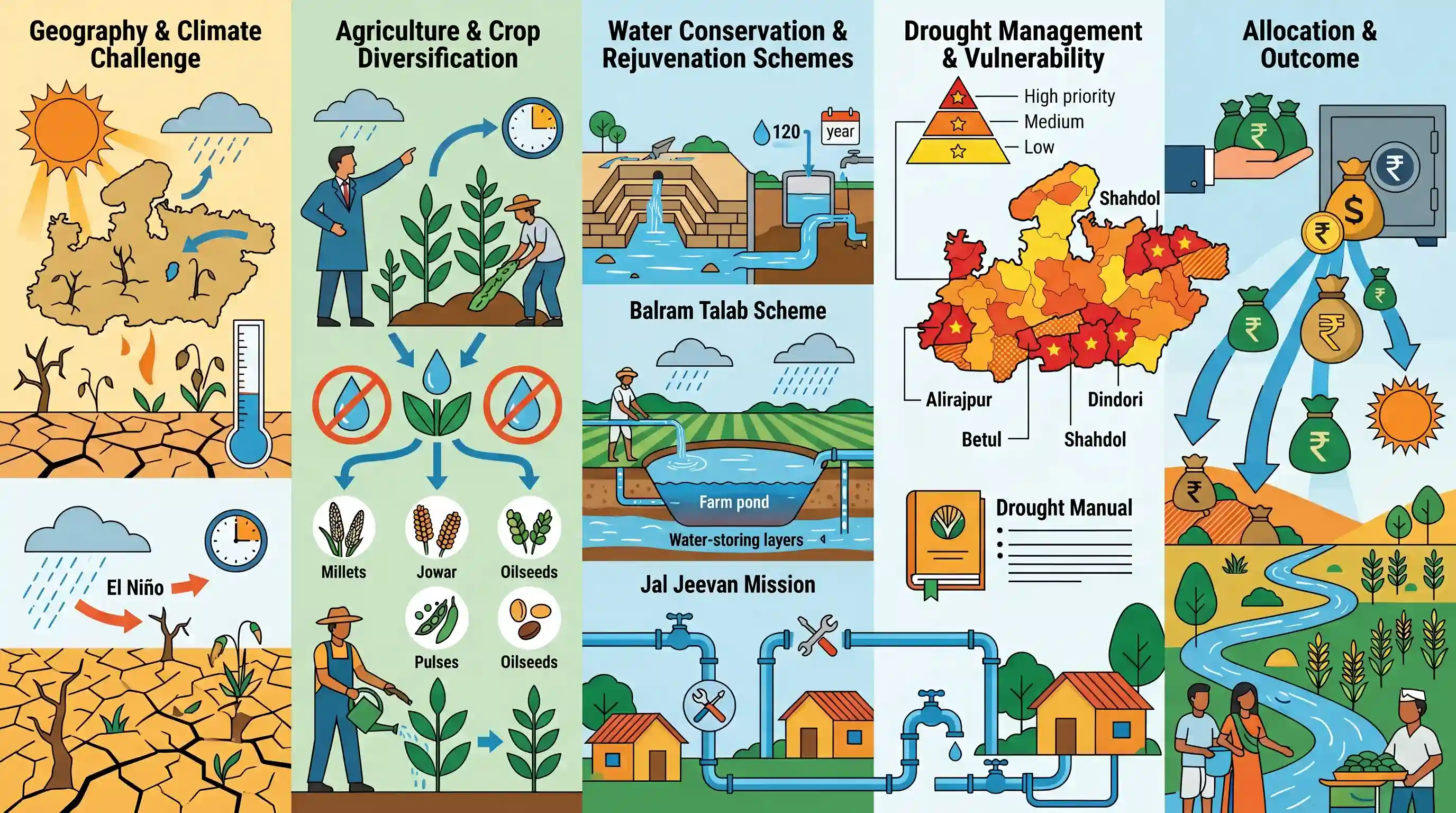
Faced with a deficient monsoon and potential drought, the Madhya Pradesh government, led by CM Mohan Yadav, has launched a statewide campaign to promote low-water-requirement, short-duration crops such as millets (Shree Anna like kodo-kutki, jowar, bajra), pulses, and oilseeds. To mitigate groundwater stress and drought risks, the state is implementing various initiatives, including 'Jalabhishek 2.0' (aimed at restoring 100 traditional water structures per block over two years), the Balram Talab Scheme for rainwater harvesting, and targeted rural water scheme repairs under the Jal Jeevan Mission. Additionally, the government has categorized vulnerable districts into priority tiers—with Alirajpur, Betul, Dindori, and Shahdol labeled high-priority—and allocated Rs 20.9 crore for drought management under the provisions of the Drought Manual.
Key Points
- Due to an impending El Niño impact and a 28% below-normal rainfall recorded from June 1 to July 1, 2026, Madhya Pradesh is bracing for a deficient monsoon (90-94% of the Long Period Average).
- Chief Minister Mohan Yadav launched a statewide campaign advocating for moisture-conservation techniques and cultivating low-water, short-duration crops like Shree Anna/millets (sorghum/jowar, pearl millet/bajra, kodo-kutki), pulses (urad, moong, tur), and oilseeds.
- The government is implementing 'Jalabhishek 2.0' to survey and restore old stepwells, wells, and traditional ponds, planning to rejuvenate at least 100 water structures in every development block within two years under the principle: 'Water of the field should remain in the field, and water of the village should remain in the village'.
- Based on irrigation coverage, districts have been categorized into vulnerability tiers: Alirajpur, Betul, Dindori, and Shahdol are high-priority; Anuppur, Mandla, and Singrauli are medium-priority; and 34 other districts are lower priority.
- Drought declarations for Kharif crops must be declared before October 31, and for Rabi crops before March 31, backed by a revenue department budgetary provision of Rs 20.9 crore to tackle drought-like scenarios.
Important Terms
Jalabhishek 2.0

A Madhya Pradesh government water conservation campaign designed to restore traditional water structures—such as ponds, stepwells, and wells—and rejuvenate at least 100 water bodies per development block over two years.
UPSC context
GS Paper III (Agriculture & Water Resources); tests decentralized conservation, groundwater recharge strategies, and climate-resilient farming.
Balram Talab Scheme
A Madhya Pradesh state scheme initiated in 2007 providing financial subsidies to farmers to construct on-farm ponds to harvest rainwater and secure decentralized irrigation.
UPSC context
GS Paper III (Agriculture & Government Schemes); tests farm-level water security, rainfed agriculture, and localized climate adaptation models.
Jal Jeevan Mission
A centrally sponsored flagship initiative launched in 2019 to provide safe, adequate drinking water through Functional Household Tap Connections (FHTCs) to all rural households.
UPSC context
GS Paper II (Governance) & GS Paper III (Infrastructure); tests rural basic services, welfare policy execution, and health-infrastructure delivery.
AMRUT 2.0
A national mission launched in 2021 by the Ministry of Housing and Urban Affairs to make all statutory towns water-secure and ensure universal household tap connections.
UPSC context
GS Paper II & III (Urbanization & Infrastructure); tests urban water supply systems, circular water economy, and urban sanitation governance.
Drought Manual
A national guidelines document issued by the Ministry of Agriculture and Farmers Welfare setting scientific indices, assessment matrices, and timelines for objective drought declaration by states.
UPSC context
GS Paper III (Disaster Management); tests systematic disaster assessment frameworks, central-state coordination, and mitigation of extreme weather events.
Prelims Trap
The Union Ministry of Agriculture officially declares nationwide or state-specific droughts to trigger National Disaster Response Fund (NDRF) assistance.
Under the 2016 Manual, the State Government is the sole authority to declare drought within its territory. The Union Government does not declare drought; it only assesses requests for financial assistance from the NDRF.
Static Concepts Connected
What are the key provisions and triggers under the Manual for Drought Management, 2016?
- State Authority: States are the sole legal authority to declare drought, and any such notification remains valid for a maximum of six months.
- Strict Timelines: The manual sets October 31 as the hard deadline for Kharif drought declarations and March 31 for Rabi crops.
- Two-Step Assessment: Requires a mandatory first trigger (rainfall deficit) followed by at least three out of four impact indicators (Agriculture, Vegetation/Remote Sensing, Soil Moisture, and Hydrology) for a 'severe' declaration.
What are Minor Millets and how do they differ from Major Millets?
- Major Millets: Sorghum (Jowar), Pearl Millet (Bajra), and Finger Millet (Ragi) are major millets due to their larger grain size and higher production share.
- Minor Millets: Includes Kodo, Kutki (Little Millet), Foxtail, and Barnyard millets, which are highly drought-tolerant, possess superior nutritional profiles, and are often cultivated in marginal lands.
- Tribal Linkage: Minor millets are central to the dryland farming practices of Central Indian PVTGs, such as the Gond, Baiga, and Bharia tribes.
Cross-Topic Patterns
Drought guidelines & Centre-State relations
Disagreements over rigid scientific parameters in the 2016 Drought Manual often strain Centre-State relations when states demand NDRF funds but fail to meet strict indicator thresholds.
PVTG livelihoods & climate resilience
Promoting minor millets like Kodo-Kutki preserves traditional agricultural biodiversity of PVTGs (like Baigas) while safeguarding dryland farmers against recurrent El Niño events.

UPSC may target the multi-tiered scientific criteria of the 2016 Drought Manual and the statutory role of States in drought declarations.
Linked PYQs · 4
Linked PYQs · 4
- 2025MPPSC_PRELIMSGS1
Read the following statements regarding the climate of Madhya Pradesh and select the correct answer from the codes given below: 1. Most of the rainfall in the state is received from the monsoon. 2. Wind speed during winters is faster than in summer and rainy seasons. 3. Distance from sea also affects the distribution of monsoon rains in the state. 4. Summer temperature in Pachmarhi is related to the altitude above sea level. Codes:
- 2024MPPSC_PRELIMSGS1
The south-eastern part of Madhya Pradesh receives maximum rainfall from :
- 2022MPPSC_PRELIMSGS1
Which of the following is a major source of irrigation in Madhya Pradesh?
- 2020MPPSC_PRELIMSGS1
Main crop of Madhya Pradesh is
