High Court Directive on Tiger Reserves and Virus Outbreak
Source:The Hindu ↗
Why It Matters
Madhya Pradesh is known as the 'Tiger State' of India. Epidemics like Canine Distemper Virus (CDV) pose a massive threat to conservation efforts. This development highlights the intersection of judicial oversight, wildlife health administration, and statutory bodies like the NTCA (established under the Wildlife Protection Act, 1972) in managing ecological emergencies.
Summary
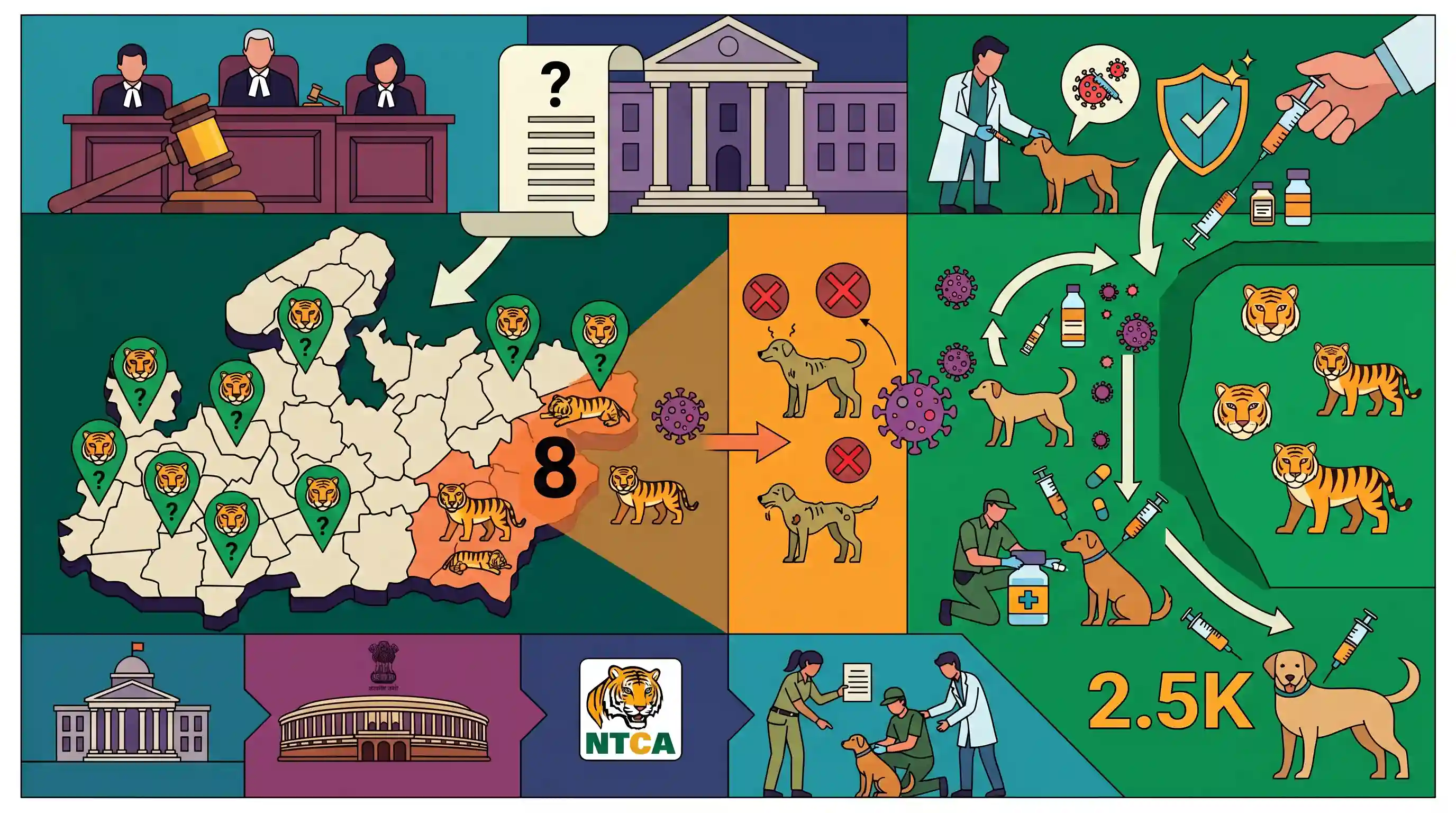
The Madhya Pradesh High Court has sought a status report on all nine tiger reserves of the state following the deaths of eight tigers in Kanha Tiger Reserve due to Canine Distemper Virus (CDV). A division bench directed the State, Centre, and NTCA to keep strict vigil and conduct vaccination drives for dogs in the buffer zones. Around 2,500 dogs have been vaccinated around Kanha to halt the transmission of this highly contagious viral disease to the tiger population.
Key Points
- The Madhya Pradesh High Court (Division Bench of Justices Anand Pathak and B.P. Sharma) has directed the State Government, Central Government, and the National Tiger Conservation Authority (NTCA) to keep strict vigilance over all tiger reserves in the state.
- The judicial intervention comes in the wake of the deaths of eight tigers since April due to Canine Distemper Virus (CDV) in the Kanha Tiger Reserve.
- To prevent the zoonotic spillover of the virus, wildlife authorities have vaccinated approximately 2,500 domestic/feral dogs in and around the Kanha Tiger Reserve.
- The CDV outbreak in Kanha first raised alarms in April when a female tiger and her four cubs died within a span of 10 days. Three more tigers have succumbed to the virus since then.
- The High Court has sought a detailed status report on all nine tiger reserves of Madhya Pradesh, emphasizing the need for timely vaccination drives to protect the big cats from health calamities.
- Kanha Tiger Reserve, famous for the Royal Bengal Tiger and the hard-ground swamp deer (Barasingha), was the first reserve in India to introduce an official mascot, 'Bhoorsingh the Barasingha'.
Important Terms
National Tiger Conservation Authority (NTCA)

A statutory body under the Ministry of Environment, Forest and Climate Change, established under the Wildlife (Protection) Act, 1972 to strengthen tiger conservation and oversee Project Tiger.
UPSC context
GS Paper III (Environment); tests statutory environmental bodies, governance frameworks, and tiger conservation policies.
Wildlife (Protection) Act, 1972
A landmark Indian legislation providing the legal framework for the protection of wild animal and plant species, habitat management, and regulation of wildlife trade.
UPSC context
GS Paper III (Environment & Ecology); tests environmental laws, regulatory mechanisms, protected area networks, and conservation schedules.
Project Tiger
A centrally sponsored conservation program launched in 1973 aimed at ensuring a viable population of Bengal tigers in their natural habitats across India.
UPSC context
GS Paper III (Environment); tests iconic species conservation programs, ecological corridors, and habitat management strategies.
Canine Distemper Virus (CDV)
A highly contagious, multi-systemic RNA virus of the Paramyxoviridae family that targets the respiratory, gastrointestinal, and central nervous systems of wild and domestic carnivores.
UPSC context
GS Paper III (Science & Technology/Environment); tests understanding of zoonotic pathogens, infectious diseases in wildlife, and conservation biology.
Kanha Tiger Reserve
Located in Madhya Pradesh's Maikal range, it is the state's largest national park, famously known for saving the hard-ground Barasingha from extinction.
UPSC context
GS Paper I & III (Geography/Environment); tests regional geography, mapping of tiger reserves, and species conservation milestones.
Prelims Trap
Canine Distemper Virus (CDV) is host-specific to canids and cannot naturally infect or cause mortality in large felids like tigers and lions.
CDV is highly contagious across multiple mammalian families, posing a severe threat to large felids (e.g., Bengal tigers in Kanha, Asiatic lions in Gir) through spillover from feral dogs.
Static Concepts Connected
What is the National Tiger Conservation Authority (NTCA) and its mandate?
- Establishment: Statutory body under the Ministry of Environment, Forest and Climate Change, constituted under the Wildlife (Protection) Act, 1972 (amended in 2006).
- Mandate: Strengthens tiger conservation, approves Tiger Conservation Plans prepared by state governments, and lays down normative standards for reserve management.
What are the ecological features and status of the hard-ground Barasingha?
- Unique Subspecies: Rucervus duvaucelii branderi is the hard-ground swamp deer, distinguished from other wetland subspecies by its adaptation to hard, dry grass plains.
- Conservation Status: Listed as 'Vulnerable' on the IUCN Red List, Schedule I of the Wildlife (Protection) Act, 1972, and CITES Appendix I.
- Habitat Exclusivity: Kanha Tiger Reserve is the last remaining natural refuge and global stronghold for this specific hard-ground subspecies.
Cross-Topic Patterns
Feral dogs & wildlife epidemiology
The domestic-wildlife interface in buffer zones creates critical transmission pathways for epizootic pathogens, making domestic veterinary interventions central to wild predator conservation.
Judicial oversight in conservation
High Courts increasingly exercise writ jurisdiction to monitor wildlife emergencies, bridging the gap between executive implementation and statutory obligations under the Wildlife Protection Act.

Wildlife epizootics (like CDV) and statutory roles of NTCA under WPA 1972 are highly likely to be tested in a multi-statement Prelims question.
Linked PYQs · 3
Linked PYQs · 3
- 2018MPPSC_PRELIMSGS1
Kanha National Park is famous for
- 2022MPPSC_PRELIMSGS1
Which of the following National Parks is the first in India to officially introduce a mascot named "Bhoorsingh the Barasingha"?
- 2016MPPSC_PRELIMSGS1
In which year was the wildlife protection act enforced in India?
