Madhya Pradesh High Court Rules on Personal Liberty in Detention
Source:lawbeat ↗
Why It Matters
This ruling addresses critical concerns regarding human rights violations, illegal detentions by private rehabilitation facilities, and the protection of individual personal liberty under Article 21 of the Indian Constitution, making it highly relevant for governance and legal studies in MPPSC.
Summary
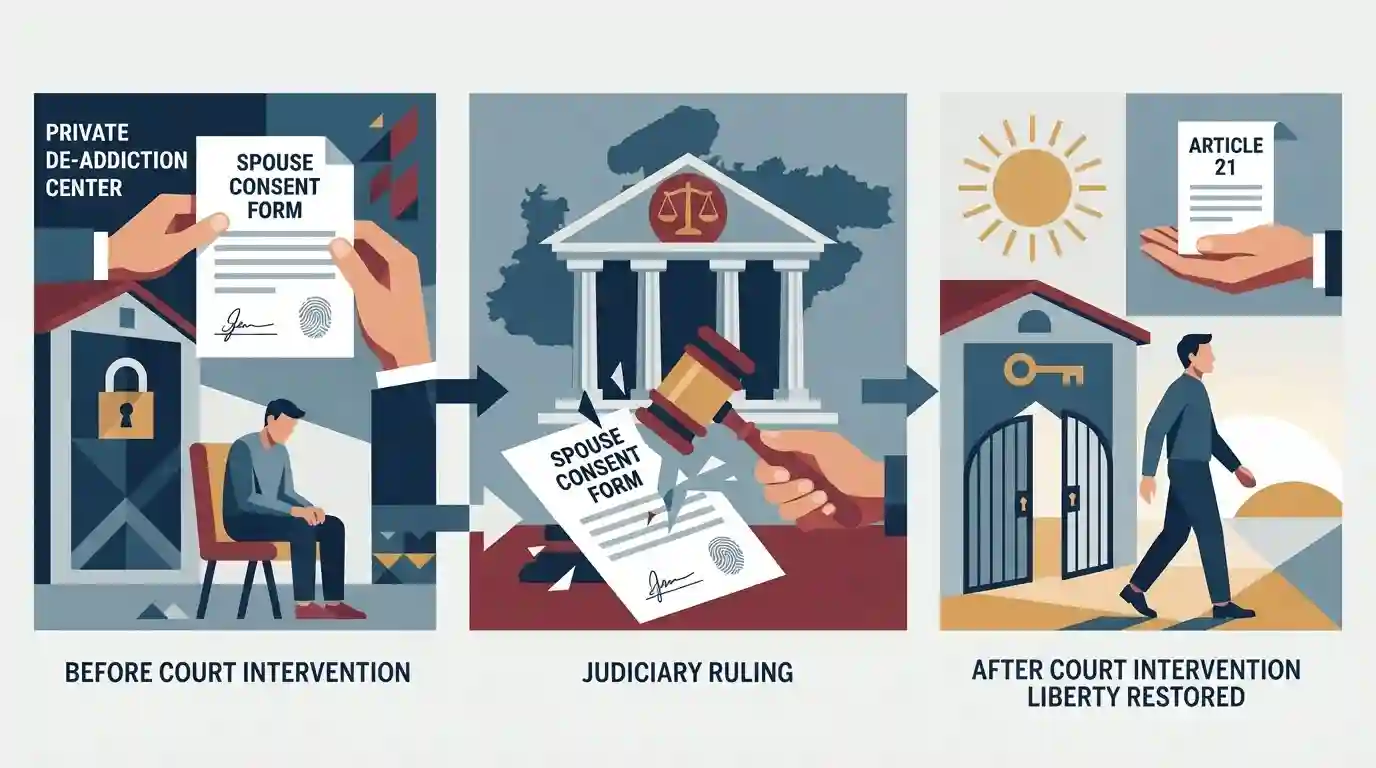
The Madhya Pradesh High Court has held that private de-addiction and rehabilitation centres do not have the legal authority to detain an adult individual against their will merely on the basis of a consent form signed by the spouse. The court reinforced that individual personal liberty guaranteed under Article 21 cannot be arbitrarily curtailed by private bodies without proper statutory procedures and voluntary consent.
Key Points
- The Madhya Pradesh High Court ruled that a private de-addiction centre cannot detain an adult individual against their will based solely on a consent form signed by their spouse.
- The Court emphasized that personal liberty is a fundamental right under Article 21, and involuntary confinement without proper legal and medical backing or statutory compliance violates personal freedom.
- The ruling underscores the importance of habeas corpus and judicial scrutiny over private institutions holding individuals under the guise of medical treatment or rehabilitation.
Important Terms
Article 21 of the Constitution

Guarantees right to life and personal liberty, stating no person shall be deprived of liberty except according to procedure established by law.
UPSC context
Mains GS Paper II & MPPSC Paper II (Polity): Fundamental Rights and personal liberty protection against illegal confinement.
Article 226 of the Constitution
Empowers High Courts to issue writs including Habeas Corpus to enforce fundamental rights and redress illegal detentions.
UPSC context
Mains GS Paper II & MPPSC Paper II: Constitutional remedies and High Court writ jurisdiction.
Madhya Pradesh High Court
The highest constitutional court of Madhya Pradesh with jurisdiction over state legal matters, writ petitions, and public interest litigation.
UPSC context
MPPSC Paper II & IV: State judiciary structure, judicial activism, and protection of citizen rights within MP.
Private De-addiction Centre
Non-governmental facilities providing rehabilitation for substance abuse, which lack legal authority to detain adults against their will without statutory backing.
UPSC context
MPPSC Paper II (Social Sector & Public Health): Regulation of health facilities and prevention of illegal detentions.
Static Concepts Connected
What are the constitutional provisions and writs related to illegal detention in India?
- Article 21: Guarantees protection of life and personal liberty, which can only be deprived according to procedure established by law.
- Article 226: Empowers High Courts to issue writs including Habeas Corpus to secure the release of illegally detained persons.
- Habeas Corpus: Literally means 'to have the body of', serving as a vital remedy against unlawful executive or private confinement.
Cross-Topic Patterns
Article 226 and Private Writs
The writ jurisdiction of High Courts under Article 226 extends against private entities discharging public functions or infringing fundamental rights like personal liberty.

Expect a direct question on Article 21's scope regarding personal autonomy and the constitutional remedy of habeas corpus against private bodies.
Linked PYQs · 2
Linked PYQs · 2
- 2019MPPSC_PRELIMSGS1
The scope of the Article 21 of the Constitution was expanded to include Right to Education, because of the decision of Supreme Court in the case
- 2022MPPSC_PRELIMSGS1
According to which Article of the Indian Constitution, can the President of India (in consultation with the Chief Justice) transfer a Judge of a High Court from one court to another?
