MP High Court mandates time-bound judicial infrastructure upgrade
Source:indianmasterminds ↗
Why It Matters
This highlights the critical intersection of fundamental rights (Article 21) and state obligations regarding judicial infrastructure. Questions on the structure of the MP judiciary and the interpretation of Fundamental Rights are staples in MPPSC State Service Prelims.
Summary
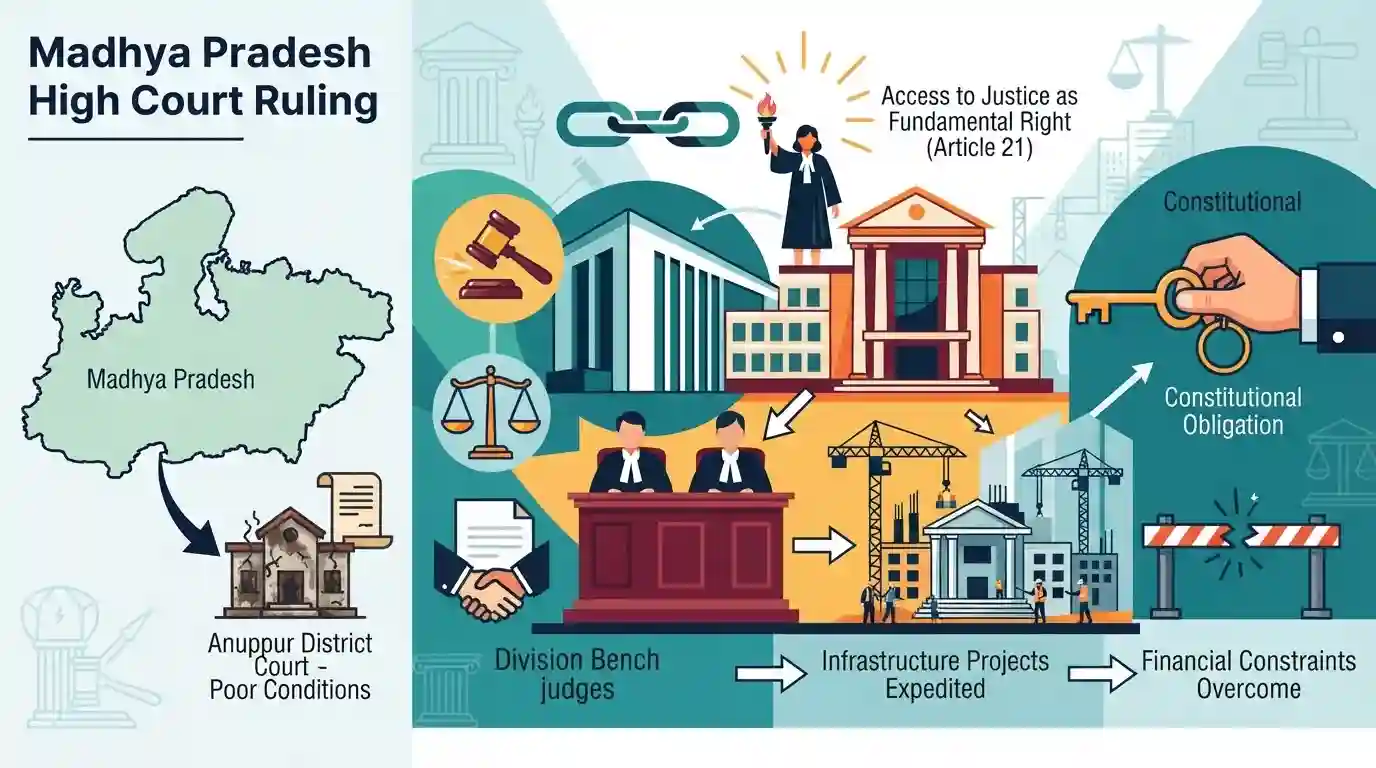
The Madhya Pradesh High Court has directed the state government to expedite pending judicial infrastructure projects, ruling that providing adequate facilities for the judiciary is a constitutional obligation. A division bench comprising Acting Chief Justice Vivek Rusia and Justice Pradeep Mittal asserted that the state cannot use financial constraints as an excuse for delays. Originating from a PIL regarding the Anuppur District Court's poor conditions, the court expanded the case's scope to cover the entire state, emphasizing that access to justice is a fundamental right enshrined in Article 21 of the Constitution.
Key Points
- The Madhya Pradesh High Court ruled that providing judicial infrastructure is a constitutional duty of the state government.
- The court clarified that financial constraints cannot be cited as an excuse for delaying judicial infrastructure projects.
- The observation was made while hearing a Public Interest Litigation (PIL) concerning poor infrastructure at the District Court in Anuppur.
- The High Court expanded the scope of the PIL to monitor all pending judicial infrastructure projects across Madhya Pradesh.
- The court emphasized that 'access to justice' is an integral part of the fundamental right to life and liberty under Article 21 of the Constitution.
Important Terms
Article 21 of the Indian Constitution

A fundamental right guaranteeing life and personal liberty. The MP High Court recently affirmed that it includes the right to access justice, making adequate judicial infrastructure a constitutional mandate.
UPSC context
MPPSC Paper 2 (Constitution). Tests the expanding scope of Fundamental Rights through progressive judicial interpretations and state obligations.
Madhya Pradesh High Court
The apex judicial body in the state. A division bench recently directed the MP government to fast-track pending court projects, ruling that financial constraints cannot excuse justice delivery delays.
UPSC context
MPPSC Paper 2 (State Judiciary). Crucial for understanding the High Court's administrative oversight and constitutional checks on the state executive.
Public Interest Litigation (PIL)
A legal mechanism to address public grievances. The MP High Court expanded a localized PIL regarding the Anuppur District Court's poor conditions into a state-wide directive on infrastructure.
UPSC context
MPPSC Paper 2 (Polity). Tests understanding of judicial activism and how local issues can trigger broad legal and administrative reforms.
Judicial Infrastructure
The physical courts, resources, and facilities required for justice delivery. The MP High Court ruled that providing this infrastructure is an essential sovereign function, not a matter of executive discretion.
UPSC context
MPPSC Paper 2 (Governance). Highlights systemic challenges in justice delivery and the state's budgetary responsibilities toward constitutional institutions.
Prelims Trap
Providing judicial infrastructure and access to justice is merely a Directive Principle of State Policy under Article 39A.
Aspirants often confuse DPSP Article 39A (free legal aid) with the overarching concept of 'access to justice', which courts strictly define as a Fundamental Right under Article 21.
Static Concepts Connected
What is the structural organization of the Madhya Pradesh High Court?
- Principal Seat: The Principal Seat is located in Jabalpur.
- Permanent Benches: Two permanent benches operate in Indore and Gwalior, which were established in 1968 under the States Reorganisation Act.
- Jurisdiction: The High Court exercises appellate and writ jurisdiction over the entire territory of Madhya Pradesh.
Which landmark facets of the judicial process have been read into Article 21?
- Speedy Trial: Recognized as a fundamental right in the landmark Hussainara Khatoon case, protecting undertrials.
- Access to Justice: The Supreme Court (e.g., Anita Kushwaha case) explicitly tied access to the justice system to Articles 14 and 21.
- Free Legal Aid: Providing legal assistance is heavily linked to Article 21's guarantee of fair procedure, alongside Article 39A.
Cross-Topic Patterns
State Finances vs. Fundamental Rights
Courts routinely dismiss "lack of funds" as a defense for Article 21 violations, a pattern seen not just in judicial infrastructure, but also in health, prison reform, and environmental PILs.
Localized Grievance to Statewide PIL
High Courts frequently expand localized PILs (like the Anuppur district court condition) into suo motu statewide monitoring mechanisms, showcasing the flexible procedural nature of Public Interest Litigation in India.

Expect Prelims questions distinguishing Article 39A (Free Legal Aid/DPSP) from Article 21 (Access to Justice/Fundamental Right).
Linked PYQs · 1
Linked PYQs · 1
- 2020MPPSC_PRELIMSGS1
Who among the following Chief Justice of Madhya Pradesh High Court has not been the Judge at Supreme Court of India?
