District Collector Powers: Madhya Pradesh High Court Limits Scope
Source:indian-masterminds ↗
Why It Matters
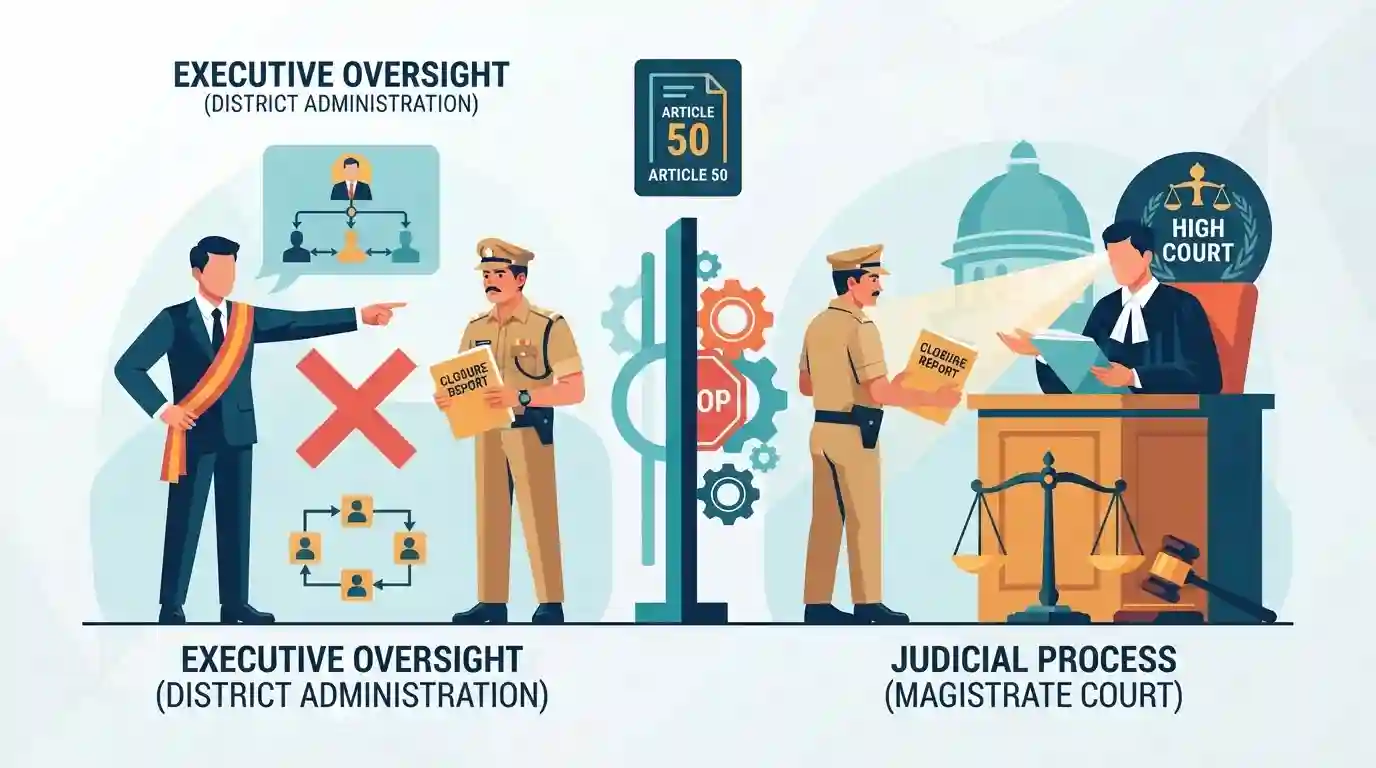
The ruling is an excellent practical illustration of the separation of powers between the executive and the judiciary (Article 50). It clearly demarcates the boundary where administrative police oversight ends and the Magistrate's judicial authority begins, highly relevant for state civil services aspirants studying the roles of District Collectors.
Summary
The Madhya Pradesh High Court's Indore Bench delivered a significant ruling clarifying the limits of a District Collector's powers in criminal investigations. The court stated that once police file a closure report before a Magistrate, the process becomes judicial, and the District Collector (acting as the executive) lacks the authority to direct the police to recall the report or reopen the investigation. The judgment strongly reaffirmed the constitutional mandate of the Separation of Powers (Article 50), ensuring that executive administrative oversight does not encroach upon the independent functioning of the judiciary in criminal proceedings.
Key Points
- The Madhya Pradesh High Court ruled that a District Collector cannot order police to recall a closure report or reopen a criminal investigation once filed before a Magistrate.
- Filing a closure report marks the transition of a case from an executive process (police investigation) to a judicial process.
- The court emphasized that allowing executive interference at this stage violates the constitutional principle of Separation of Powers.
- Reinvestigation or further investigation (under Section 173(8) of CrPC / corresponding BNSS provisions) is exclusively within the Magistrate's purview, not the Collector's.
Important Terms
Bharatiya Nagarik Suraksha Sanhita (BNSS)

India's new criminal procedure code, effective July 1, 2024, replacing the CrPC. It modernizes the justice system by introducing strict timelines, digital processes, and mandatory forensic investigations.
UPSC context
GS Paper 2 (Governance); critical for understanding ongoing criminal justice reforms and the modernization of legal procedures in India.
Code of Criminal Procedure (CrPC)
The erstwhile procedural law governing criminal law administration in India, enacted in 1973. It established the rules for investigation, arrest, and trials before being officially replaced by the BNSS.
UPSC context
GS Paper 2 (Polity); essential for understanding the legacy procedural framework and police-judiciary dynamics in criminal investigations.
Constitution of India
The supreme law of India detailing the state framework. Specifically, its Directive Principles (Article 50) mandate the separation of the judiciary from the executive to ensure impartial justice.
UPSC context
GS Paper 2 (Polity); frequently tests constitutional doctrines like the Separation of Powers and judicial independence.
Madhya Pradesh High Court
The supreme judicial authority in Madhya Pradesh. It exercises writ and appellate jurisdictions to ensure the rule of law by checking executive overreach and protecting judicial independence at the state level.
UPSC context
GS Paper 2 (Polity); relevant to state-level judicial structure and the application of writ jurisdiction under Article 226 against executive orders.
Prelims Trap
The District Magistrate, as head of district criminal administration, can direct police to reinvestigate a case after a closure report is filed.
Once a closure report is filed in court, the case enters the judicial domain. Only a Judicial Magistrate, not an Executive Magistrate/DM, has jurisdiction to order reinvestigation.
Static Concepts Connected
How does the Indian legal system separate Judicial and Executive Magistrates?
- Constitutional basis: Article 50 of the Directive Principles mandates separating the judiciary from the executive branch in public services.
- Judicial Magistrates: Subordinate to the High Court, they handle trials, evaluate evidence, and decide on police closure reports.
- Executive Magistrates: Appointed by State governments, they focus strictly on administrative law, order maintenance, and preventive detention.
What is the procedure when police file a final closure report?
- Judicial transition: Filing a closure report transfers the case from executive investigation to the exclusive jurisdiction of the Magistrate.
- Magistrate's choices: The Magistrate can accept the report, order further investigation, or issue summons based on a victim's protest petition.
Cross-Topic Patterns
Police reforms and executive interference
This ruling reinforces the Prakash Singh directives by preventing political or administrative executives from arbitrarily directing or reopening police investigations once they become sub-judice.
Dual control in district governance
Highlights the structural friction between the District Magistrate's administrative oversight of police and the constitutional limits preventing executive intrusion into judicial processes.

2026 exams will likely test the boundary between Executive DMs and Judicial Magistrates regarding police report approvals and BNSS updates.
Linked PYQs · 3
Linked PYQs · 3
- 2014MPPSC_PRELIMSGS1
Who is empowered for imposition and realization of collective fine under SC and ST (Prevention of Atrocities) Act, 1989?
- 2018MPPSC_PRELIMSGS1
In relation to offences described under Section 175, Section 178, Section 179, Section 180 or Section 228 of the Indian Penal Code, the Human Rights Commission is to be deemed
- 2021MPPSC_PRELIMSGS1
The power of Supreme Court of India to decide the disputes between Centre and States falls under which Jurisdiction ?
