Madhya Pradesh High Court defamation case ruling on Rahul Gandhi
Source:The Hindu ↗
Why It Matters
This case highlights the procedural role of the MP High Court, the operation of Special MP/MLA courts established under Supreme Court directives, and the relevance of regional political geography (Jhabua district) and tribal demographics for state civil services examinations.
Summary
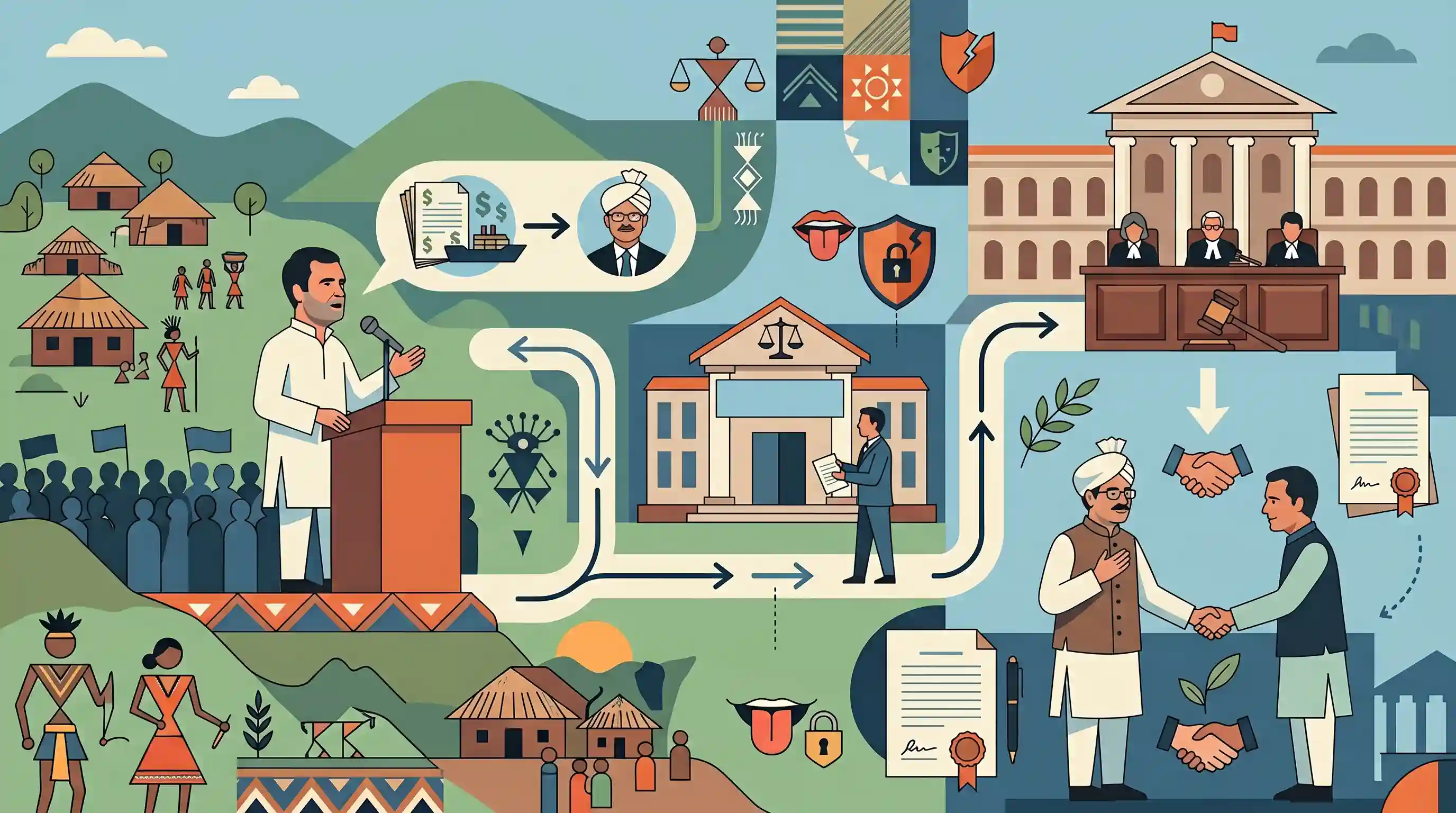
The Madhya Pradesh High Court in Jabalpur closed a defamation lawsuit against Leader of the Opposition Rahul Gandhi. The case, initiated by Kartikeya Singh Chouhan (son of Union Minister Shivraj Singh Chouhan) in a Bhopal Special MP/MLA Court, was settled amicably after Gandhi expressed regret for erroneously linking Chouhan to the Panama Papers during a 2018 assembly election rally in Jhabua district.
Key Points
- The Madhya Pradesh High Court (Jabalpur single bench of Justice Pramod Kumar Agrawal) officially closed a defamation case against Congress leader Rahul Gandhi.
- The case stemmed from an October 2018 assembly election campaign rally in Jhabua district, where Rahul Gandhi mistakenly linked Kartikeya Singh Chouhan (son of Shivraj Singh Chouhan) to the Panama Papers controversy.
- The defamation suit was originally pending in the Special Court for MPs and MLAs (JMFC) in Bhopal.
- Rahul Gandhi submitted a formal statement expressing regret, acknowledging that his mention of Kartikeya Singh Chouhan was an error and that he had intended to refer to the son of the former Chief Minister of Chhattisgarh.
- The high court disposed of the proceedings after the complainant accepted the written expression of regret, resulting in the closure of proceedings in both the High Court and the Bhopal trial court.
Important Terms
Bharatiya Nyaya Sanhita, 2023

India's primary criminal code that replaced the Indian Penal Code on July 1, 2024. It codifies offenses, including criminal defamation (Section 356), with updated standards.
UPSC context
GS Paper II: Criminal law reforms. Tests understanding of statutory updates, free speech boundaries, and judicial interpretations under the new criminal code.
Salary and Allowances of Leaders of Opposition in Parliament Act, 1977
A central statute providing statutory recognition and cabinet-minister equivalent rank, salary, and facilities to the Leader of the Opposition in both Houses of Parliament.
UPSC context
GS Paper II: Parliament and Constitution. Tests the statutory status, historical evolution, and significance of the Leader of the Opposition post.
States Reorganisation Act, 1956
A landmark parliamentary legislation that redrew India's internal state boundaries, primarily along linguistic lines, abolishing the four-fold classification of states and establishing 14 states and 6 union territories.
UPSC context
GS Paper I: Post-Independence History. Tests knowledge of India's linguistic integration, state formation, and regional political dynamics.
Special Court (MP & MLA)
Dedicated fast-track judicial bodies established following a 2017 Supreme Court directive to exclusively and expeditiously try pending criminal cases involving sitting and former Members of Parliament and Legislative Assemblies.
UPSC context
GS Paper II: Electoral reforms. Tests understanding of fast-track courts, decriminalization of politics, and judicial separation of powers.
Judicial Magistrate First Class (JMFC) Court
A second-lowest tier criminal court in the subordinate judiciary. Under the Bharatiya Nagarik Suraksha Sanhita (BNSS), it can sentence offenders to up to three years' imprisonment and impose fines up to ₹10,000.
UPSC context
GS Paper II: Subordinate Judiciary. Tests familiarity with the hierarchy, structural reforms, and penal powers of lower criminal courts in India.
Madhya Pradesh High Court
The apex judicial body in Madhya Pradesh, established in 1956 following the reorganization of states. Centered in Jabalpur, it has two permanent benches in Gwalior and Indore.
UPSC context
GS Paper II: State Judiciary. Tests knowledge of the structure, jurisdiction, and historical evolution of High Courts under federal reorganization.
Prelims Trap
Special Courts for MPs and MLAs are statutory bodies established under the Representation of the People Act, 1951.
These special courts are not statutory. They were created under Supreme Court directives in the Ashwini Kumar Upadhyay (2017) case, causing jurisdictional debates.
Static Concepts Connected
What is the constitutional and operational basis of Special Courts for MPs/MLAs in India?
- Judicial origin: Established following Supreme Court directives in the landmark Ashwini Kumar Upadhyay v. Union of India (2017) case to expedite trials.
- Operational mechanism: They designate existing sessions/magistrate courts to hear political cases, rather than constituting newly legislative-backed independent tribunals.
- Jurisdictional debate: Critics (including High Court committees) argue criminal courts must be offence-centric, whereas these are criticized as being unconstitutionally offender-centric.
How does Indian defamation law under BNS 2023 differ from English Common Law?
- Unified offence: Indian criminal law (BNS Section 356) punishes both spoken (slander) and written (libel) defamation, unlike English law where slander is only civil.
- New BNS punishment: Section 356 of BNS introduces community service as a statutory alternative punishment to simple imprisonment or fine.
- Uncodified civil law: Unlike criminal defamation which is codified, civil defamation in India remains uncodified and is governed by common law principles of torts.
Cross-Topic Patterns
Judicial Directives vs. Legislative Domain
The creation of MP/MLA courts via SC orders highlights the tension between judicial activism to curb political criminalization and the constitutional requirement for statutory backing.
Defamation, Speech, and Article 19(2)
Retaining criminal defamation under BNS Section 356 tests the balance between the right to free speech (Article 19(1)(a)) and "reasonable restrictions" (Article 19(2)) like defamation.

BNS 2023 defamation reforms (community service) and constitutional debates on 'offender-centric' Special Courts will likely feature in 2026.
Linked PYQs · 2
Linked PYQs · 2
- 2015MPPSC_PRELIMSGS1
Bhil tribe population is largest in
- 2023MPPSC_PRELIMSGS1
Who amongst the following was the first Speaker of the Madhya Pradesh Legislative Assembly ?
