Madhya Pradesh High Court closes political defamation lawsuit
Source:The Hindu ↗
Why It Matters
This case highlights key institutional and statutory frameworks relevant to MPPSC State Service Prelims, including the structural setup of the MP High Court, the role of fast-track Special Courts for public representatives, and the application of defamation laws.
Summary
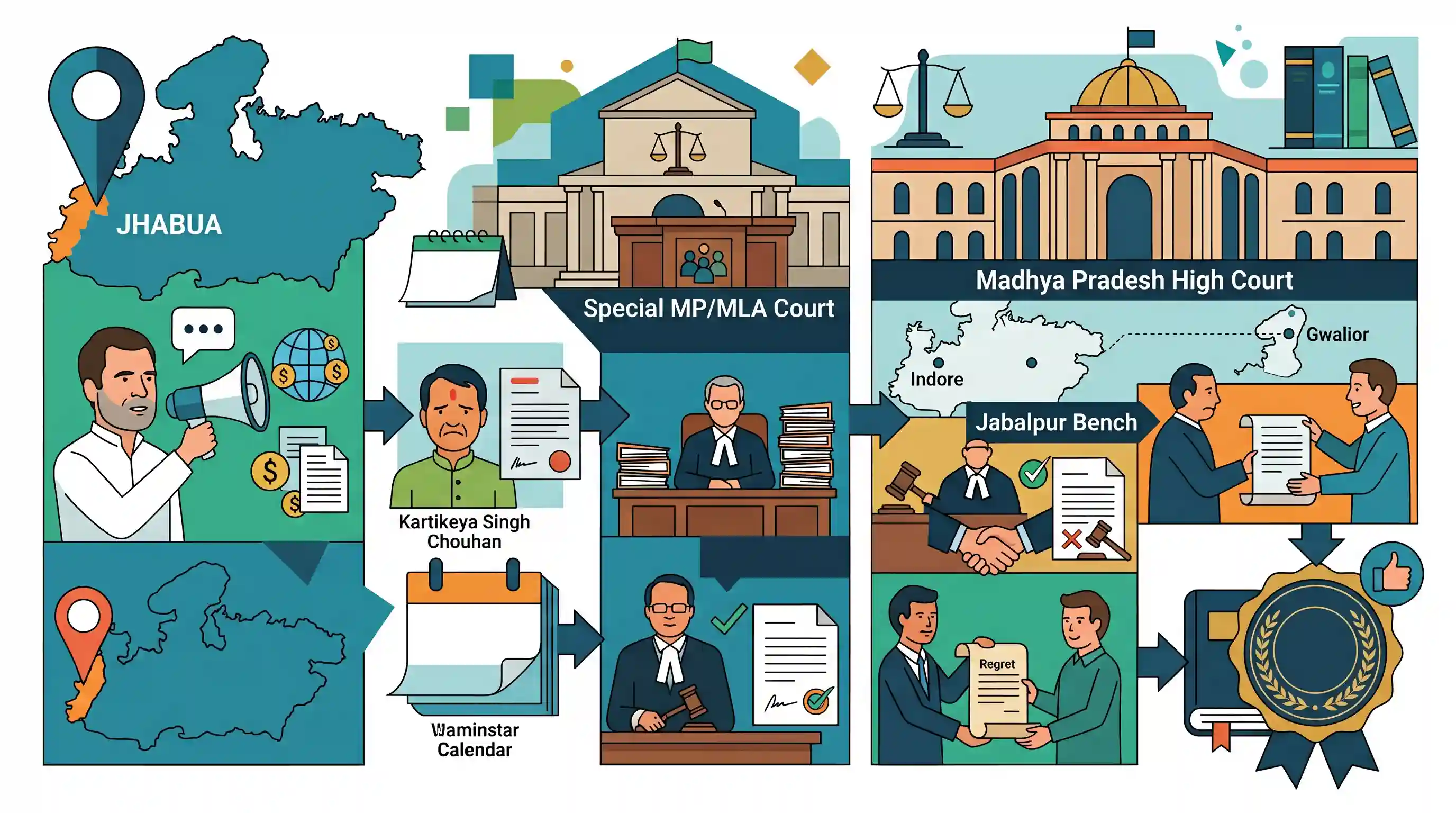
The Madhya Pradesh High Court's Jabalpur Bench closed a long-pending criminal defamation case against Leader of the Opposition Rahul Gandhi. The case, filed in a Special MP/MLA Court in Bhopal by Kartikeya Singh Chouhan over a 2018 rally statement in Jhabua regarding the Panama Papers, was terminated after Gandhi submitted a written regret statement that was formally accepted by the complainant.
Key Points
- The Madhya Pradesh High Court has closed a defamation case against Congress leader Rahul Gandhi after he expressed regret for mistakenly linking Kartikeya Singh Chouhan to the Panama Papers controversy during a 2018 election rally in Jhabua district.
- A Single Bench of Justice Pramod Kumar Agrawal in Jabalpur closed the proceedings after the complainant, Kartikeya (son of Union Agriculture Minister and former MP Chief Minister Shivraj Singh Chouhan), accepted the written regret.
- The defamation case was originally pending before the Judicial Magistrate First Class (JMFC), Special Judge (MP & MLA) Bhopal, which had issued summons for Gandhi's personal appearance.
- Gandhi had clarified the day after his 2018 rally that his comments were intended for the son of the former Chief Minister of Chhattisgarh, rather than the son of the then-Chief Minister of Madhya Pradesh.
Important Terms
Bharatiya Nyaya Sanhita

The primary substantive criminal code of India, enacted in 2023 to replace the colonial-era Indian Penal Code (IPC), focusing on victim-centric, restorative, and modernized justice.
UPSC context
GS Paper II: Criminal Justice Reforms. Tests understanding of legislative overhauls and judicial paradigm shifts in India.
Indian Penal Code
The official criminal code of India drafted in 1860 during British rule, which defined crimes and prescribed punishments across the country until its repeal in 2024.
UPSC context
GS Paper II: Indian Polity & Judiciary. Tests historical legal systems, colonial legacy, and comparative evolutionary aspects of Indian criminal law.
Panama Papers
A massive leak of 11.5 million financial documents in 2016 exposing how global elites, including politicians and celebrities, used offshore shell companies in tax havens to evade taxes and launder money.
UPSC context
GS Paper III: Money Laundering and Black Money. Tests understanding of tax evasion, international financial transparency, and economic offenses.
Madhya Pradesh High Court
The highest judicial institution in the state of Madhya Pradesh, established in 1956 with its principal seat in Jabalpur and permanent benches in Gwalior and Indore.
UPSC context
GS Paper II: State Judiciary. Tests structure, jurisdiction, and power of state High Courts in constitutional administration.
Special Court (MP & MLA) Bhopal
A designated specialized fast-track court in Bhopal set up under Supreme Court directives to expeditiously try criminal cases pending against sitting and former Members of Parliament and Legislative Assemblies.
UPSC context
GS Paper II: Criminalisation of Politics. Tests judicial measures, speedy trials, and legal accountability of elected political representatives.
Prelims Trap
Special Courts for MPs/MLAs only hold jurisdiction over criminal offenses committed by legislators during their official tenure as sitting members.
These fast-track courts have jurisdiction over both sitting and former legislators, regardless of whether the offense was committed before, during, or after their legislative tenure. Tenure status does not limit their mandate.
Static Concepts Connected
What is the legal framework for criminal defamation in India and how is its constitutionality justified?
- Statutory Framework: Criminal defamation transitioned from IPC Sections 499/500 to Section 356 of the Bharatiya Nyaya Sanhita (BNS), 2023, which introduces community service as an alternative punishment.
- Constitutional Validity: In Subramanian Swamy v. Union of India (2016), the Supreme Court upheld criminal defamation, ruling that the 'right to reputation' is protected under the Article 21 right to life.
- Article 19(2) Alignment: The Court ruled that criminalizing defamation acts as a permissible, reasonable restriction on freedom of speech and expression under Article 19(2) of the Constitution.
What is the origin and jurisdictional scope of Special Courts for MPs and MLAs in India?
- Judicial Origin: Established following a 2017 Supreme Court directive in the Ashwini Kumar Upadhyay case to fast-track long-pending criminal cases against legislators.
- Broad Scope: They try criminal offenses against both sitting and former MPs/MLAs, irrespective of whether the alleged crimes occurred before, during, or after their legislative terms.
- Nodal Oversight: High Courts monitor these specialized units to bypass normal trial delays, promoting the constitutional objective of cleaning up the political executive.
Cross-Topic Patterns
Decriminalising politics via fast-track courts
Connects the judiciary's mandate for Special MP/MLA Courts with GS-2 themes on electoral reforms, Representation of the People Act 1951, and efforts to clean up the legislature.
Free speech vs. Article 21 reputation rights
Explores the friction between political campaign speech and individual dignity, mapping directly onto fundamental rights jurisprudence under Articles 19(1)(a), 19(2), and 21.

BNS Sec 356 reforms to criminal defamation (including community service) alongside Article 19(2) bounds likely to be tested in 2026.
Linked PYQs · 2
Linked PYQs · 2
- 2022MPPSC_PRELIMSGS1
According to which Article of the Indian Constitution, can the President of India (in consultation with the Chief Justice) transfer a Judge of a High Court from one court to another?
- 2020MPPSC_PRELIMSGS1
Who among the following Chief Justice of Madhya Pradesh High Court has not been the Judge at Supreme Court of India?
