MP High Court Grants 720 Days Child Care Leave to Contractual Staff
Source:hrkatha ↗
Why It Matters
This ruling highlights judicial interpretation of constitutional welfare mandates (Articles 14, 15, and 42) in the context of changing employment paradigms. It sets a crucial precedent for labor rights and women's empowerment, relevant for Polity and Governance sections in MPPSC and UPSC exams.
Summary
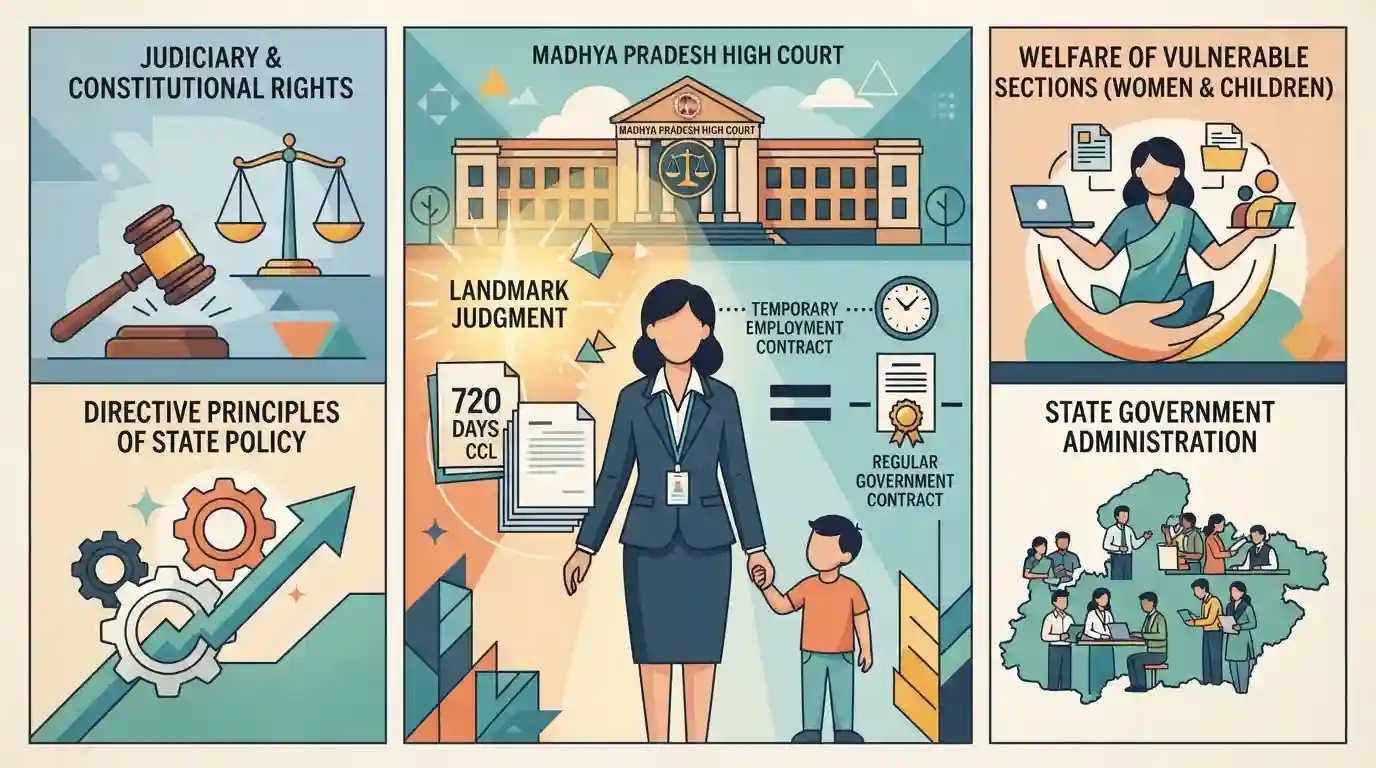
The Madhya Pradesh High Court has passed a landmark judgment affirming that contractual women employees hold the right to avail up to 720 days of Child Care Leave (CCL), bringing them on par with regular state government employees. Adjudicating a petition by a contractual worker from Khandwa, the court noted that denying such basic welfare benefits based on the nature of employment contradicts the constitutional ethos of equality and the Directive Principles of State Policy, specifically referencing the state's obligation to provide maternity relief and support child welfare.
Key Points
- The Madhya Pradesh High Court ruled that contractual women employees are entitled to up to 720 days of Child Care Leave (CCL) just like regular employees.
- The ruling was issued in a petition filed by Ayesha Sheikh, a contractual programmer whose request for CCL to care for her child with Duchenne Muscular Dystrophy was rejected.
- The Court emphasized that denying maternity and child care benefits based on employment nature (regular vs. contractual) violates fundamental rights of equality (Article 14 and 15) and welfare objectives.
- The decision aligns with the Directive Principles of State Policy (Article 42), highlighting the state's responsibility to ensure humane conditions of work and maternity relief.
Important Terms
Article 42

A constitutional directive under the DPSP requiring the State to make provisions for securing just and humane conditions of work, as well as maternity relief.
UPSC context
GS Paper 2 (Social Justice). Directly relevant to labor reforms, women's workforce participation, and maternal welfare rights.
Directive Principles of State Policy (DPSP)
Guidelines in Part IV of the Indian Constitution (Articles 36-51) that instruct the State to frame laws and policies promoting socio-economic justice and public welfare.
UPSC context
GS Paper 2 (Indian Constitution). Crucial for evaluating the alignment of government administrative policies with constitutional welfare goals.
MP Civil Services (Leave) Rules, 1977
Service rules in Madhya Pradesh that permit eligible state employees to avail up to 720 days of Child Care Leave during their entire service tenure.
UPSC context
GS Paper 2 (Governance). Acts as a vital case study for extending statutory service benefits to contractual workers.
Article 14
A Fundamental Right guaranteeing equality before the law and equal protection of laws, prohibiting arbitrary discrimination between similarly situated individuals by the State.
UPSC context
GS Paper 2 (Fundamental Rights). Central to striking down arbitrary distinctions, such as unequal leave benefits between regular and contractual staff.
Article 15
A Fundamental Right prohibiting discrimination on grounds of religion, race, caste, sex, or place of birth, explicitly empowering the State to make special provisions for women and children.
UPSC context
GS Paper 2 (Social Justice). Provides constitutional backing for specialized welfare schemes and benefits, including childcare and maternity leave.
Prelims Trap
"The Maternity Benefit Act mandates 720 days of Child Care Leave (CCL) for all female employees."
720/730 days of CCL is typically a provision under Civil Services (Leave) Rules for government staff. The Maternity Benefit Act mandates 26 weeks of maternity leave, not 2 years of CCL.
Static Concepts Connected
What are the constitutional bases for maternity relief and child care in India?
- Article 42 (DPSP): Directs the State to make provision for securing just and humane conditions of work and for maternity relief.
- Articles 14 & 15: Ensures equality before the law and prohibits discrimination on grounds of sex, forming the basis for equalizing benefits for contractual workers.
- Article 39(f): Declares that the State shall direct its policy towards ensuring that children are given opportunities to develop in a healthy manner.
What are the key features of the Maternity Benefit (Amendment) Act, 2017?
- 26 Weeks Leave: Increased paid maternity leave from 12 weeks to 26 weeks for women with fewer than two surviving children.
- Adopting/Commissioning Mothers: Provides 12 weeks of paid leave for commissioning (surrogate) mothers and women legally adopting a child below three months of age.
- Creche Facility: Mandates establishments with 50 or more employees to provide creche facilities within a prescribed distance.
Cross-Topic Patterns
Contractual workforce + Social security gaps
The judiciary is actively bridging welfare gaps for non-regular workers. Expect questions linking the vulnerabilities of India's growing contractual workforce with DPSP mandates and the new Labour Codes.
Article 42 read with Article 14 & 15
Courts are increasingly elevating DPSP welfare goals (like maternity relief) to enforceable rights by linking their denial to Article 14 (arbitrariness) and Article 15 (discrimination against women).

Expect a multi-statement Prelims question mixing Maternity Benefit Act provisions with the specific eligibility of contractual/daily-wage workers.
Linked PYQs · 3
Linked PYQs · 3
- 2023MPPSC_PRELIMSGS1
The Directive Principles of State Policy are explained in Part IV of the Indian Constitution. This system has been taken from the Constitution of which country ?
- 2025MPPSC_PRELIMSGS1
The objective of "Mukhyamantri Ladli Behna Yojana" implemented in entire Madhya Pradesh, in addition to economic self-reliance is:
- 2023MPPSC_PRELIMSGS1
The functions of the National Commission for Women are Specified in:
