MP expands digital health systems to bridge remote healthcare gaps
Source:social-news-xyz ↗
Why It Matters
State-level progress on national e-governance missions, such as the Ayushman Bharat Digital Mission, is highly relevant for MPPSC Prelims. Key metrics, awarded districts, and health policy terms like IPHS-12 are likely candidates for factual objective questions regarding state administration and healthcare infrastructure.
Summary
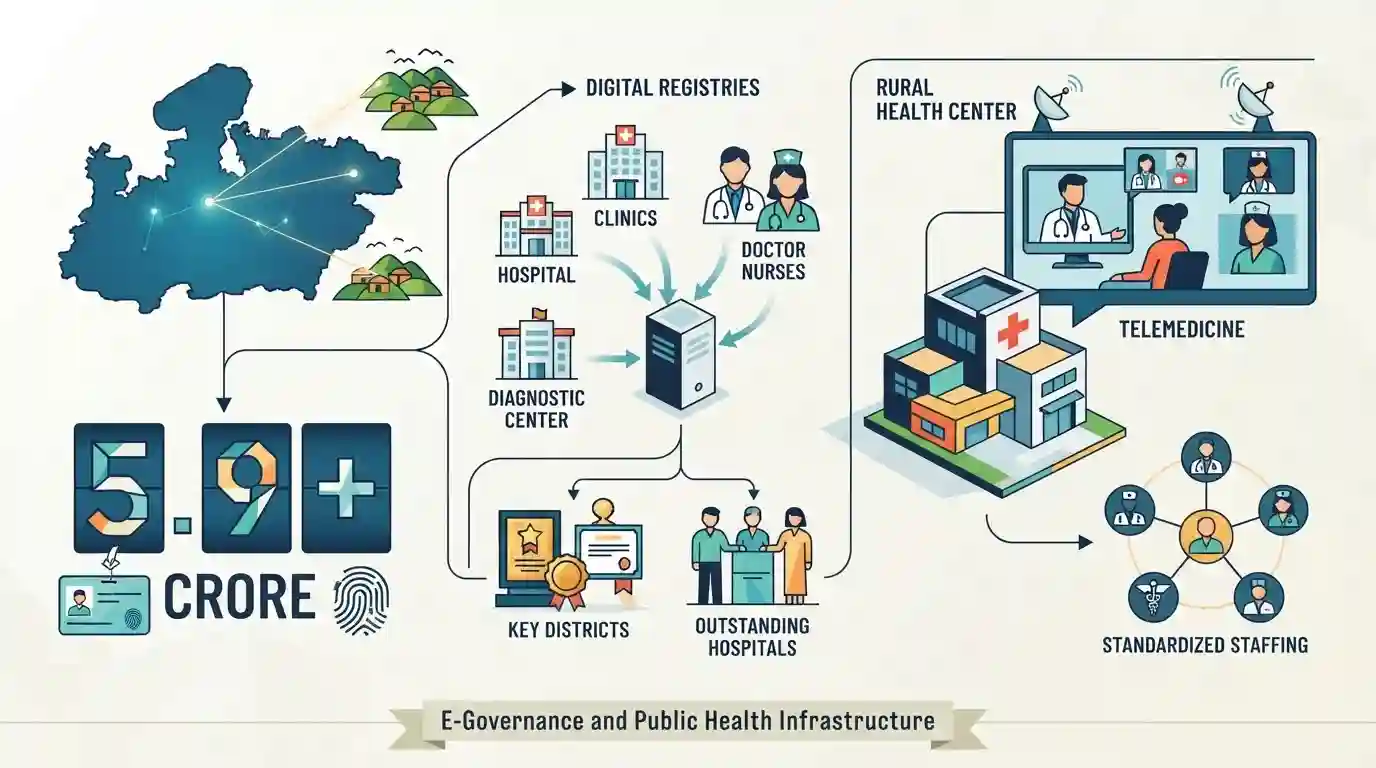
Madhya Pradesh Deputy Chief Minister Rajendra Shukla highlighted the state's success in leveraging the Ayushman Bharat Digital Mission (ABDM) to improve healthcare accessibility in remote areas. Over 5.9 crore ABHA IDs have been generated, and thousands of institutions and professionals have been onboarded into digital health registries. Key districts and hospitals were honored for their outstanding performance in digital healthcare initiatives. The government is also establishing posts in line with IPHS-12 standards and promoting telemedicine to address the shortage of specialists in rural parts of the state.
Key Points
- Madhya Pradesh is bridging healthcare gaps in remote areas by utilizing the Ayushman Bharat Digital Mission (ABDM).
- The state has generated over 5.9 crore ABHA IDs, bringing a large portion of the population under digital health coverage.
- MP successfully registered 20,444 health institutions and 19,274 healthcare professionals in digital registries.
- Districts like Jabalpur, Gwalior, Indore, Satna, and Bhopal were honored for high performance in ABHA ID creation, token generation, and digital record filing.
- The state government is ensuring adequate staffing by creating new posts according to IPHS-12 standards and actively promoting telemedicine in rural regions.
Important Terms
Ayushman Bharat Digital Mission (ABDM)

A Government of India initiative building a unified digital health infrastructure, connecting patients, medical professionals, and facilities for secure, real-time access to health records.
UPSC context
Vital for MPPSC GS Paper 2 (e-Governance, Health) as MP leverages it to bridge rural healthcare gaps.
Ayushman Bharat Health Account (ABHA)
A unique 14-digit digital ID under ABDM that functions as a personal health locker, enabling citizens to securely store, access, and share their medical history.
UPSC context
Tests knowledge of state welfare metrics in MPPSC GS Paper 2, given MP's generation of over 5.9 crore IDs.
Indian Public Health Standards (IPHS-12)
National benchmarks—revised in 2012—that prescribe minimum requirements for infrastructure, human resources, essential drugs, and services at government healthcare facilities across India.
UPSC context
Crucial for MPPSC GS Paper 2 (Public Health Infrastructure). MP aligns with these standards to resolve rural specialist shortages.
AIIMS Bhopal
An Institute of National Importance and leading public medical university in Madhya Pradesh, established under PMSSY in 2012 to provide advanced tertiary healthcare and education.
UPSC context
Relevant to MPPSC GS Paper 2 (State Health Institutions). It was recently honored for outstanding performance in state digital healthcare.
Index Medical College Indore
A major private medical institution and teaching hospital established in Indore in 2007, serving as a critical multi-specialty healthcare center for urban and rural populations.
UPSC context
Significant for MPPSC GS Paper 2 as it was recognized alongside public hospitals for adopting MP's digital health systems.
Prelims Trap
"ABHA ID generation automatically provides Rs 5 lakh health insurance coverage under PM-JAY."
ABHA is merely a 14-digit unique identifier for storing digital health records. It is distinct from PM-JAY, which provides the actual Rs 5 lakh insurance coverage.
Static Concepts Connected
What are the population norms for healthcare facilities under Indian Public Health Standards (IPHS)?
- Primary Health Centres: Established for every 30,000 population in plain areas, and 20,000 in hilly, tribal, or difficult areas.
- Community Health Centres: Established for every 1,20,000 population in plain areas, and 80,000 in hilly or tribal areas.
- Sub-Centres: The most peripheral contact point, set up for every 5,000 population in plains and 3,000 in tribal/hilly areas.
How does the eSanjeevani telemedicine system function in public health?
- Hub and Spoke: It operates on a 'Hub and Spoke' model, connecting local wellness centres (spokes) with zonal medical colleges or district hospitals (hubs) for specialist consultations.
- Dual Variants: It comprises two modules: eSanjeevani AB-HWC (a doctor-to-doctor system for rural health centres) and eSanjeevani OPD (a patient-to-doctor system for direct home consultations).
Cross-Topic Patterns
Telemedicine as an E-Governance tool
MPPSC frequently tests the intersection of IT (Paper 3) and Public Service Delivery (Paper 2). ABDM and eSanjeevani serve as prime examples of bridging rural-urban divides using ICT.
IPHS implementation in tribal districts
IPHS population norms are relaxed for tribal zones. MP's large tribal population makes these infrastructure standards crucial for addressing localized issues like high IMR and malnutrition.

Expect a Prelims question on the exact number of digits in the ABHA ID (14) or differentiating ABDM record-keeping from PM-JAY insurance.
Linked PYQs · 4
Linked PYQs · 4
- 2024MPPSC_PRELIMSGS1
National Health Policy 2017 identified co-ordinated action on seven priority areas for improving the health. Which option is not included under the seven priority areas?
- 2024MPPSC_PRELIMSGS1
What are the four pillars of E-Governance?
- 2024MPPSC_PRELIMSGS1
UNNATI (Agri-GISl project of Madhya Pradesh Government is for :
- 2025MPPSC_PRELIMSGS1
The objective of "Mukhyamantri Ladli Behna Yojana" implemented in entire Madhya Pradesh, in addition to economic self-reliance is:
